By Tripp Henderson | Staff Writer
The 2026 midterm elections changed the balance of power in Texas government. Now that Democrats have significantly more political influence, questions arise about how much power they really have and whether Texas is officially “blue.”
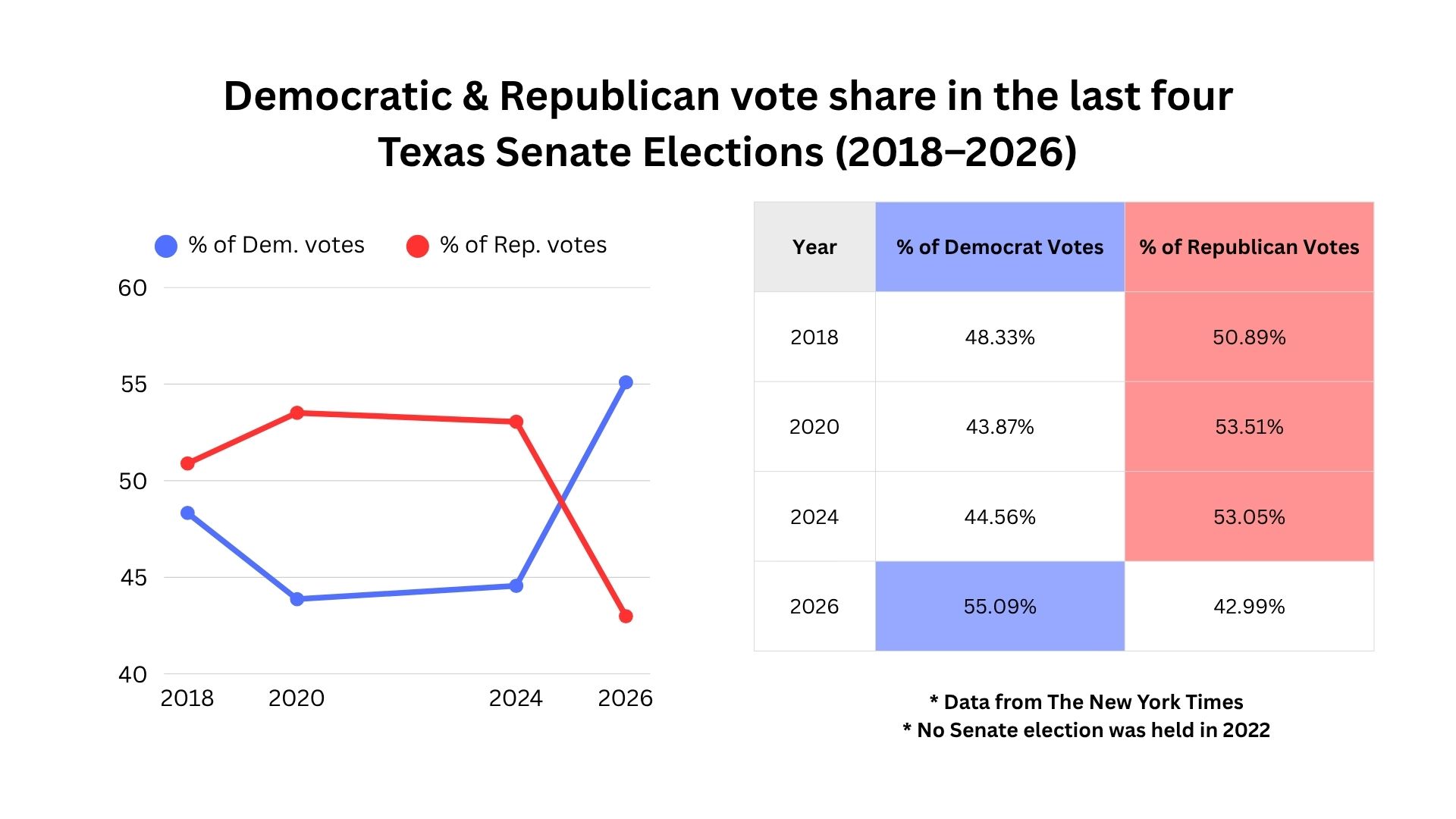
For the first time in 24 years, Democrats won the Texas House of Representatives, now holding 78 seats to Republicans’ 63 seats, with nine races yet to be called as of Wednesday. Democrats swept every statewide race, including upset victories by Gina Hinojosa in the gubernatorial race and Vikki Goodwin in the Lieutenant Governor race.
Even with control of the House and the governor’s office, it is important to understand that Texas isn’t officially a blue state, and Democrats could still face significant roadblocks in implementing their campaign agenda.
Dr. Patrick Flavin, chair of the political science department, said that Democrats’ success was a mixture of an energized base and Republicans who flipped their vote. He said this election showed that “no majority is permanent” and that a large base of voters was “up for grabs.”
“I think it surprised a lot of political scientists because you just don’t see wave elections of this magnitude because there’s so few people willing to oscillate from one party to the other,” Flavin said. “But this suggests that the influence of partisanship on voting has maybe reached sort of its peak.”
Political Science expert and professor at Texas Woman’s University Dr. Parker Hevron called the midterms a “thorough drubbing” for Republicans. Hevron pointed to the Democratic wave as a response to displeasure with the Trump Administration, as well as a “bad national political environment for Republicans.”
The sitting president’s party typically struggles in midterms, but Hevron said a long-standing Republican majority could have made candidates apathetic.
“I think anytime you’re dealing with a one-party state and a party that has been in power for such a long time … it makes politicians lazy, and it makes them forget in some ways, how to ask normal people for their votes,” he said.
Both Flavin and Hevron said Democrat victories don’t necessarily mean Texas is officially flipped blue, but could make Texas lean purple. Hevron said this election was unfamiliar territory for both parties and that Democrats being elected isn’t something Texas has “muscle memory” for, but it could make future elections more competitive.
“I think that opens up a whole lot of possibilities, whether it’s the 2028 presidential election, or Texas being competitive, being a battleground state,” Hevron said.
If Texas were to go blue in future presidential elections, Hevron said Republicans likely would not have “a path to victory.”
Although Democrats control the Texas House and the executive, both Flavin and Hevron noted that they don’t have unlimited control. Both pointed to a Texas Senate still controlled by Republicans that will prevent Democrats from passing all of their legislative priorities.
“For any legislation to pass, it has to pass both the House and the Senate in identical form,” Flavin said. “I think Democrats are going to have to be open to compromising on some of their initiatives to win enough votes in the Senate to make that happen.”
While a divided Texas Congress could cause two years of gridlock, Flavin also said it might open up an unfamiliar door to bipartisanship. He said that in order to pass anything, such as the budget, Democrats and Republicans will have to be willing to compromise.
“There’s going to have to be some give and take, which is what politics is all about,” Flavin said.
Hevron said the predicted new Speaker of the House, Senfronia Thompson, could signal future collaboration between both parties. Hevron said that Thompson has mentioned bringing some Republicans back to chair committees, despite their minority status. He called Thompson a “living legend” who knows how to work “both sides of the aisle.”
Flavin acknowledged that some Republican senators have said they are the last line of defense for conservative principles in the new Texas political landscape, which could make it harder for Democrats to pass their initiatives. He also noted that many of those senators won their districts with a small margin, which could add pressure for them to work with Democrats.
Flavin pointed to expanding Medicare and housing affordability as two main issues that may see bipartisan support.
Hinojosa, along with other Texas Democrats like senator-elect James Talarico, centered large parts of their campaigns on expanding healthcare. Texas is one of only 10 states that have not expanded Medicaid, and under the Medicaid funding structure, the federal government would pay for 90% of expansion.
Flavin said Texas has the highest uninsured rate in the nation and that Medicaid expansion is not only an “opportunity for compromise, but it’s also [something] that would have an enormous impact on the state.”
Texas is facing a housing affordability crisis, and Flavin said that could be an issue that garners a coalition of support, with Republicans pushing to scale back regulations and Democrats recognizing the need for new homes.
Democrats, including governor-elect Hinojosa, ran on supporting public education and ending the TEFA school voucher program. Hevron said that although Hinojosa cannot unilaterally use executive authority to end the voucher program directly, she could potentially try to defund it.
“I think a few things that could go away are the TEFA vouchers; they are pretty unpopular, especially among rural school districts, conservatives and Democrats alike,” Hevron said.
The Texas comptroller directly oversees the voucher program, and Flavin said comptroller-elect Democrat Sarah Eckhardt will likely slow the pace of voucher implementation.
Beyond the school voucher system, Flavin said Democrats could change other aspects of public education. Both Republicans and Democrats now hold seven seats on the State Board of Education, with one race not yet called. Flavin said Democrats will likely focus on reversing cultural issues in schools, such as mandating that public schools post the Ten Commandments and reducing diversity initiatives in curricula.
Democratic candidates have also promised to make day-to-day life more affordable for Texans. Flavin said this is an issue Democrats won’t be able to fix overnight, but they may try to take steps toward it by suspending the gas and diesel tax or freezing utility rates.
Hevron said that the pressure is now on Democrats to follow through on their promises.
“If in two years, Texans don’t feel like their lives have improved in terms of affordability, then they’ll have a chance to go in and let the incumbents know this time that they weren’t able to meet the moment,” Hevron said.