By Tripp Henderson | Staff Writer
For many Waco residents, finding an affordable place to live is becoming increasingly difficult as housing prices rise faster than incomes and the supply of affordable homes remains limited.
In an article published in June 2025, MeridianLink reported that housing prices in Waco are 23% below the national average. On paper, this number seems promising, but it hardly tells the full story.
John Calaway is president and director of Mission Waco, a non-profit organization that offers programs and services to help the marginalized. As director, Calaway also leads Creekside Community Village, a community that provides living and housing for individuals exiting homelessness. In this role, Calaway has seen the affordability crisis firsthand.
“There is no question we have an affordable housing issue in Waco,” Calaway said.
As wealth increases, housing prices rise
Waco ranked sixth among Texas cities for growth in wealthy households from 2023 to 2024, according to Culturemap Austin, with the city experiencing a 53% increase in high-income earners. As more high-income households move into the area, Calaway said rising property costs can also affect renters.
“If you’re renting, then all of the higher property taxes get pushed down to the person who’s barely making ends meet,” Calaway said. “They’ll see rent expense double in some cases, from one lease to the next.”
Down-market buying limits the availability of affordable housing
Calaway said another challenge in the Waco housing market is that many middle-class home hunters buy down and purchase cheaper housing, even when they can afford nicer accommodations.
This creates what Calaway described as a downmarket squeeze that limits the quantity of cheap housing available to individuals who need it most. KKXV News Waco estimates a shortage of roughly 5,000 affordable homes in the greater Waco area.
Housing prices rise, yet income remains low

According to the U.S. Census Bureau, the average income in Waco is currently $58,177, but this number is slightly skewed by the recent influx of high earners. The median sits at $54,365, which means Wacoans at or below that income spend more than 30% of their income on rent. Anything above 30% qualifies a person as “cost-burdened,” and Waco ranked second-worst among Texas metropolitan areas on this metric, according to USAFacts.
Jimmy Dorrell formerly served as the pastor of Church Under the Bridge and director of Mission Waco. In both of these roles, Dorrell worked actively among the homeless and began to recognize the desperate need for affordable housing.
Dorrell said that because the Texas minimum wage is so low, it makes it very difficult for low-income earners to make a livable profit.
“Minimum wage is $7.25 an hour; you multiply that times 40 hours a week, times a year, it’s just a little over $15,000 a year,” Dorrell said.
The U.S. Census Bureau reported Waco’s poverty rate is almost double the national average at 23.1%. Dorrell said that many homeless individuals have jobs, but they just “can’t make it on minimum wage.”
Creekside Community Village provides a way out

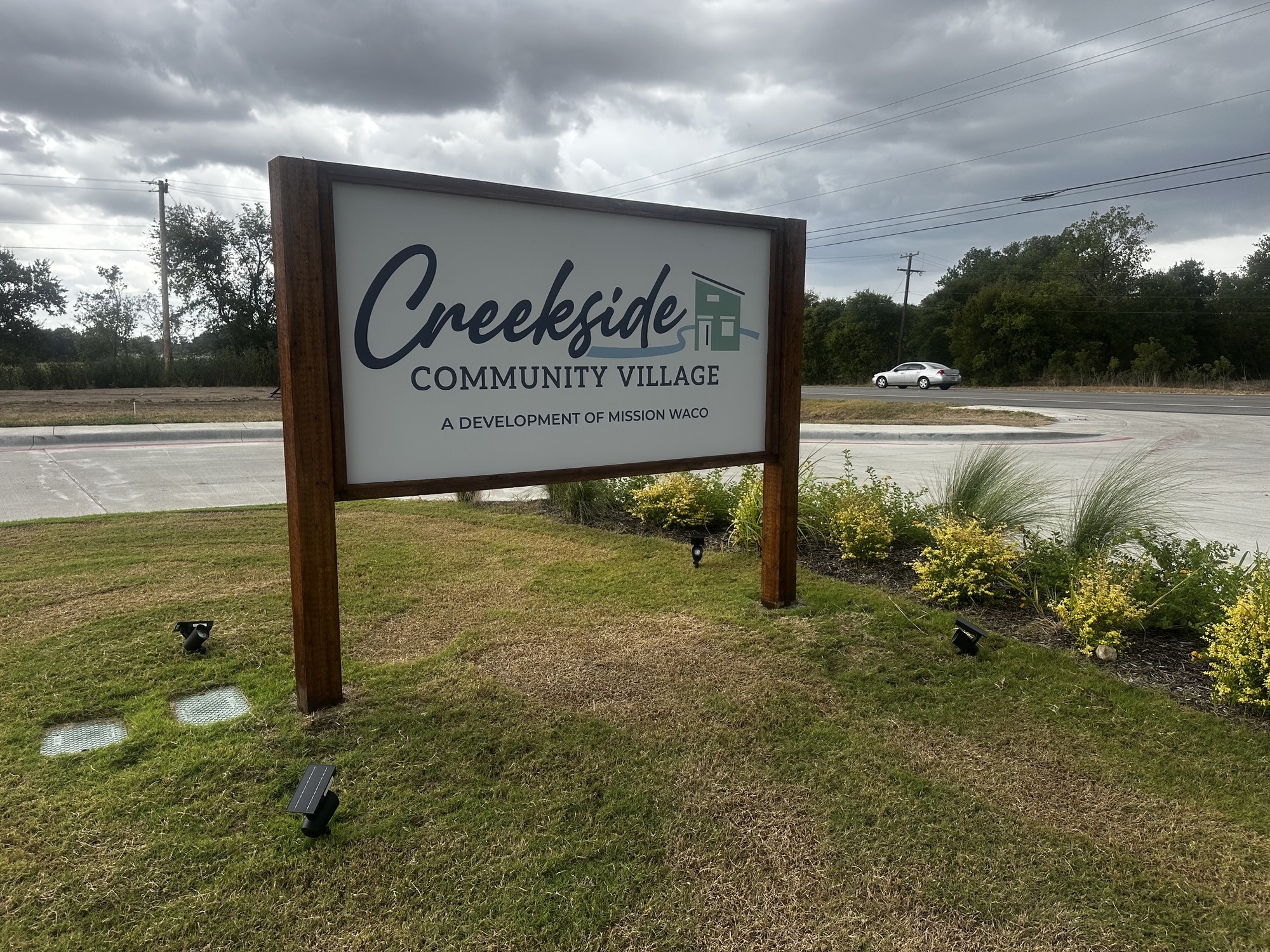
As cheap housing becomes harder and harder for lower-income individuals to find, just minutes from Baylor’s campus, Mission Waco’s Creekside Community Village is stepping up to address the need.
In 1991, Dorrell opened a 56-bed homeless shelter called My Brothers Keeper. As the homeless flocked to the shelter, Dorrell turned his eyes towards expansion.
“[My Brothers Keeper] continued to grow, and we ended up with more homeless, so we decided to look for an alternative, and so we went down to Austin,” Dorrell said.
In Austin, Dorrell visited Community First! Village, a 157-acre master-planned community directed by Alan Graham.
“Community First! Village is a master planned neighborhood that provides affordable, permanent housing and a supportive community for men and women who are coming out of chronic homelessness,” the website reads.
Dorrell adapted this model to help guide the planning for Creekside Community Village.
Funding for the project started with a million dollars from the city of Waco and another million from a private donor. Those original funds were used to purchase the property that would eventually be home to Creekside.
Calaway, who now primarily oversees operations at Creekside, said total funding exceeded $16 million, with $2 million coming from the city.
“By and large, the funding has been from individuals, churches and foundations,” Calaway said.
Calaway emphasized the support of local churches, saying “a little over half of the homes [at Creekside] were paid for by churches.”
The community officially finished construction in March of 2026 and has 38 current residents. To live in the village, applicants must meet five qualifications; two include residency in McLennan County for at least a year and a health assessment.
Calaway said prior to Creekside’s opening, he surveyed individuals staying at My Brothers Keeper to see what would matter most to them in the new community.
“The number one response I got was that ‘we’ll have a choice,’” Calaway said.
Mission Waco took that priority seriously in the village’s construction and provided three different types of homes for residents to choose from. Calaway said the variety lets occupants choose the living situation that best fits their budget and needs.
Rent at Creekside is all bills paid, and Calaway said rent can “range anywhere from $275 a month to about $550 a month.”
Calaway highlighted that all of the homes are built with efficiency and longevity in mind to help keep utility prices low. Each neighborhood has its own kitchen, wash house and laundry for residents to use.
Community focused

The focus of Creekside is not just to provide a place for people to live at, but for a community to live in.
“The way we designed everything promotes community,” Calaway said. “… We want people to be engaged.”
The community has an outdoor pavilion where the neighborhood can gather and have fellowship. Additionally, many of the residents contribute to the village by helping with tasks like cleaning and landscaping in exchange for a livable wage from Creekside.
Calaway said that 20 to 30% of the people living at Creekside are what they call “missionals.”
“Missionals” are residents who are not formerly homeless but choose to live in the community to engage with neighbors, be a support system and build friendships.
“One of the main reasons people exit homelessness and remain housed is relationships with people who have not experienced homelessness,” Calaway said. “That’s a part of the community model.”
Calaway also said that a vital part of the community’s flourishing is the help and support of volunteers. He said volunteers fill around 10 to 15 full-time staff positions and that Baylor students often contribute.
“We have a lot of Baylor groups that come out here and serve, because there’s always something to do,” Calaway said.
The value of serving
Recent Baylor graduate Jeremy Hill had the opportunity, as a youth pastor, to bring a group of youth to serve with Mission Waco. Hill said that many of the preconceived notions he had about homelessness were reversed after his time serving.
“I think one of the biggest things that I learned was just how many people that are in the homeless community don’t fit your stereotypical thought of homelessness,” Hill said. “… Several of them, at one point or another, for a long time in their life, held a steady job, family or home life.”
Hill highlighted the importance of being involved and serving in the homeless community and warned that “for Baylor students it’s very easy to be distant.”
“I would just say the ministry of crisis, getting out and loving these people, that’s what [God] has called us to do, and that’s the level of association and care he has for these people,” Hill said. “So, it’s crucial for Baylor students to have those experiences, especially those that are professing Christ.”
Hill said that the homeless are deeply loved by God and “if they’re good enough for Christ to associate with, we should be associating with them too.”
An optimistic future
Creekside Community Village aims to keep growing. The village plans to open the Welcome Home Center, a place of fellowship for neighbors and expand to 346-unit houses over 68 acres.
Calaway said that if the village reaches that goal, “every person [in Waco] who doesn’t want to be on the streets can be housed.”