By Tripp Henderson | Staff Writer
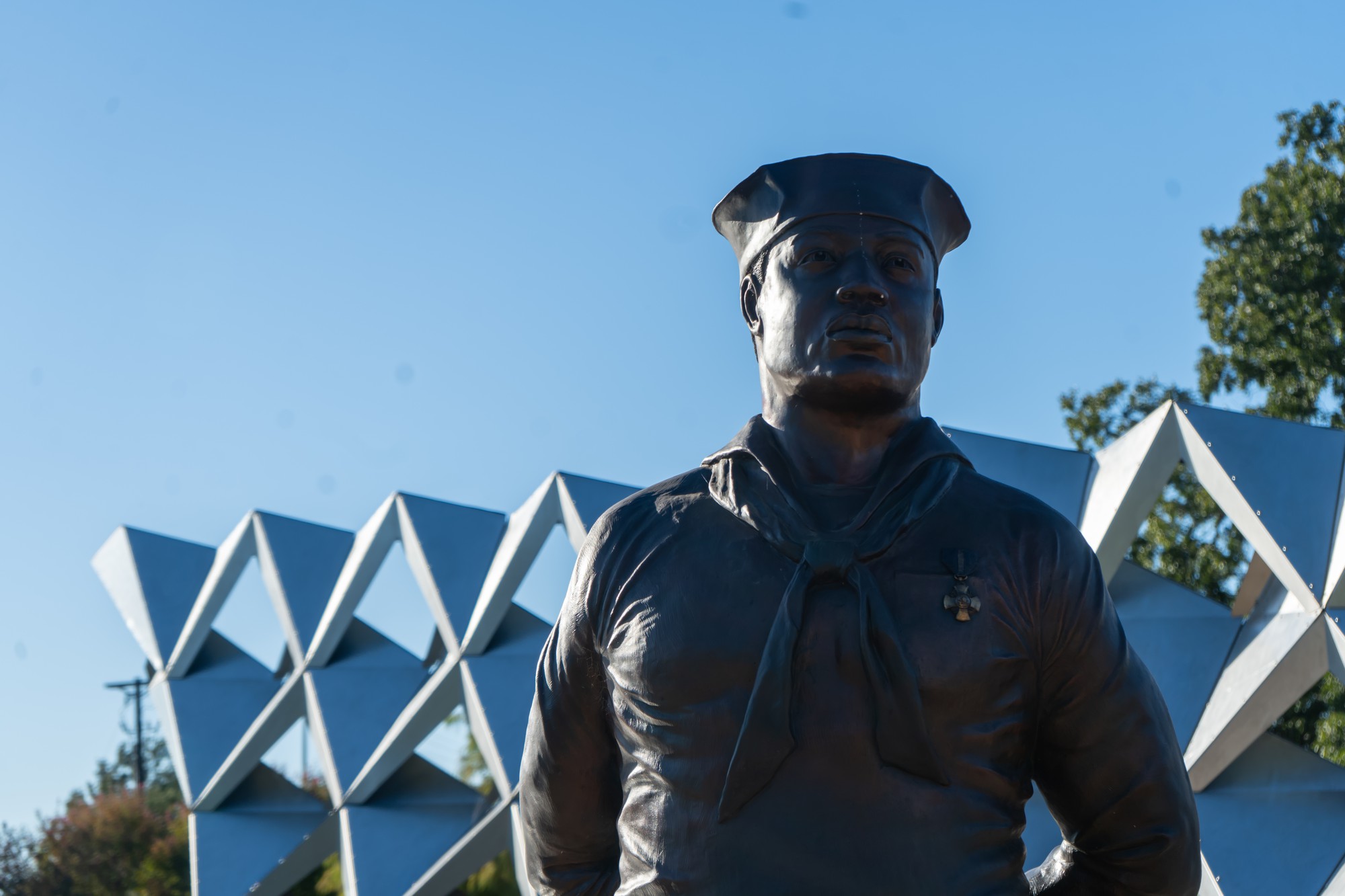
Doris Miller was never meant to be a hero. In fact, on the early morning of Dec. 7, 1941, mere moments before the Japanese launched a surprise attack on Pearl Harbor, Miller was aboard the USS West Virginia collecting laundry.
Former Baylor professor and historian Dr. T. Michael Parrish wrote a book that explores Miller’s impact and heroic actions.
Parrish said that as a Black messman, Miller was often delegated to the most drudging of tasks, treated unfairly, disrespected, forbidden from wearing Navy insignia and completely untrained in anti-aircraft weaponry. That did not stop him from taking hold of a .50 caliber machine gun, downing enemy aircraft, saving fellow crewmen and establishing himself as the most notable World War II figure in Waco history.
“He was the first African American hero of World War II,” Parrish said.
In 2020, acting Secretary of the Navy Thomas B. Modly announced that a future U.S. aircraft carrier, CVN-81, would be named in Miller’s honor. The carrier would be the first named for an African American and an enlisted sailor.
That distinction, however, could change before the carrier ever enters service. In August, CNN reported that Navy officials were considering removing Miller’s name from the aircraft, with internal discussions including the possibility of naming the carrier after President Donald Trump.
“It’s unclear what the Navy is seeking to change the name of the carrier to, though two of the sources said there have been internal conversations about renaming it to honor Trump,” CNN reported.
The Navy typically has only 11 aircraft carriers commissioned at a time, and if Miller’s name stands, it will join the likes of Ronald Reagan, George Washington, Abraham Lincoln and others. The Navy has not yet announced a final decision on a new title. Naming the carrier after Trump would also break with precedent, as an aircraft carrier has never been named for a sitting president.
The potential change has faced backlash from some lawmakers. Sen. Cory Booker of New Jersey is pushing three pieces of legislation to prevent the potential renaming.
“Booker’s three bills approach the controversy from different directions. One would prohibit federal funds from being used to change CVN-81 from the USS Doris Miller,” EURweb reported Monday.
Naval Academy graduate and former Marine Corps Maj. Chris Childs said the Navy traditionally reserves aircraft carrier names for former presidents and admirals, making the decision to honor Miller “definitely a break from tradition.”
“The U.S. Navy is very deep in customs and traditions,” Childs said. “So when tradition is broken, it sends a message that either something is wrong, or there is a major shift in policy.”
Childs said current Secretary of War Pete Hegseth has sought to move military culture back toward more traditional practices and that it “makes sense that a renaming might take place because [naming it after Miller] was a break from tradition.”
Since Trump appointed Hegseth in January 2025, he has made several significant changes, including a planned 20% reduction in the top-ranking military leaders and strict sex-neutral physical fitness standards, according to The Hill.
Childs noted it would also break precedent to name an aircraft carrier after a sitting president, though the ship is not expected to enter service until after Trump leaves office.
“You have to remember it takes about four to five years to construct a ship of this size,” Childs said. “The name officially starts when the keel is laid. President Trump will no longer be the president when this ship is actually commissioned and floating.”
Parrish said Miller is worthy of having the aircraft carrier hold his name, and he was disappointed to learn of the potential renaming. He said that changing the name would not cause Miller’s name to be forgotten, but it would diminish his legacy.
“[Renaming] it would remove the opportunity for Americans of all colors, of all backgrounds, of all beliefs, to recognize Doris Miller for the great hero that he was,” Parrish said. “… By renaming it, it would no longer put Doris Miller’s name front and center.”
Parrish said that Miller’s impact extends beyond being the most widely known black hero in World War II.
“When people think of black heroes in American history, Miller’s name is one that comes up most often,” Parrish said. “Certainly civil rights leaders were extremely aware of Miller and promoted his name as an example to black people and to all Americans of the willingness of Black Americans to sacrifice and serve.”
Parrish said Miller not only contributed to the Civil Rights movement, but also helped start it.
“The modern Civil Rights movement of the 1950s and 1960s actually began at Pearl Harbor in 1941 when Doris Miller’s bravery inspired the African American press and political leaders, including President Franklin Roosevelt, to recognize Black military heroes and begin the process of promoting Blacks to higher ranks with more responsibilities,” Parrish said.
Parrish added that Martin Luther King, along with other civil rights leaders, pointed to Miller’s courage and service as proof that African Americans deserve to live in a fully desegregated America.
Both Parrish and Childs believe Miller’s heroism warrants the Medal of Honor.
“If the Department of War and the President continue to honor him by awarding him the Medal of Honor, that would help repair any damage [to Miller’s legacy] in a ship’s name change,” Childs said.
Parrish added that awarding Miller the accolade has long been discussed.
“The African American press demanded that he be given the Medal of Honor, but the Navy Department refused. It still refuses to give Miller a Medal of Honor, and so I hope that day will come,” Parrish said.
Ultimately, whether the ship’s name is changed or Miller does not receive the Medal of Honor, Parrish said he “will remain in the pantheon of World War II heroes.”