By Kamryn Anthis | Staff Writer
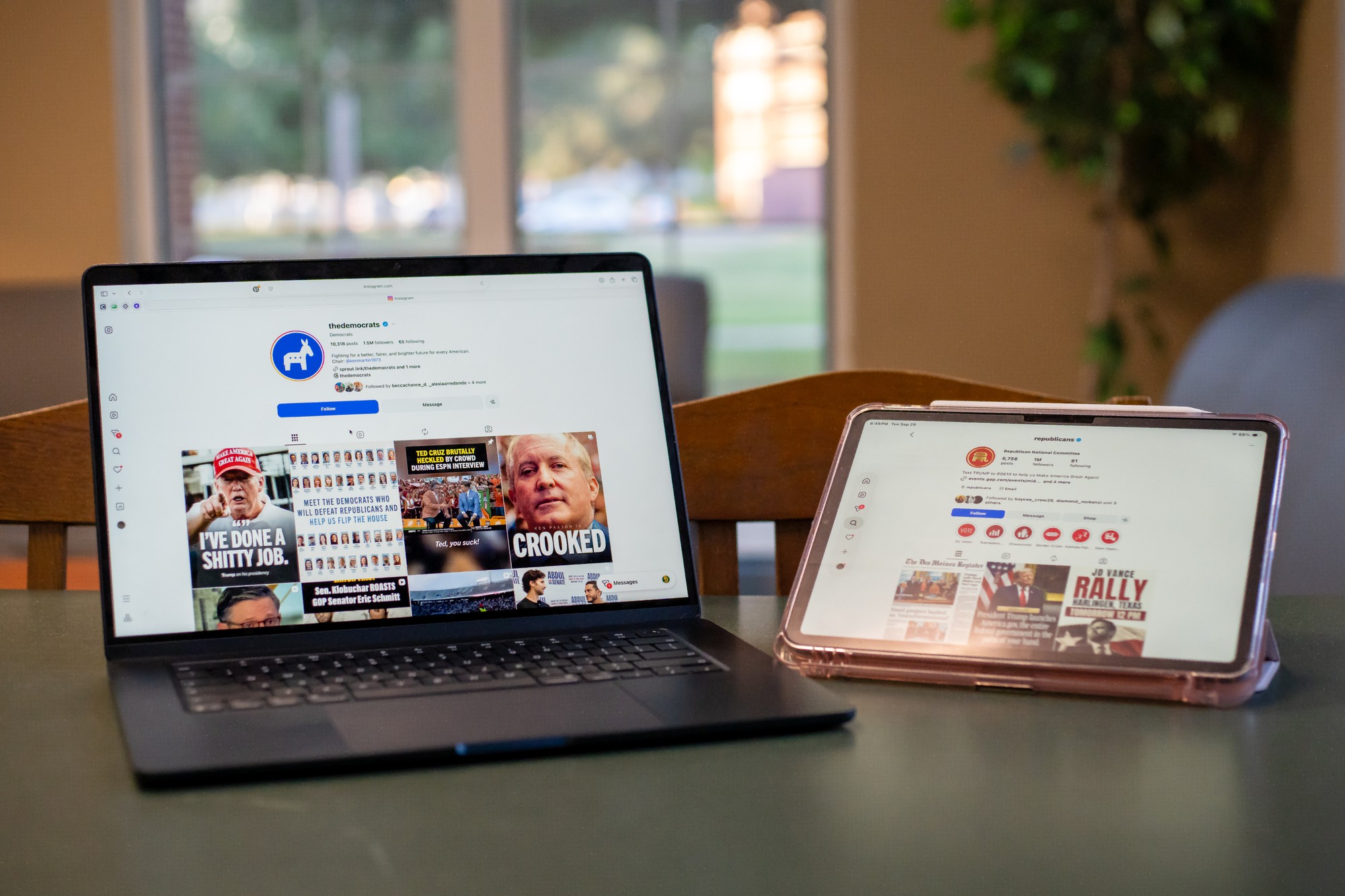
In 2026, politicians no longer need a press conference, television interview or newspaper story to reach voters. With one post, they can deliver a message directly to millions of people — including young voters who increasingly encounter news online.
That direct, unfiltered access lets politicians communicate quickly, without a traditional news organization interpreting their message, but it also opens the door to misinformation or mistakes. From deepfakes to typos, social media has undoubtedly complicated the political sphere.
Dr. Luke Winslow, professor of rhetorical studies in the Department of Communication, said the motive behind different forms of media can influence the information consumers receive.
“If the main goal is to drive clicks and to attract eyeballs and eardrums, the research is pretty clear on this: be as outrageous and extreme as you can, and you’ll attract consumers, and you’ll make more money,” Winslow said.
Social media further complicates that environment by allowing political figures to communicate without relying on traditional news organizations to carry messages.
For those young voters in particular, that communication takes place in an increasingly digital news environment. A July study from Pew Research Center found that 59% of adults ages 18 to 29 liked or saved a news post online within the previous week, compared with 32% of adults 65 and older.
Politicians appealing to younger voters are increasingly turning to social media to reach them directly. Pearland sophomore Amaya Rodney said she has noticed political content appearing in the same short-form formats young people already consume.
“I’ve seen politicians use things like Instagram Reels and the tactic of pushing out content to really reach the youth,” Rodney said. “And when we have a voice like we do now, they’re appealing to us through the media.”
For politicians, those platforms can also provide another way to reach voters when their message does not make it through traditional media.
Democratic U.S. Senate candidate James Talarico pointed to that ability during a recent campaign event at Baylor, discussing an interview with late-night host Jimmy Kimmel that was posted online rather than aired on television amid a dispute involving Federal Communications Commission rules.
“Last week, I sat down for an interview with Jimmy Kimmel.” Talarico said, “The FCC tried to keep people from seeing the interview, but I think it’s fair to say their plan backfired. Because our interview now has more than 11 million views on YouTube.”
Talarico characterized the dispute as an example of government interference with political speech.
“They’re trying to control what we watch, what we say, what we read, and this is the most dangerous kind of cancel culture, the kind that comes from the very top,” Talarico said. “Corporate media executives are selling out the First Amendment to curry favor with corrupt politicians.”
Kimmel said the interview was moved online after pressure from the FCC over equal-time requirements for political candidates. The dispute centered on whether late-night programs should qualify for an exemption traditionally applied to bona fide news interviews.
Winslow said the episode demonstrates the complicated relationship between political communication, media companies and the institutions that regulate broadcasters. Media companies, Winslow said, have to look at how political decisions could affect business interests.
“If Jimmy Kimmel’s bosses are beholden to their board, and their board of directors is worried about upsetting Donald Trump because he’ll use the FCC as a cudgel to beat them into submission,” Winslow said.
He said that concern could lead executives to monitor programming more closely.
“They’re going to monitor Jimmy Kimmel’s programming,” Winslow said, arguing that upsetting the president could “cause the FCC to intervene on his behalf, and ultimately hurt their share price.”
While social media can give voters access to politicians’ messages without those institutional layers, receiving information directly from a political figure does not necessarily make it neutral or complete.
Winslow said voters should consume information from multiple sources, particularly when trying to understand people with whom they disagree.
“If your goal is to understand the world and then have more productive conversations about political issues with people that disagree with you, you also have to understand the arguments and where they’re getting the arguments from,” Winslow said. “If you get your news from just one source … you’re going to kind of have blinders on when you have to have those challenging political conversations with people that you disagree with.”