By Alexandra Brewer | Arts & Life Writer
They’ve led troops. Traveled the world. Now they’re navigating lecture halls, textbooks and deadlines. At Baylor, student veterans are discovering the challenges of college are battles of a different kind — and they’re not doing it alone.
Northumberland, Va., junior Nick Bradford balances military and academic life while raising a family. Bradford spent four years on active duty and is now a drill sergeant in the Reserves.
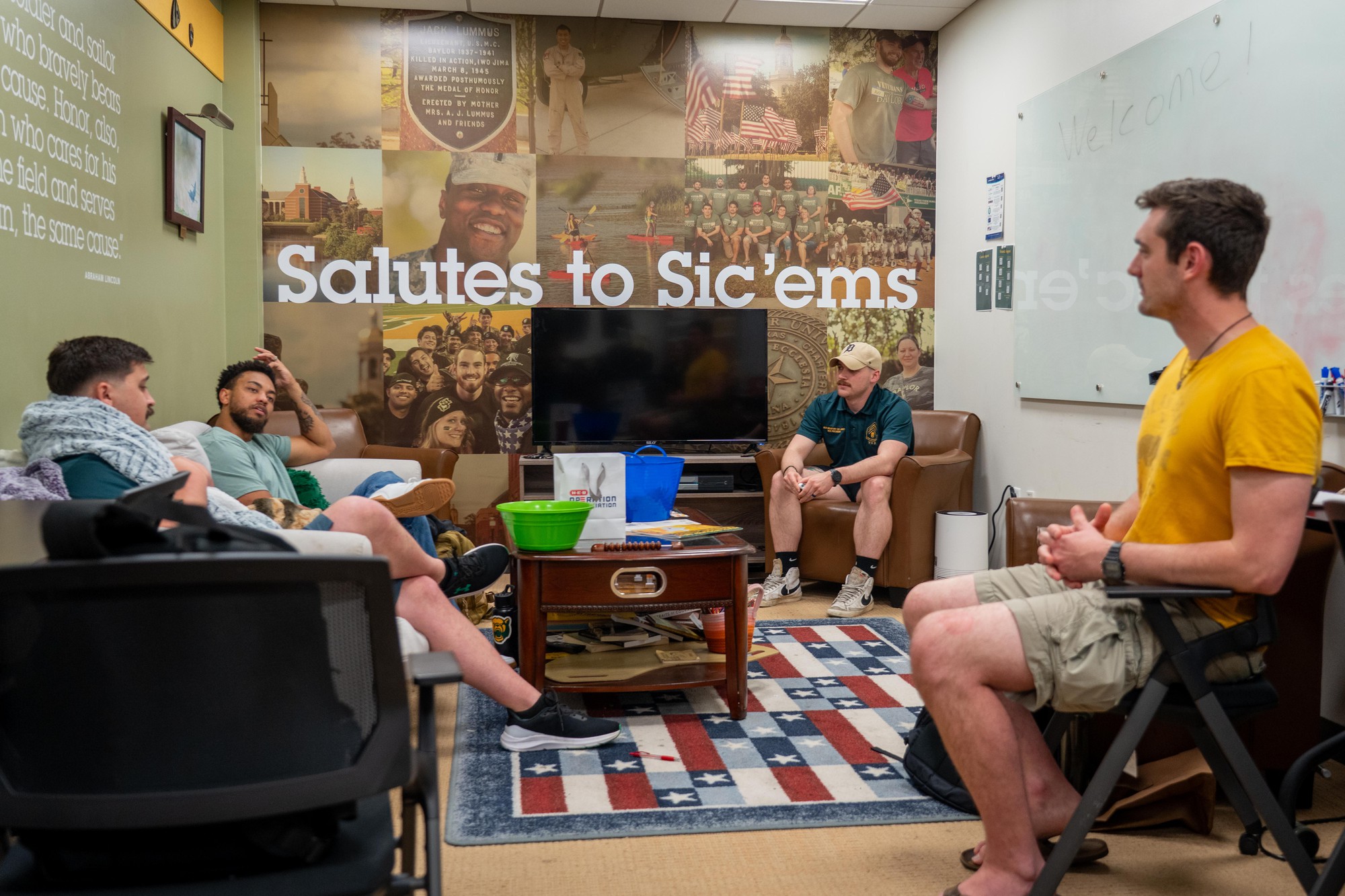
Bradford is the vice president of Veterans of Baylor, an organization that connects student veterans to Department of Veterans Affairs benefits, campus resources and local organizations in Waco, while also helping guide their transition from military service into college and eventually into professional life.
Veterans of Baylor serves more than 1,000 student veterans, spouses and ROTC members, providing practical support and a community for those navigating the transition from military to campus life.
Regular events, mentoring and social opportunities give student veterans the support that can be the difference between feeling lost and thriving.
“Even if you’re the only student veteran in a class, there’s a community for you,” Bradford said.
Bradford described the discipline and performance skills he developed in the military as vital for handling stress and pressure in college.
“The discipline you gain in the military is different from the discipline needed for school,” Bradford said. “Military consequences are immediate; school is intrinsically motivated.”
Even though the risks aren’t the same, the pressure to perform never goes away.
“In the military, failing your duties can put lives at risk; school doesn’t,” Bradford said. “The most useful skill I bring is performance under pressure, handling stress for long periods without breaking down.”
Even with the stress, Bradford has found support within the classroom.
“Professors at Baylor are incredible,” Bradford said. “If you talk to them, they’ll go the extra mile … One even cooked a meal for me and my wife after our son was born.”
He also emphasized that student veterans face unique challenges that are often misunderstood by their peers.
“We’re just regular students trying to earn our degrees,” Bradford said. “Our experiences give us a different perspective, especially in subjects like political science and military studies.”
Lubbock junior Chris Varner is a Marine veteran who joined Baylor after a 16-year career in the military. She faced a stroke and a complete life reset before deciding to return to school.
“I never dreamed I’d be coming back to school at this age,” Varner said. “I was 55 when I started, and I was a year past having a stroke. It’s been some incredible highs and lows and a lot of hard work in between.”
The transition from military life to college was difficult. Varner said she initially felt lost.
“Before I realized there was a Veterans of Baylor group, I fell through the cracks,” Varner said. “Nobody knew I was here, nobody reached out. I was second-guessing myself. The homework was so hard. I kept falling asleep in class.”
Support from Veterans of Baylor became essential.
“Having people around who understood where I was coming from made a huge difference,” Varner said. “Being a veteran is like being in a 12-step program. We’re better off when we have a mission and we’re serving someone.”
Making friendships and connections made her excited to show up.
“I forged a couple of relationships,” Varner said. “Once you see somebody, you’re like, ‘Oh, I hope so-and-so is there today.’ It gives you a reason to keep coming back. We genuinely like these people, and they genuinely like us back.”
Varner described the group as a genuine community that blends social support with organized events.
“We try to be a light for our fellow veterans, not just on campus but in the broader community,” Varner said.
Varner’s academic journey is ambitious. She is a University Scholars major with concentrations in art history, history and museum studies.
Currently, she is writing her honors thesis on whether museum interventions can be used as an adjunct to therapy for veterans with PTSD and traumatic brain injury. Her ultimate goal is to pursue a doctorate in social care through museums.
Tyler senior and ROTC cadet Mya Crayton brought another perspective. Inspired by her brother, a Navy veteran, she joined ROTC and is learning firsthand the demands of leadership, early mornings and weekend exercises, all while keeping up with nursing curriculum.
“People think ROTC students are super serious all the time,” Crayton said. “We’re just regular students. It’s definitely harder than I thought, but it’s preparing me for what comes next.”
All three stressed the importance of understanding veterans beyond their service.
“Ask about our story, sit down, listen,” Varner said. “Don’t just say ‘Thank you for your service.’ Walk the talk.”