By Stephanie Starks | Staff Writer
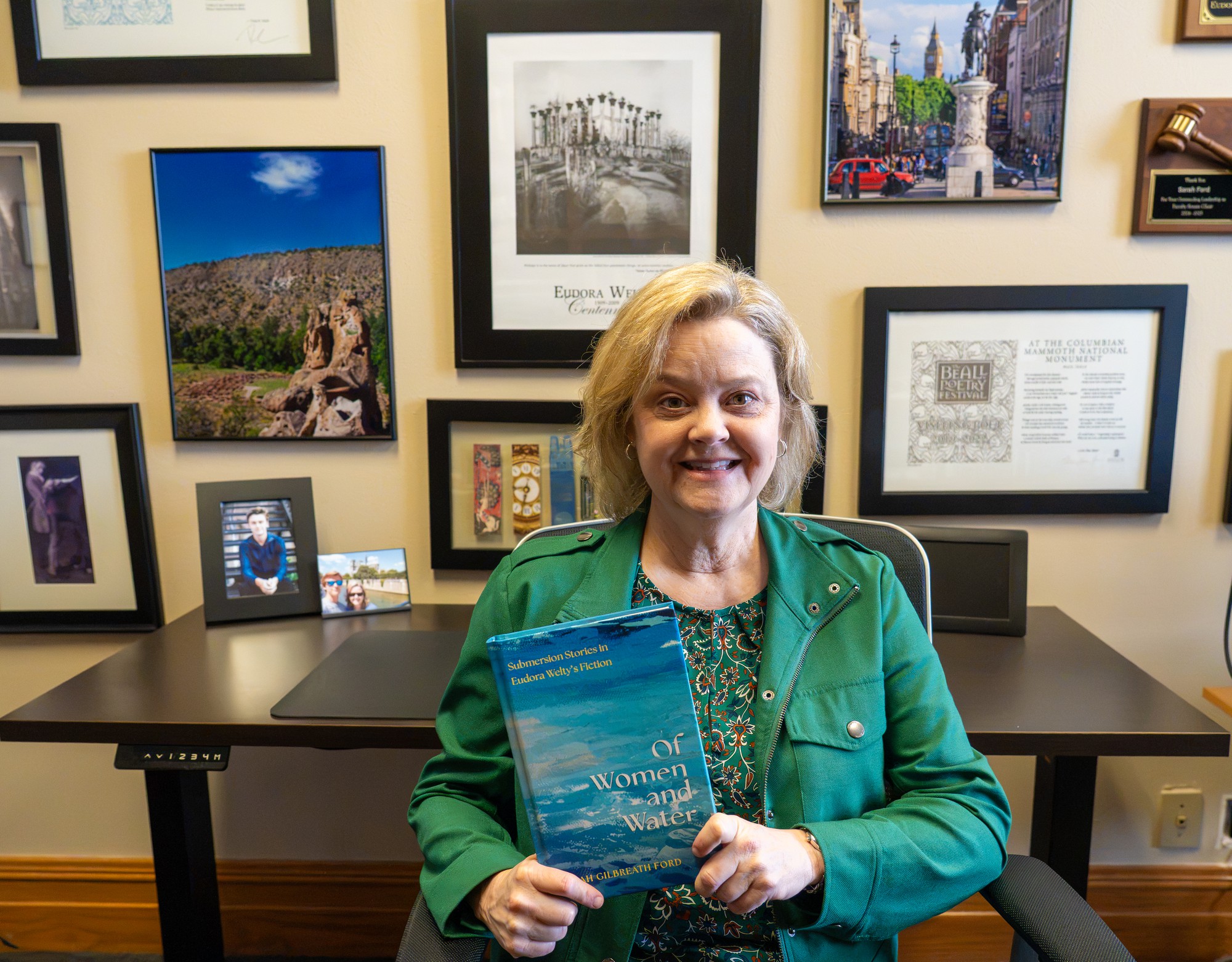
The stories women inherit can shape the futures they imagine for themselves. In “Of Women and Water,” Baylor professor Sarah Ford examines how Southern author Eudora Alice Welty challenged traditional coming-of-age narratives through recurring scenes of women submerging themselves in water.
Welty, a Jackson, Mississippi, native, received numerous awards for her novels and short stories. Her writing is deeply rooted in Southern culture and storytelling, often drawing on events from her own life, including the deaths of family members.
In 19th-century Gothic and Victorian literature, the image of women submerging themselves in water often symbolized death. In later works, however, the image took on another meaning, resembling a baptism that empowers women. Welty’s work continues this literary tradition, giving women the opportunity to tell their own stories.
Dr. Sarah Ford, professor of American literature, has studied Welty’s work for years. Although Ford has written several articles about the author, she eventually decided to devote a book to exploring one recurring element of Welty’s stories: women’s experiences with water.
Years ago, Ford presented a conference paper examining scenes in literature in which women experience submersion or baptism. She began questioning why Welty returned to the image so frequently. Although Ford temporarily set the idea aside to pursue other research, it remained in the back of her mind.
In 2019, Ford received the Baylor Centennial Award, which allowed her to travel to Jackson, Mississippi, and study Welty’s drafts and personal papers. She also visited Welty’s former home and gardens, now preserved as a museum.
I was reading her mail, which is wonderful,” Ford said. “A lot of this was called ‘V mail’ or ‘Victory mail.’ It was mail that happened during World War II when the soldiers would write a letter. The army would take a photograph of it because paper is really heavy. Take a photograph of it, shrink it down, put it on these reels that would get flown over and they would print it. The mail that came was this really tiny thing that people almost needed a microscope to read it.”
During her research, Ford read letters from Welty’s brothers and friends, gaining a closer look at the relationships and experiences that shaped the author’s life and writing.
On Oct. 23, Ford presented her finished book, “Of Women and Water,” at the 38th annual Eudora Welty Writers’ Symposium, held at Mississippi University for Women.
“I was putting Welty’s depictions of submersion scenes into a framework that had to do with a female coming-of-age experience in literature writ large,” she said. “I start with Ophelia in Shakespeare’s ‘Hamlet,’ and I am really looking at this broad background of how we talk about women when they are reaching adulthood and the options that they may or may not have.”
Ford said her classroom experiences also shaped her understanding of coming-of-age stories. Watching students navigate questions about identity and adulthood has given her a firsthand perspective on the themes she explores in Welty’s work.
“Teaching at the university, you get a front row seat at it,” Ford said. “You sort of see how it plays out. Even though times change and fads come and go, those central questions of, ‘What kind of person do I want to be?’ are the same questions every 20-year-old asks.”
For Ford, the questions Welty explored in her own time remain relevant today.
“I think she is thinking about the way we tell stories, and the way we tell stories often limits our imagination of what people can do,” Ford said. “We tend to want to wrap up that ending in a nice bow. You know that, unfortunately, in coming-of-age stories in literature, the woman often dies. She has sort of a failure-like ending. Something happens, and she dies. Often we get the fairy tale ‘happily ever after,’ which is a good version, but it still kind of cuts off possibilities.”
One of the central moments in “Of Women and Water” comes in the book’s penultimate chapter, which Ford describes as the high point in the tragedy of the submersion stories.
“This is when it works — the woman gets it, she has a beautiful submersion, she chooses to go into the water, she’s choosing her own life,” Ford said. “That character named Virgie sort of walks out of the story with all the power.”
Ford initially thought that moment would be the defining point of the book. However, the chapter she found most difficult to write ultimately became one of the most rewarding parts of the process.
Ford said Welty’s only Civil War story was particularly difficult to interpret, with an unusual point of view that left readers uncertain about what was happening and who was telling the story. Despite the challenges, Ford said that she knew she “needed to write on it.”
“It ended up being a wonderful experience because I was spending that much time on it, I felt like I could finally understand what was happening in the story, and by looking at the drafts in Jackson, I was able to see how the story had changed over time in a really interesting way,” Ford said.
Grace McCright, a postdoctoral teaching fellow in the English Department, worked with Ford when she served as her dissertation adviser at Baylor. McCright, who hopes to turn her dissertation into a book, said Ford’s expertise helped her develop a chapter focused on Welty.
“Her whole book is on Eudora Welty, and I was talking about Eudora Welty for one chapter of my dissertation, and so she was really able to give me a lot of expertise in helping me research for that chapter and really understand what I was writing more clearly,” McCright said.
Working with Ford also gave McCright a new perspective on literature she had previously studied.
“She has complicated Eudora Welty stories in a new way,” she said. “I think it is really great what she has been able to do with it, and she’s an excellent mentor.”