By Giselle Lee | Staff Writer
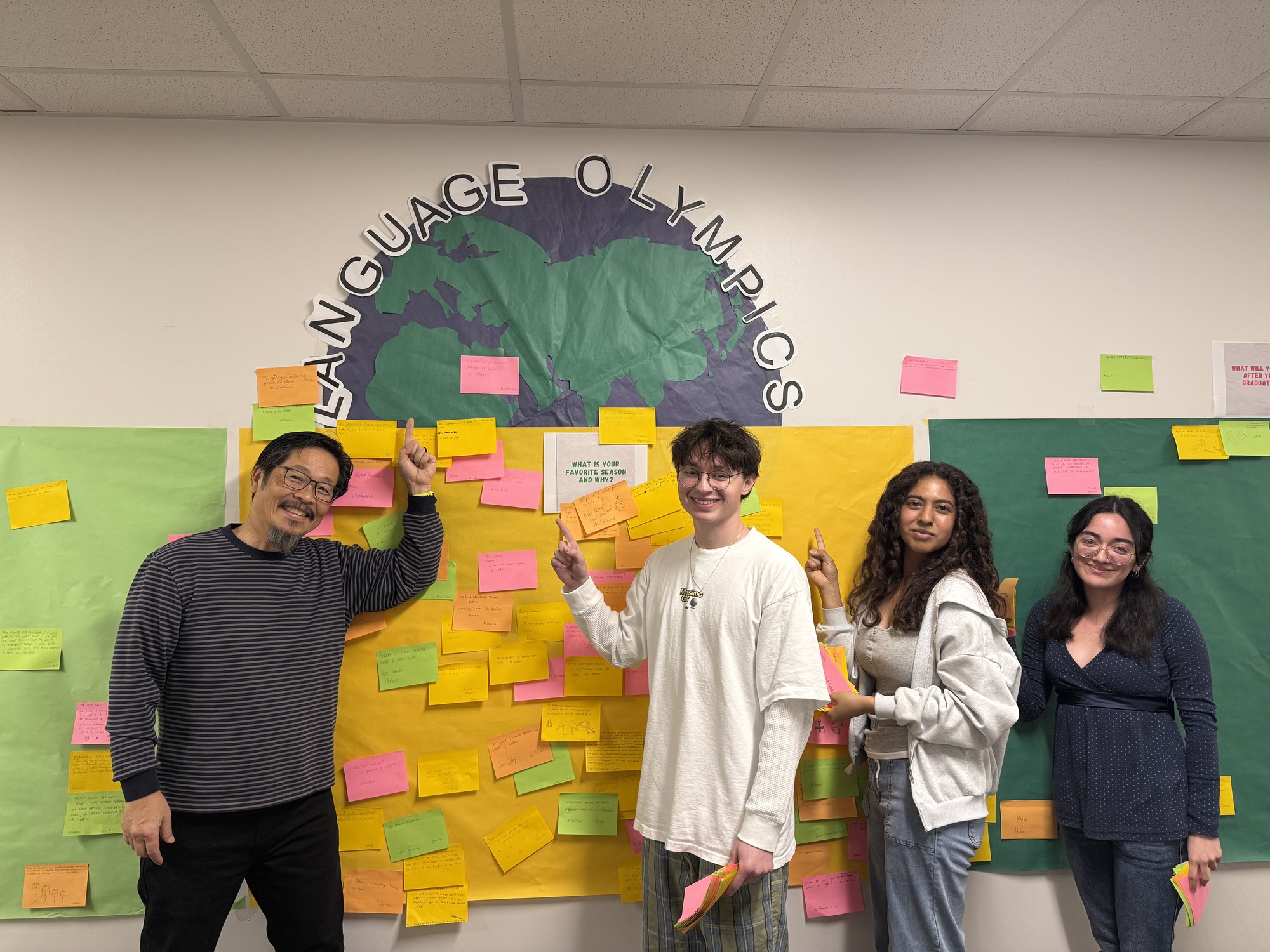
As students turn the corner on the top floor of the Draper Academic Building, a bold, vibrant billboard is covered with sticky notes and languages they may not recognize. A globe with the words “Language Olympics” hangs above the display as students flock to answer questions, score points and support a foreign language.
The Language Olympics is a week-long competition between Baylor’s language departments, taking place throughout International Education Week to promote awareness of the different languages spoken across the globe.
Organized by Baylor’s Interactive Media and Language Center (iMLC), current students and alumni are encouraged to join the friendly competition by answering daily prompts in a language other than English. Students can submit answers by writing a sticky note on the billboard outside the iMLC, commenting on the iMLC’s Instagram posts or submitting audio and video recordings on Padlet.
For Bixby, Oklahoma, senior Katie Turner, the Language Olympics is a fun and competitive opportunity to represent different foreign languages.
“I’m doing [the Language Olympics] for Russian at the moment, and my Russian class will always come and put down our answers in Russian,” Turner said. “There’s a little bit of incentive to get in there, especially because Russian is a smaller department, but it’s fun because you just feel like you learn words that you wouldn’t really know otherwise.“
Turner, who is taking Russian and French language classes at Baylor, grew up with a strong passion for learning foreign languages as it builds deeper cross-cultural understanding.
“There’s just something special about learning a language that is not your own,” Turner said. “It opens up a whole new world to culture and cultural understanding … because there’s so much nuance and beauty to a foreign language that you get when you’re learning it.“
Houston freshman Jeremy Figaro, who participated in the event with his Spanish class, said learning a foreign language is more than a class for him; it’s a way to deepen his connection to his mother’s Honduran background. He said he has attempted to learn Spanish in the past.
“It’s nice that everybody’s coalescing in their studies and there’s this great intersection of cultures and linguistics,” Figaro said. “[My mom] and all her side of the family speak Spanish. I’ve been exposed to it growing up, and now I just get the chance to fully engage myself in learning.“
Hajime Kumahata, the director of the iMLC, said the Language Olympics is a “celebration of languages” used at Baylor, beyond the 11 languages taught on campus.
“I want a student [to first] be stimulated by reading others’ posts, maybe in the language that they’re studying or in the language that they’re not studying,” Kumahata said. “… Then you become empathetic to the student; maybe they’ll find something common, maybe they’ll find something different. Those are important discoveries.”
Kumahata hoped the exposure to different languages would encourage students to study a new language and create a melting pot of culture among the Baylor community — a phenomenon that is not new in America.
“The U.S. does not only [speak] one language, but multiple languages,” Kumahata said. “When you want to become a global citizen, you’ve got to learn other languages so that you can function in different areas. Language and culture are very closely related. You’re not only learning language, but you’re also learning the culture and why people do things [a certain] way.“
Beyond becoming a global citizen, the iMLC also equips students to learn languages using technology, such as a VR headset and software.
“You can have a conversation with a VR headset; you can talk, or you can recognize what’s being written,” Kumahata said. “We not only academically teach language but also encourage students to acquire language in a way that it’s fun and it’s meaningful so that those students will be ready to be a global citizen when they graduate.“
Turner hoped the Language Olympics would spark students’ interest in learning a foreign language.
“It’s important to steward foreign language learning because we can’t just rely on English to get us everywhere,” Turner said. “Don’t be afraid of failing. Don’t be afraid of doing something new and doing something hard because it’s so rewarding.“