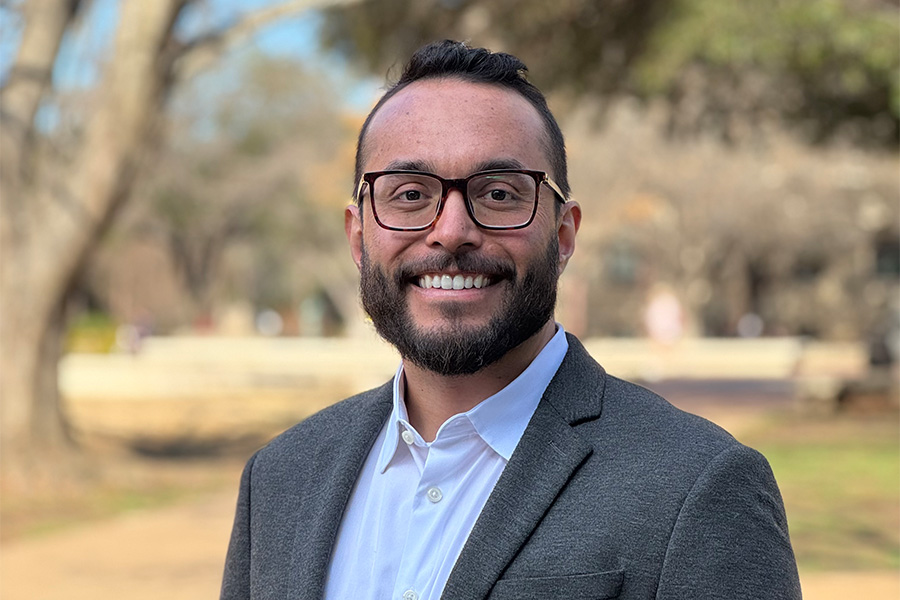
By Elliott Nace | Assistant News Editor
Baylor faculty, family, staff and students gathered at 5 p.m. Thursday in Paul W. Powell Chapel to attend a remembrance service held in honor of a beloved professor, husband, father and friend.
Dr. Ricardo Álvarez-Pimentel, an assistant professor of history, died Oct. 15 after battling cancer. He was 36 years old.
Assistant Professor of history Dr. Daniel Barish said Álvarez had a zeal about him that “animated everything he did.”
“[Álvarez] was brave; he was confident in his identity and his ideas; and extremely impatient in the best possible sense of the term, with inequities or injustices that got in the way of other people expressing their own ideas or embracing their own identities,” Barish said.
Álvarez joined Baylor faculty in 2022 after receiving his doctorate in history from Yale University earlier that year. His research focused on the history of Latin America, particularly that of Mexico, as well as how gender and religion influence day-to-day life and distinct elements of culture.
In addition to his academic obligations, Álvarez co-founded the Historians of Catholic Mexico research collaborative, was a member of Baylor’s Faculty Senate and served as president of the LatinX Faculty and Staff Association. He also volunteered at St. Louis Catholic Church in Waco.
Dr. Marilia Corrêa, assistant professor of history, remarked on how Álvarez incorporated his morals into his work ethic.
“Listening to his priest say on Tuesday that he also volunteered at his church, I could only ask, ‘How did he do it all?’” Corrêa said. “[Álvarez] deeply cared about equipping members of our community so we could all thrive together. He was the best kind of scholar, one that did not separate academics from activism. He fought for social justice and to make the world a better place where everyone could live with dignity and respect.”
Several of Álvarez’s colleagues pointed to his friendliness and easygoing attitude, best exemplified by his ability to dominate at soccer meets while wearing a pair of Crocs.
“[Álvarez] was better than all of us,” Dr. Moisés Park, associate professor of Spanish, said. “I think the secret [was] all those hours swimming and watching Star Wars and getting the Force.”
Álvarez’s Catholic faith underpinned his love for God and others, as well as his devotion to his work. In a reflection submitted for the gathering, professor of history Dr. Barry Hankins recalled that while on the panel presiding over Álvarez’s faculty interview at Baylor, Álvarez explained how he would fervently pray in the middle of the night for the ability to balance his responsibilities as a husband and father with the completion of his doctoral dissertation at Yale.
“Dr. Hankins said that while the interview committee sat stunned and in awe, Ricardo added, ‘So that would be one such experience of my faith,’” Dr. Sara Barton, director of pastoral care and the first speaker at the gathering, said.
Álvarez’s first book, “Counterrevolutionary Women: Race, Gender, and Mexico’s Unfinished Religious Restoration, 1917-1946,” examines how women in Mexico reacted to changes in youth culture through Catholic conservatism. The book will be released by University of Nebraska Press on Dec. 1.
Baylor’s Office of Spiritual Life organized the gathering, which featured readings from the Books of Job and Revelation alongside hymns sung in both English and Spanish.
Aaron Ramos, a doctoral candidate speaking on behalf of his peers, said Álvarez’s words motivated him to fully embrace his academic vocation.
“I’m struck by all the similarities between all of our memories of Ricardo,” Ramos said. “He invested so much time, energy, love and genuine concern for all of us. He was our greatest advocate. He was our greatest confidant. He was our greatest mentor and our greatest friend.”
Letter from the editor: Baylor provides resources for students facing personal or emotional challenges, including support through the Office of Spiritual Life and the Counseling Center.