By Josh Siatkowski | Lead Writer
Baylor’s AI Venture Challenge returned for a second year Tuesday night, bringing more applicants, bigger ideas and a tougher decision for the panel of judges.
The competition, in which students proposed startup ideas rooted in the world’s favorite two-letter acronym, featured pitches from a wide range of industries. Students presented search engine optimization businesses, disaster response ventures and a technology that turned video of ocean waves into random cryptographic sequences.
For the judges, deciding how to split the $5,000 in prize money was harder with the new level of competition and the increase in applications. Starting with 70 ideas, the pre-screening process narrowed it down to 10 worthy finalists.
“Compared to last year, it was obvious that the caliber of applicants was extremely high, much higher, so we just had top 10 finalists that were all really good,” judge and 2002 Baylor alumnus Charley Donaldson said. “So ultimately, it came down to ventures that we felt could actually go from concept to business in more of a straight line than in theory.”
Aston Teague, another judge and an energy and power entrepreneur, said the panel had to find new criteria on which to assess the pitches. The chosen criteria included feasibility, impact, and the increasingly important question of defensibility.
“I think what makes AI development tough is that almost anyone can go develop something,” Teague said. “So that’s really where things are going to become defensible. What is your moat? What are you doing that no one else can replicate?”
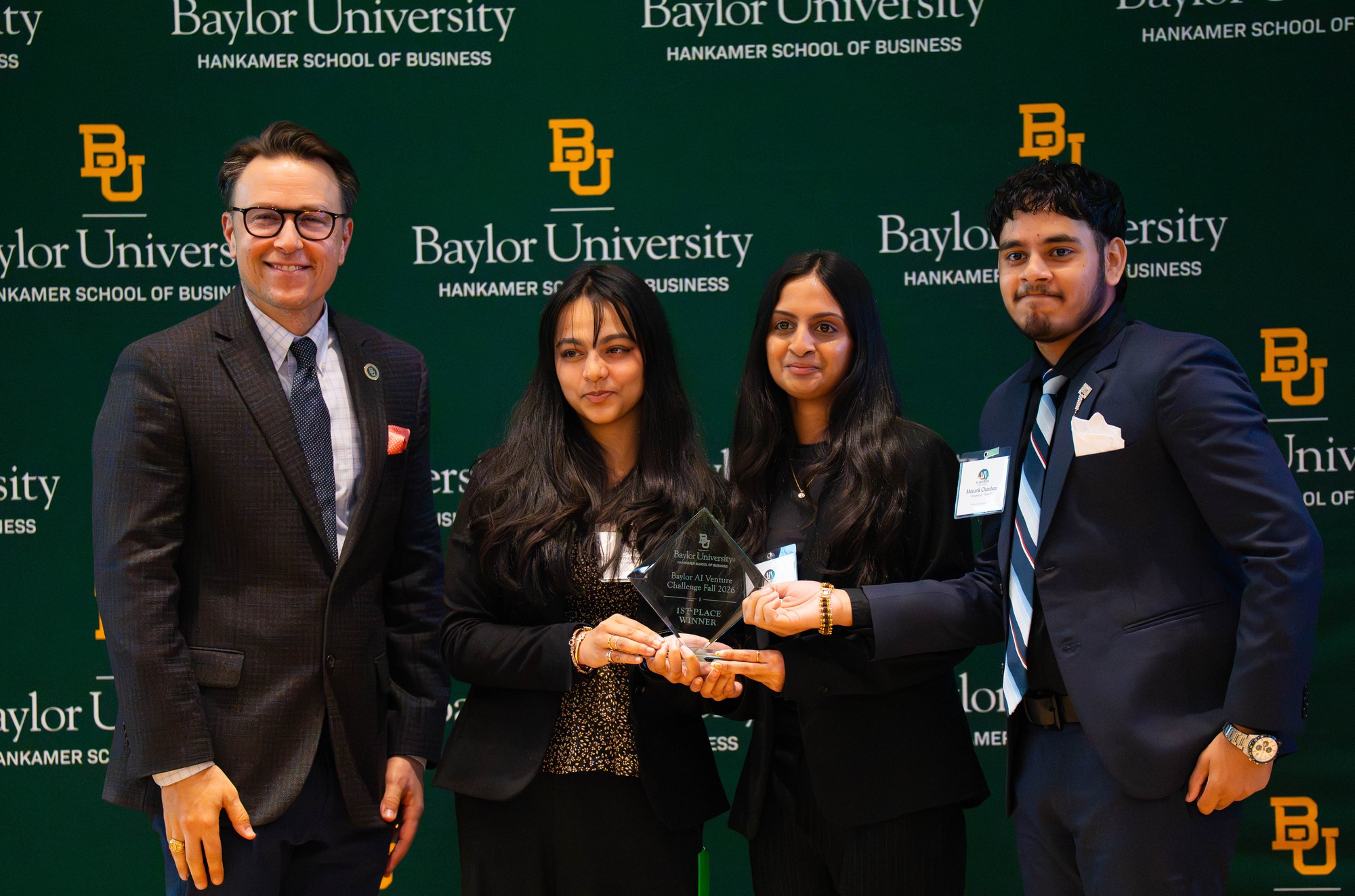
Under those criteria, the winner was Easibility, a healthcare startup founded by San Jose, California, junior Ananya Bharathapudi; Chicago junior Vrinda Tadepalli; and New Delhi sophomore Mayank Chauhan. The trio took home a $3,000 prize to continue working on their business idea, which connects patients in need with grant funding and financial assistance from hospitals.
The product itself is an application that allows hospitals to see all the grants a patient is eligible to apply for, along with any qualifications the patient may have for the hospital’s own financial assistance programs. For the founding team, two of whom are on the pre-med track, the idea came from challenges they saw in their work experiences.
“I work at the ER, so I see these patients come in, and their first instinct was not to tell us what’s wrong, but it’s like, ‘I can’t pay for this. How am I going to pay for it?’” Tadepalli said.
The team built Easibility last April in another local business competition, the Wacode hackathon. During that weekend, Chauhan led the technical development and helped the team secure a third-place prize.
Since then, the trio has met with Baylor faculty and local physicians to continue discussions about development and implementation. The prize money will also go toward those efforts.
“We are hoping to sort of build ourselves more professionally, reach out for grants, funding, but also actually get a pilot and a clinic started, so we can start helping some people,” Bharathapudi said.
Taking home the remainder of the $5,000 prize pool were second-place AI verification company Mandate and third-place pitch Bureaucrat, which automates the submission of regulatory forms.
A year after the first AI Venture Challenge, Baylor’s business school has continued to push AI in its curriculum and organizational structure. Anthony Lapes, previously the assistant dean for operations, was retitled assistant dean for AI and business technology. As the technology reshapes every corner of the Foster Campus for Business and Innovation and the rest of the world, Lapes reminded attendees of the value of human thought.
“[AI] can generate 1000 options, but it can’t keep a promise, earn a client’s trust over 20 years, or sit with a colleague who’s having the worst week of his or her life,” he said. “Discernment, character, compassion, creativity, faith — these are all human endeavors, and they are becoming more valuable, not less.”
For Jeremy Martin, a 1999 Baylor alumnus and judge of the competition, the pitches showed that AI had reduced “the barrier to think big,” acting as a partner and amplifier of human ingenuity.
“We saw some really big ideas this year,” he said. “So it’s almost like that imagination, that barrier to think big, has come down significantly, and it’s good to see the students are embracing that and thinking big and trying to solve big problems that make an impact.”