





By Arden Berry | Staff Writer
It takes a village to maintain a healthy Bear.
Student health and wellness, the department of communication, students and staff across campus worked together to create HealthyBearsTXT, a new text-message-based initiative for students.
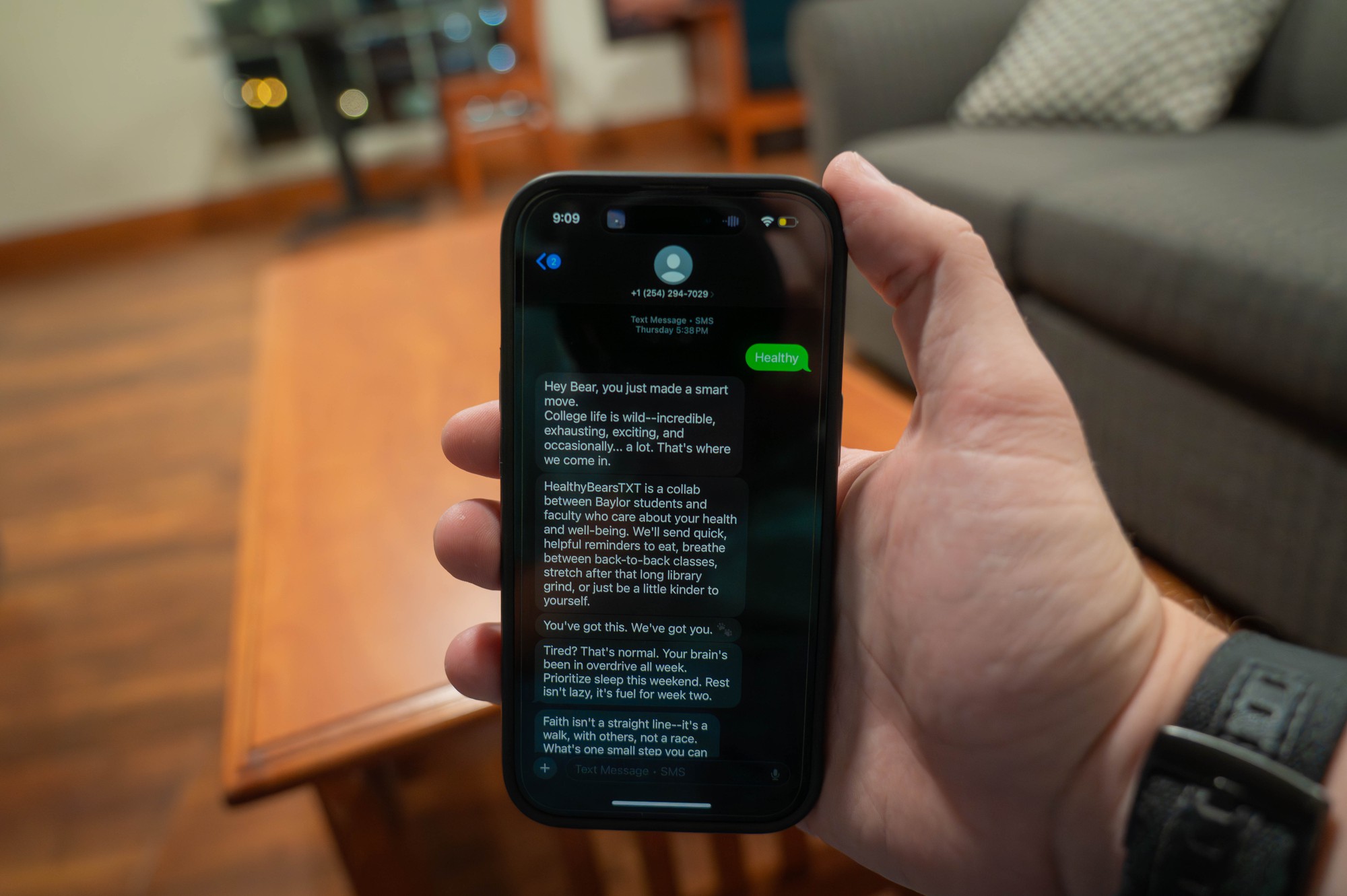
According to the student health and wellness website, students who sign up for HealthyBearsTXT will receive two to three weekly text messages providing health support in a variety of areas.
“Whether through tips for better sleep before exams, reminders about free campus resources or encouragements during stressful times, HealthyBearsTXT can help students stay on track,” the website reads.
Dr. Jim Marsh, dean of student health and wellness, said an intersection of the new strategic plan — a strong foundation of care for student wellbeing at Baylor and a national student focus on health and wellness — led to the formation of this initiative.
The team took into consideration a 2024 report from the National Association of Student Personnel Administrators, which showed that health and wellness were particularly important to college students.
“Out of the top ten list of things, six or seven of those are related to health and wellbeing, and the top three are health and wellbeing,” Marsh said. “So it’s something that’s really important to students.”
Dr. Jessica Ford, an associate professor of communication with expertise in health and risk communication, said the idea itself came from a successful text-message-based campaign at her previous institution.
“That’s what started the conversations,” Ford said. “That then ballooned into a lot of discussions amongst faculty and staff across campus over the last year.”
These discussions included 52 focus groups and interviews with 66 faculty and staff members.
“I’m an expert in the messaging of health-related messages, but I am not the expert in mental health or spiritual formation,” Ford said. “This was an interdisciplinary effort across campus. This is more than just Dean Marsh and myself.”
Ford said a qualitative analysis of these interviews revealed eight themes for messages to reflect: sleep, faith formation, resilience, anxiety, health and risk, nutrition, social relationships and exercise and physical activity. Ford then had students in her health communication class use the interviews to create 20 text messages from a particular theme and then have 50 students rate the messages to test their effectiveness. The most effective text messages from these studies will be sent to students.
According to Ford, the messages are built on “nudging theory,” an idea similar to the philosophy of an Apple Watch. Someone wearing one may receive a notification to stand up. While one might stand up when prompted and might not, one definitely wouldn’t think about it unprompted.
“These are gentle nudges to encourage different behaviors that are proven to help students,” Ford said.
Students interested in receiving these “gentle nudges” — created with the help of faculty and students across campus — can text “healthy” to 254-294-7029.
“We believe that Baylor is uniquely situated to have a rich and deeply thoughtful approach to wellbeing as a private Christian university,” Marsh said. “And we believe that the voice of Baylor plays a significant role in shaping what that’s going to look like.”


