By Arden Berry | Staff Writer
The Board of Regents approved the addition of “Pro Mundo” to the university motto in May 2024. Over a year later, its impact radiates throughout research across campus.
President Linda Livingstone said students and faculty have come up to her personally to tell her about their pro mundo research.
“That has really resonated with the Baylor community in so many ways,” Livingstone said. “It’s become a descriptor of work that people are doing.”
One can find pro mundo research, or research “for the world,” across the disciplines. Plano senior Mary Dickinson works with Dr. Melisa Dracos, associate professor and interim undergraduate program director for linguistics and Dr. Tracey Jones, senior lecturer in the school of education, on research that examines bilingual language acquisition.
“[La Vega Primary School has] dual-language programs, so they have programs where the students are speaking both English and Spanish in school, and we test the students on basics, like morphosyntactic things so can they form a passive sentence, can they make nouns plural, things like that,” Dickinson said.
According to Dickinson, the purpose of the research is to determine how effective the school’s dual-language program is and to broaden the research on bilingualism.
“Something that I think a lot of Americans don’t realize is that multilingualism is actually far more prevalent than monolingualism worldwide,” Dickinson said. “It’s most likely, comparatively uncommon for people to only speak one language, which sounds weird to us in America because we’re just used to all of us speaking English, but on the reverse of that, there’s much less research about bilingualism than there is about monolingualism.”
She said the ultimate goal of the research is to help with the development of dual-language programs in the U.S.
“Dual-language programs have been a thing in places like Canada, where there are two national languages, so kids are getting English and French in schools because they need to be able to speak both for their country,” Dickinson said. “So they’ve been a thing in other places, but they’re relatively newer in the U.S., and a lot of them aren’t very robust.”
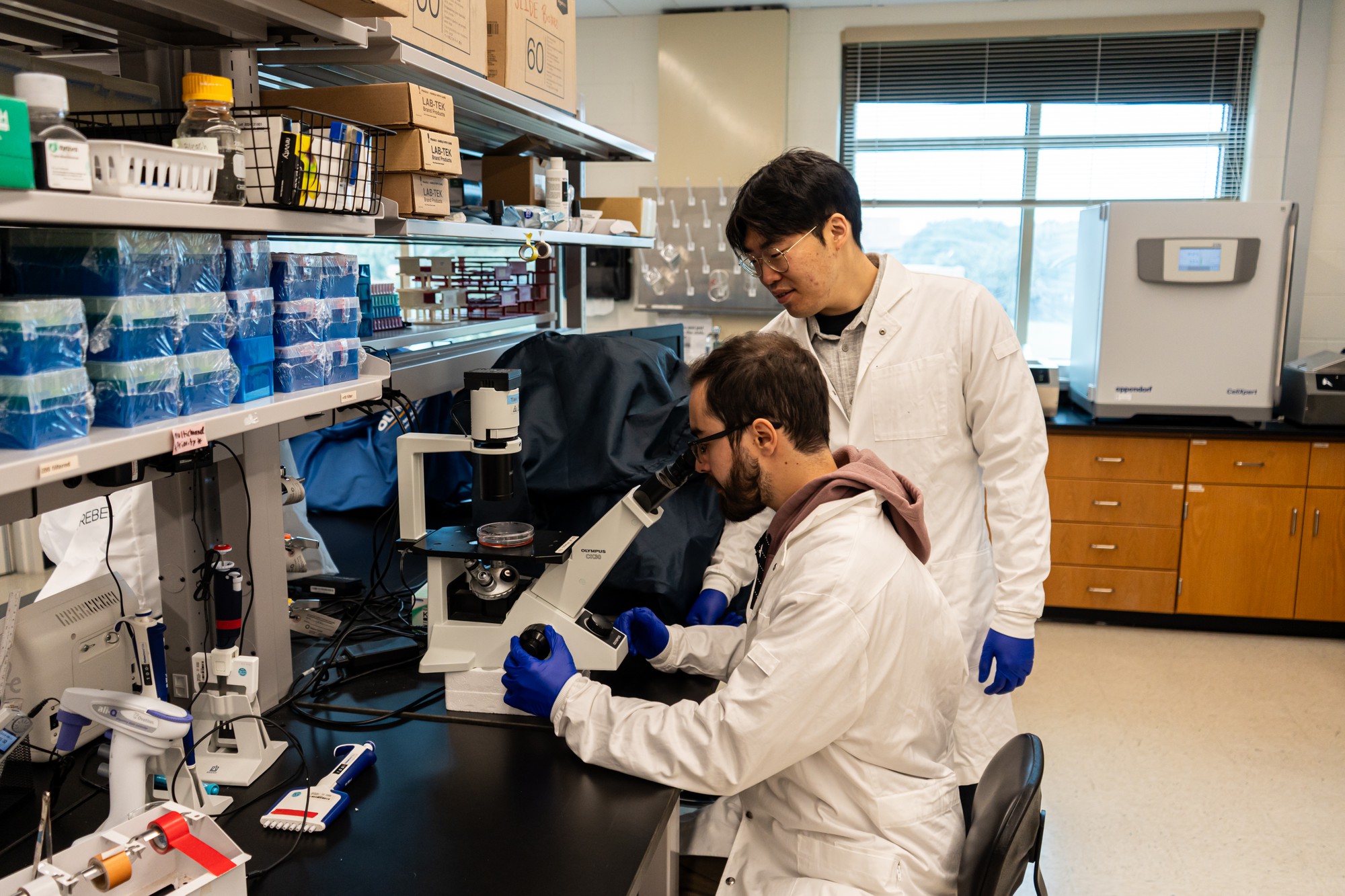
For science research, Portland senior Rebecca Tietze said she works in assistant professor of biology Katelyn McKindles’ lab studying a species of cyanobacteria — a type of algae that blooms in lakes and can produce toxins called microcystins.
“I’m tracking across many different samples of this species the genetics of toxin production,” Tietze said. “I’m looking at the genes that the actual part of the DNA is responsible for making the toxins and how that is different between different strains, which is a word for different samples, and comparing ones that do produce toxins to ones that don’t produce toxins and seeing what the difference [is] there.”
Tietze said she had noticed existing tests were not consistently working well, giving her false positive and negative results.
“My research is gearing to clear that up a little bit,” Tietze said. “Maybe there’s a better way for us to be tracking the toxicity of water that doesn’t lead to faulty results that could end up harming people. And then potentially proposing a better test based on toxic genes to replace what they’re currently doing that might work better is the hope and goal.”
While Tietze said the focus on cyanobacteria is often primarily environmental, she said focusing on their production of toxins is also helpful for human health.
“In trying to improve the health of water bodies, we are also improving the health of humans because there is a direct correlation,” Tietze said. “When the lakes are not healthy, if people swim in there, they can potentially get sick, or if we aren’t cleaning our water properly — because they’ve also been like, ‘How can we filter and clean water to remove these toxins so that water is drinkable?’”
Whether it’s working with local students to contribute to a broader body of research on multilingualism or studying a specific toxin produced by algae to improve human health, student and faculty research performed at and around Baylor has the potential for wider impact.
“As we move forward with Baylor in Deeds, how much more we’re going to be able to do that really leans into that global piece of who we are at Baylor and the way that we can impact the world in really, really significant ways,” Livingstone said.