By Cameron Stuart | Radio Director
In the 1990s, it was tough to turn your head and not see a plastering of black culture, be it on your TV screen, in the movie theaters, in the retail stores or hearing it through a car radio passing by.
Did the decade still have its fair share of race relations issues? Of course. From Rodney King to O.J. Simpson, there were issues that were still there in America, but there was now an undeniable platform for black people across the country. Unlike during race issues of the 1960s and ’70s, people could now hear about problems facing black people in the mainstream media from Arsenio Hall instead of Johnny Carson. They could hear it through the music of N.W.A. rather than Bob Dylan on the radio and see the success on the mainstream charts. They could see movies about very real gang violence facing young black people in the inner cities in “Boyz n the Hood” in every theater rather than watching the Jets and the Sharks duke it out in “West Side Story.”
Dr. Tyrha Lindsey-Warren, a clinical assistant professor of marketing, doesn’t believe the ’90s represented a rise in black culture, but rather a bigger platform. She also thinks pin-pointing the ’90s as the time where black culture rose as “unfair and limiting.”
“Black culture has been very influential throughout American history, since the beginning of American history, from the Harlem Renaissance to gospel music and beyond,” Lindsey-Warren said.
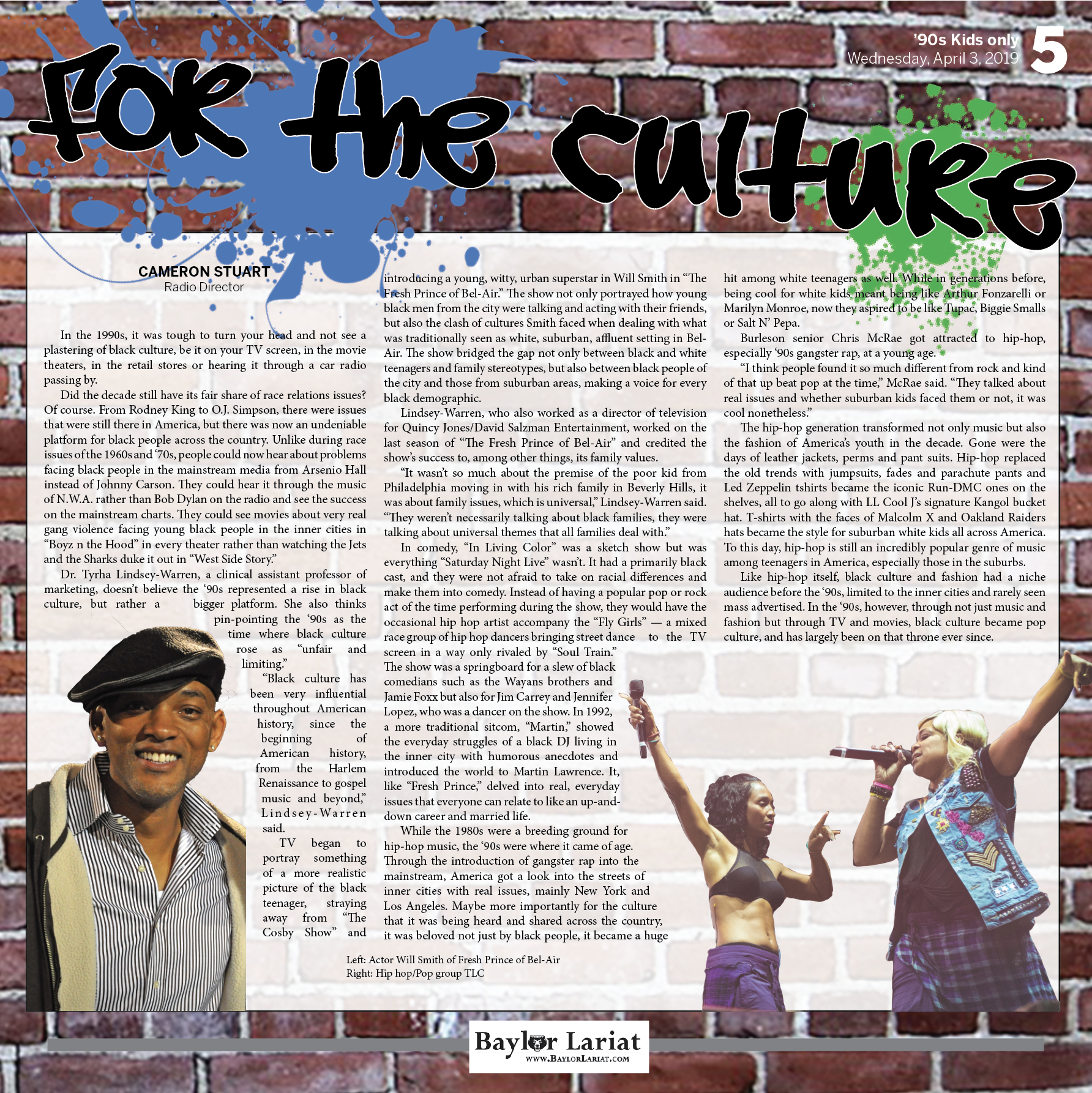
TV began to portray something of a more realistic picture of the black teenager, straying away from “The Cosby Show” and introducing a young, witty, urban superstar in Will Smith in “The Fresh Prince of Bel-Air.” The show not only portrayed how young black men from the city were talking and acting with their friends, but also the clash of cultures Smith faced when dealing with what was traditionally seen as white, suburban, affluent setting in Bel-Air. The show bridged the gap not only between black and white teenagers and family stereotypes, but also between black people of the city and those from suburban areas, making a voice for every black demographic.
Lindsey-Warren, who also worked as a director of television for Quincy Jones/David Salzman Entertainment, worked on the last season of “The Fresh Prince of Bel-Air” and credited the show’s success to, among other things, its family values.
“It wasn’t so much about the premise of the poor kid from Philadelphia moving in with his rich family in Beverly Hills, it was about family issues, which is universal,” Lindsey-Warren said. “They weren’t necessarily talking about black families, they were talking about universal themes that all families deal with.”
In comedy, “In Living Color” was a sketch show but was everything “Saturday Night Live” wasn’t. It had a primarily black cast, and they were not afraid to take on racial differences and make them into comedy. Instead of having a popular pop or rock act of the time performing during the show, they would have the occasional hip hop artist accompany the “Fly Girls” — a mixed race group of hip hop dancers bringing street dance to the TV screen in a way only rivaled by “Soul Train.” The show was a springboard for a slew of black comedians such as the Wayans brothers and Jamie Foxx but also for Jim Carrey and Jennifer Lopez, who was a dancer on the show. In 1992, a more traditional sitcom, “Martin,” showed the everyday struggles of a black DJ living in the inner city with humorous anecdotes and introduced the world to Martin Lawrence. It, like “Fresh Prince,” delved into real, everyday issues that everyone can relate to like an up-and-down career and married life.
While the 1980s were a breeding ground for hip-hop music, the ’90s were where it came of age. Through the introduction of gangster rap into the mainstream, America got a look into the streets of inner cities with real issues, mainly New York and Los Angeles. Maybe more importantly for the culture that it was being heard and shared across the country, it was beloved not just by black people, it became a huge hit among white teenagers as well. While in generations before, being cool for white kids meant being like Arthur Fonzarelli or Marilyn Monroe, now they aspired to be like Tupac, Biggie Smalls or Salt N’ Pepa.
Burleson senior Chris McRae got attracted to hip-hop, especially ’90s gangster rap, at a young age.
“I think people found it so much different from rock and kind of that up beat pop at the time,” McRae said. “They talked about real issues and whether suburban kids faced them or not, it was cool nonetheless.”
The hip-hop generation transformed not only music but also the fashion of America’s youth in the decade. Gone were the days of leather jackets, perms and pant suits. Hip-hop replaced the old trends with jumpsuits, fades and parachute pants and Led Zeppelin tshirts became the iconic Run-DMC ones on the shelves, all to go along with LL Cool J’s signature Kangol bucket hat. T-shirts with the faces of Malcolm X and Oakland Raiders hats became the style for suburban white kids all across America. To this day, hip-hop is still an incredibly popular genre of music among teenagers in America, especially those in the suburbs.
Like hip-hop itself, black culture and fashion had a niche audience before the ’90s, limited to the inner cities and rarely seen mass advertised. In the ’90s, however, through not just music and fashion but through TV and movies, black culture became pop culture, and has largely been on that throne ever since.