

Close Menu
The Baylor Lariat
    Facebook X (Twitter) Instagram YouTube LinkedIn
    Trending
    • Board of Regents approves nearly $1 billion operating budget, new AI-centered master’s degree
    • Foster Pavilion to host rising country star Braxton Keith
    • Dog days: Q&A with Wacoan that built hot dog social media brand
    • Country legend Willie Nelson returns after 72 years for night of harmonies, hits
    • Students react to ‘very stressful’ Canvas outage ahead of finals
    • Canvas access to be restored, Friday finals moved to online Thursday
    • Baylor delays finals as nationwide Canvas outage impedes studying
    • SLIDESHOW: IM Claw Cup Championship
    • About us
      • Spring 2026 Staff Page
      • Copyright Information
    • Contact
      • Contact Information
      • Letters to the Editor
      • Subscribe to The Morning Buzz
      • Department of Student Media
    • Employment
    • PDF Archives
    • RSS Feeds
    Facebook X (Twitter) Instagram YouTube LinkedIn
    The Baylor LariatThe Baylor Lariat
    Subscribe to the Morning Buzz
    Sunday, May 31
    • News
      • State and National News
        • State
        • National
      • Politics
        • 2025 Inauguration Page
        • Election Page
      • Homecoming 2025
      • Baylor News
      • Waco Updates
      • Campus and Waco Crime
    • Arts & Life
      • Wedding Edition 2025
      • What to Do in Waco
      • Campus Culture
      • Indy and Belle
      • Leisure and Travel
        • Leisure
        • Travel
          • Baylor in Ireland
      • Student Spotlight
      • Local Scene
        • Small Businesses
        • Social Media
      • Arts and Entertainment
        • Art
        • Fashion
        • Food
        • Literature
        • Music
        • Film and Television
    • Opinion
      • Editorials
      • Points of View
      • Lariat Letters
    • Sports
      • Football
      • Basketball
        • March Madness 2026
        • Men’s Basketball
        • Women’s Basketball
      • Soccer
      • Baseball
      • Softball
      • Volleyball
      • Equestrian
      • Cross Country and Track & Field
      • Acrobatics & Tumbling
      • Tennis
      • Golf
      • Pro Sports
      • Sports Takes
      • Club Sports
    • Lariat TV News
    • Multimedia
      • Video Features
      • Podcasts
        • Don’t Feed the Bears
        • Bear Newscessities
      • Slideshows
    • Sing 2026
    • Lariat 125
    • Advertising
    The Baylor Lariat
    Home»News»Baylor News

    Reaction to climate ‘shocks’ studied

    By January 25, 2011 Baylor News No Comments3 Mins Read
    Share
    Facebook Twitter LinkedIn Pinterest Email
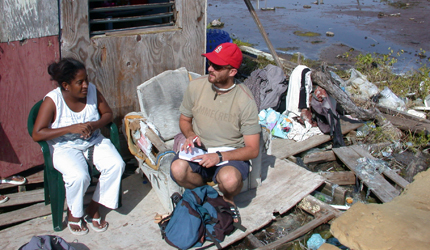
    Courtesy Photo
    Steve Cole, a graduate student at the University of Arizona, surveys a local Belizean while conducting field research in Belize.

    By Jade Mardirosian
    Staff Writer

    A Baylor associate professor’s recent study in Belize examines how people and communities respond to climate change and natural disasters. Results from the study indicated that secure households are able to respond more effectively to climate change and disasters.

    Dr. Sara Alexander, associate professor of anthropology at Baylor, conducted research in three coastal communities in Belize using a range of about 860 various households as test samples.

    Alexander and her team focused on coastal communities with varying degrees of dependency on tourism, identified vulnerable households in these communities and tested how these households respond to a climate related event or shock.

    “One of our hypotheses was that the more socially connected a household is to their local community, the less vulnerable they are in terms of these climate variables,” Alexander said.

    Over the past year Alexander has been processing and analyzing the data and has found things in her preliminary results that indicate that 62 percent of households believe chronic weather conditions, such as increased temperatures and floods, are of higher concern than an isolated disaster, such as a hurricane.

    “Their perception isn’t necessarily that this ‘one off’ disaster is more severe in terms of their lives,” Alexander said. “That was interesting because I really thought that in this area you have mostly tropical storms and hurricanes and mudslides, and I thought those sort of events would give people the perception that they were more serious than things like a drought.”

    Further results indicated that many households have a strong perception of global climate change, with 57 percent of households believing that storms are currently harsher than they were 5 to 10 years ago.

    The results will be published in the Climate Change and Mitigation and Adaptation Strategies for Global Change.

    The study was funded by way of a $235,000 grant from the National Oceanic and Atmospheric Administration.

    Dr. Susan Stonich, professor of anthropology at the University of California, Santa Barbara, worked as co-investigator on the research. The research team also consisted of doctoral students from the University of California, Santa Barbara and the University of Arizona. Once in Belize, Alexander hired Belizean high school and college students to help with conducting surveys in the community.

    Those that worked with Alexander on the research are currently conducting other research (not associated with the work done in Belize), out of the country and could not be reached for comment for this article.

    Alexander is currently working on proposals for a stage two of research, studying the same factors, but expanding the locations to the Yucatan and the Northern coast of Honduras.

    Dr. Joseph White, associate professor of biology, is currently working with Alexander on preliminary steps for this research. White says they are planning on developing a research grant for the National Science Foundation.

    “Currently the idea is to leverage the work [Alexander has] accomplished in Belize,” White said. “This would be a follow up, at this point taking a look at the combination of how agriculture and coastal reef fisheries are connected due to climate and how people using farms or fisheries are perceiving changes in their food supply and their potential relationship to climate change as it has been occurring.”

    White explained that he would be predicting future environmental changes based on computer modeling and Alexander would assess if humans are aware of changing conditions to the climate.

    Belize Featured Joseph White National Science Foundation Sara Alexander

    Keep Reading

    Board of Regents approves nearly $1 billion operating budget, new AI-centered master’s degree

    Foster Pavilion to host rising country star Braxton Keith

    Students react to ‘very stressful’ Canvas outage ahead of finals

    Canvas access to be restored, Friday finals moved to online Thursday

    Student research findings emphasize importance of deep friendships

    Seniors prepare to navigate unstable job market post-graduation

    Add A Comment

    Comments are closed.

    Recent Posts
    • Board of Regents approves nearly $1 billion operating budget, new AI-centered master’s degree May 21, 2026
    • Foster Pavilion to host rising country star Braxton Keith May 20, 2026
    About

    The award-winning student newspaper of Baylor University since 1900.

    Articles, photos, and other works by staff of The Baylor Lariat are Copyright © Baylor® University. All rights reserved.

    Subscribe to the Morning Buzz

    Get the latest Lariat News by just Clicking Subscribe!

    Follow the Live Coverage
    Tweets by @bulariat

    Facebook X (Twitter) Instagram YouTube LinkedIn
    • Featured
    • News
    • Sports
    • Opinion
    • Arts and Life
    © 2026 ThemeSphere. Designed by ThemeSphere.

    Type above and press Enter to search. Press Esc to cancel.