By Giselle Lee | Staff Writer
Late nights, early mornings and the euphoric rush of last-minute research are things every Baylor Model United Nations student experiences.
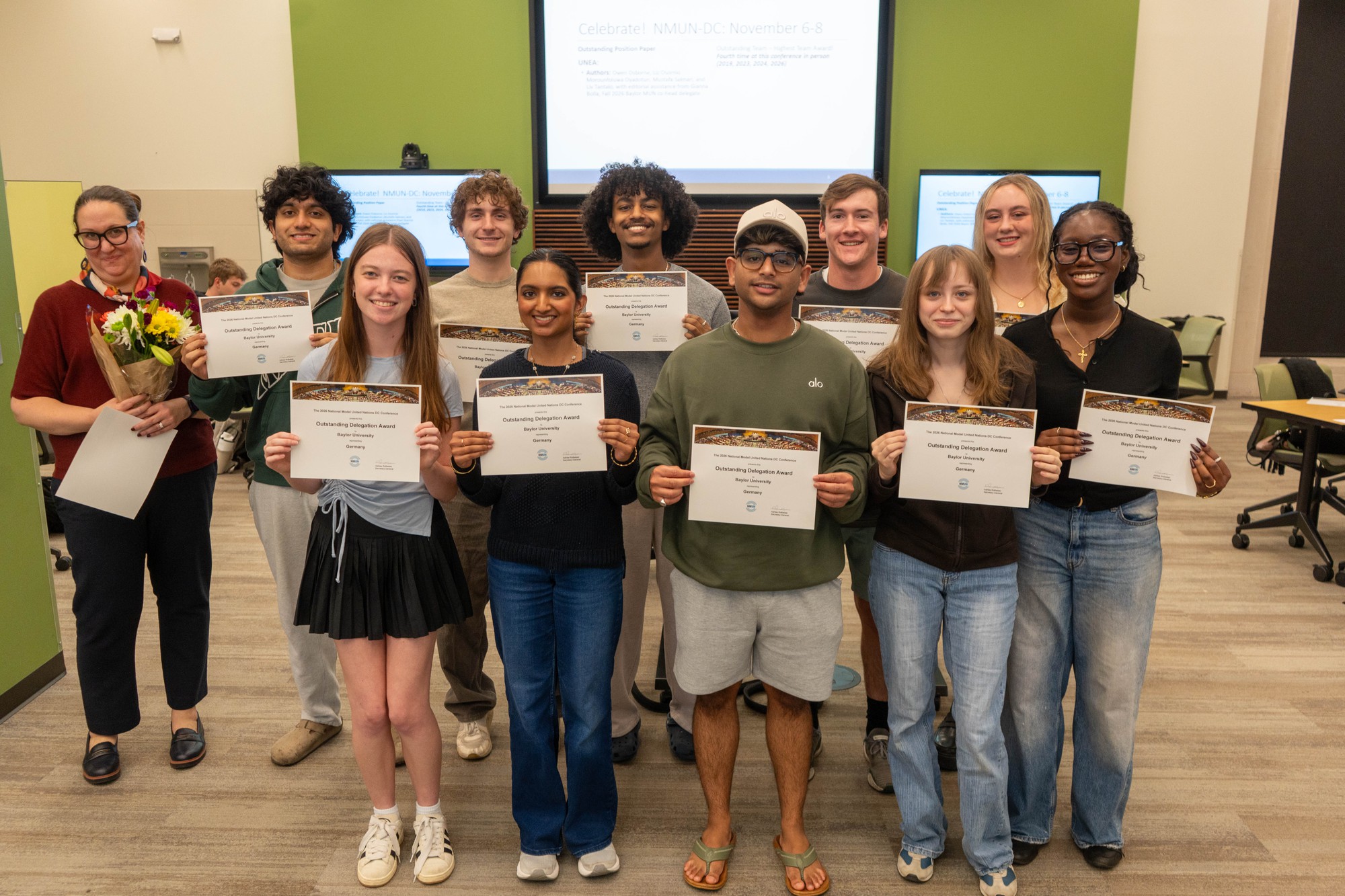
This year, their hard work paid off: at the National Model United Nations conference in Washington, D.C., they returned with the prestigious “Outstanding Delegation” award.
Baylor Model United Nations (MUN) attends two to three conferences a year, rotating the member state that the team researches every semester. With support from the university, the program has become accessible to all students, regardless of financial means, giving collegiate students the opportunity to simulate UN committee experiences.
Dr. Rebecca Flavin, professor of political science and advisor to Baylor’s MUN, said the students’ debated topics are contemporary global issues the United Nations are currently discussing, which she said has been “a fantastic way” for students to learn.
“It’s a steep learning curve, but watching how much students grow in their research abilities as one of our team’s strengths is something really important to me,” Flavin said. “Learning how to find good information and how to be technical writers is a skill that’s going to serve them well regardless of what they do next after Baylor, to become competent speakers, but above all to be really good human beings.”
During the first 11 weeks of the semester, Baylor MUN focuses on developing professional skills, such as research, public speaking and diplomacy. Flavin said the students’ competition process involved a lot of “give and take” and thinking on their feet, but emphasized the team’s educational value.
“I tell my students that I genuinely mean it, that if they came home and we didn’t win a single award, that wouldn’t make anything they did less meaningful,” Flavin said. “But the fact that they do win awards is a testament to just how well they represent the university.”
Pyeongtaek, South Korea, senior Devynn Martin said attending the D.C. conference felt like “a bubble,” but he made bonds and friendships with people despite the wide variety of leadership and communication styles.
“I don’t think I touched my phone once during that conference,” Martin said. “When all was said and done, we could still discuss what movies we saw recently, what music we like, who’s our favorite philosopher. [It’s] so cool to watch all of these different kinds of people in the world come together and focus on a solution for very pressing issues in our time.”
As one of the more experienced members of the delegation, Martin said stepping into a leadership role for the conference was a fascinating experience and built her confidence in her capabilities.
“I never consider myself or label myself as a leader because I always get afraid that that’s too presumptuous of me to do,” Martin said. “It’s always surreal when people ask me to lead and I’m always proud of myself when I’m able to take that step into leadership, because I learn in that moment that I’m capable of things that I didn’t think I could do.”
Spokane, Washington, senior Gianna Bolla said she was “extra proud” to have contributed to the paper that was awarded at the conference and hopes to use her cross-cultural communication skills in NMUN Spain over Thanksgiving break.
“Learning how to mitigate conflict and disagreements between people or groups is something I have learned exponentially throughout this program,” Bolla said. “I’ll be taking those skills with me on the UNESCO committee in researching the broader international action of how we’re preserving cultures and expanding climate education.”
Bolla said it was exciting to attend one last conference with the Baylor team as she will be partnered with a fellow member, whom she has worked with since freshman year.
“It’s exciting to do it with such a good friend and someone who I have such a great relationship with and trust and feel really confident in our ability going into conference,” she said.
As Baylor MUN prepares to send an eight-strong team to Barcelona, Flavin said conference travel opportunities are invaluable for students of all majors, and encouraged those who are curious to join and provide “invaluable” perspectives on topics that require specific knowledge.
“Sometimes we have students who did it in high school, but the vast majority of students, when they walk in the door, they have no idea what it is,” Flavin said. “If you think about when we have topics that are related to global health, if we have someone who has a background in global health, all the better that they’re able to bring that expertise to bear on their research.”