By Arden Berry | Arts & Life Editor
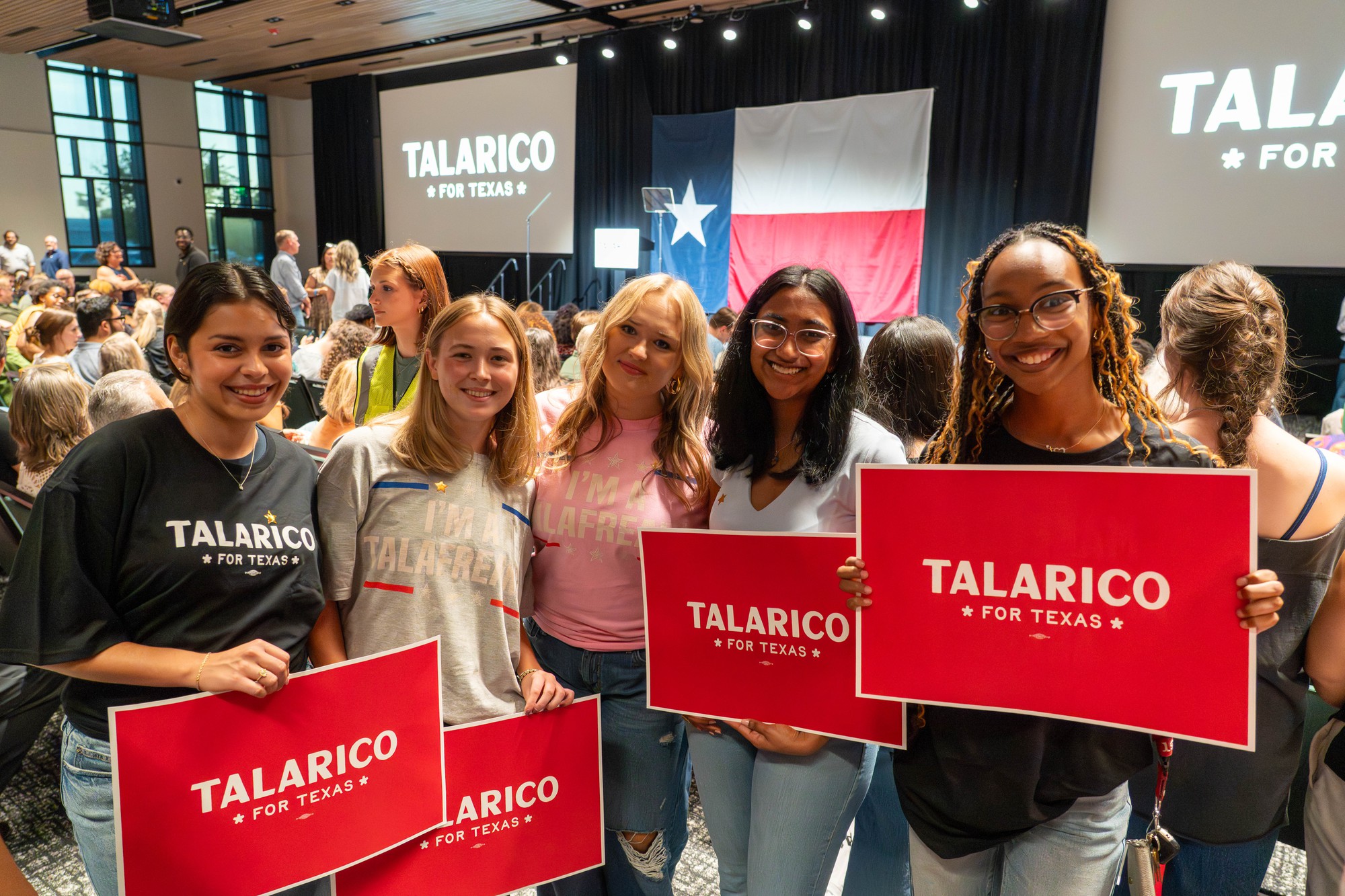
James Talarico’s black-and-white shirts and President Donald Trump’s red-and-white hats may be a common sight along the campaign trail, but it is not common to see students wearing or using political merchandise on campus.
However, political events like Talarico’s campaign stop in September and Turning Point USA tour stop in April reveal that students do own shirts, hats and signs representing their political beliefs.
Dr. Patrick Flavin, chair of the political science department, said the lack of day-to-day campaign merchandise may be because wearing this clothing can be divisive.
“You do see a couple [students] who are very proud to wear their Trump merch or whatever,” Flavin said. “But I would say what I routinely hear from students is they don’t because they’re cognizant that it creates conflict and they want to avoid that, as opposed to showing which candidate they support.”
Flavin said this mindset is understandable but can be problematic for students.
“The campus becomes apolitical,” Flavin said. “I don’t think that’s what we’re aiming for too. I think Baylor’s trying to cultivate a civic environment, but one that has civil discourse so that, so like if someone was wearing a shirt from the opposing campaign, you could say like, ‘Why do you support them?’ instead of just attacking them and try to learn something from them.”
Houston senior and Baylor College Democrats President Hanna Al-Hayek said she finds that her Talarico shirt is a conversation starter.
“It’s kind of given people an opportunity to approach with conversation, knowing where my stances are,” Al-Hayek said.
Flavin said merchandise is effective not because it advertises to undecided voters, but because it energizes supporters and raises money for campaigns.
“You donate ‘X’ amount of money and you’ll get this,” Flavin said. “So donate even more and you get a really cool T-shirt or something like that. So I think campaigns have sort of built it into their fundraising appeals. And it makes sense because then that’s free advertising even if it only has effect on the margins for the campaign if people are out there wearing it when they’re out in public.”
Al-Hayek said wearing political merch is a unifying experience.
“I think it helps with the, there’s more of us than you think, and that could help other students or people who are more aware and weary of political violence,” Al-Hayek said. “Like if one person does it and that starts a chain reaction, then it helps.”
When it comes to this midterm Senate election, much of Talarico’s merchandise features white text on a black background.
Flavin said he would guess that Talarico is trying to create a unique political brand.
“If you can create, whether it’s the colors of your signs or the color or the format of your clothing or the hats, whatever you give out, they get, it makes them more effective,” Flavin said. “It makes them stand out.”
Al-Hayek said the style is neutral.
“It’s very simple, and it’s not very scream-in-the-face blue or scream-in-the-face red, and I think that that might help people feel like, because I know a lot of Republicans who are voting Talarico, so that might be a choice that helps,” Al-Hayek said.
Talarico’s campaign also sells shirts that say, “I’m a Talafreako.”
“I think it shows sort of a good-natured awareness of being able to take what’s viewed as an insult from campaign supporters and try to turn it around and in some ways almost embrace it,” Flavin said. “And so I think it’s probably been effective at muting the ‘Talafreako’ sort of discourse that you see.”
Ken Paxton’s merchandise often features the American flag, and attendees of Paxton’s Waco campaign event wore Trump merchandise.
The Baylor College Republicans could not be reached for comment, but Flavin said Paxton’s merchandise reflects his emphasis on “true Texas values.”
“I think that aligns with sort of the Paxton campaign message, which is certainly running as a supporter and having the support of President Trump,” Flavin said. “But also, I think, how you would put it, is defending Texas from, again, how you would put it, a liberal takeover or a democratic takeover.”
However, Flavin said he has not seen much Paxton merchandise in Waco.
“A lot of the Paxton political ads are being run not by the campaign, but by outside groups,” Flavin said. “So the campaign may be relatively thrifty on merch. But it just, again, anecdotally, seems like you don’t see a bunch of people wearing Paxton shirts or even signs, even here in McLennan County, which is 60% to 70% Republican leaning.”
Despite the absence of political merchandise in Baylor classrooms, Flavin is optimistic that wearing this merchandise at an academic institution like Baylor has the potential to create productive civil discourse.
“It often doesn’t, so I understand why students wouldn’t wear it,” Flavin said. “But I do think Baylor is in maybe a unique position … we want students to be politically engaged, we want them to vote. And so, yeah, so I’m going to be optimistic and be hopeful that students at Baylor are thoughtful and mature enough that if someone’s wearing merchandise of the opposing party, opposing candidate, that they could have an intelligent, reasonable conversation with that person.”