By Arden Berry | Arts & Life Editor
Behind the Waco Parks and Recreation building lies a piece of Waco history over 100 years old.
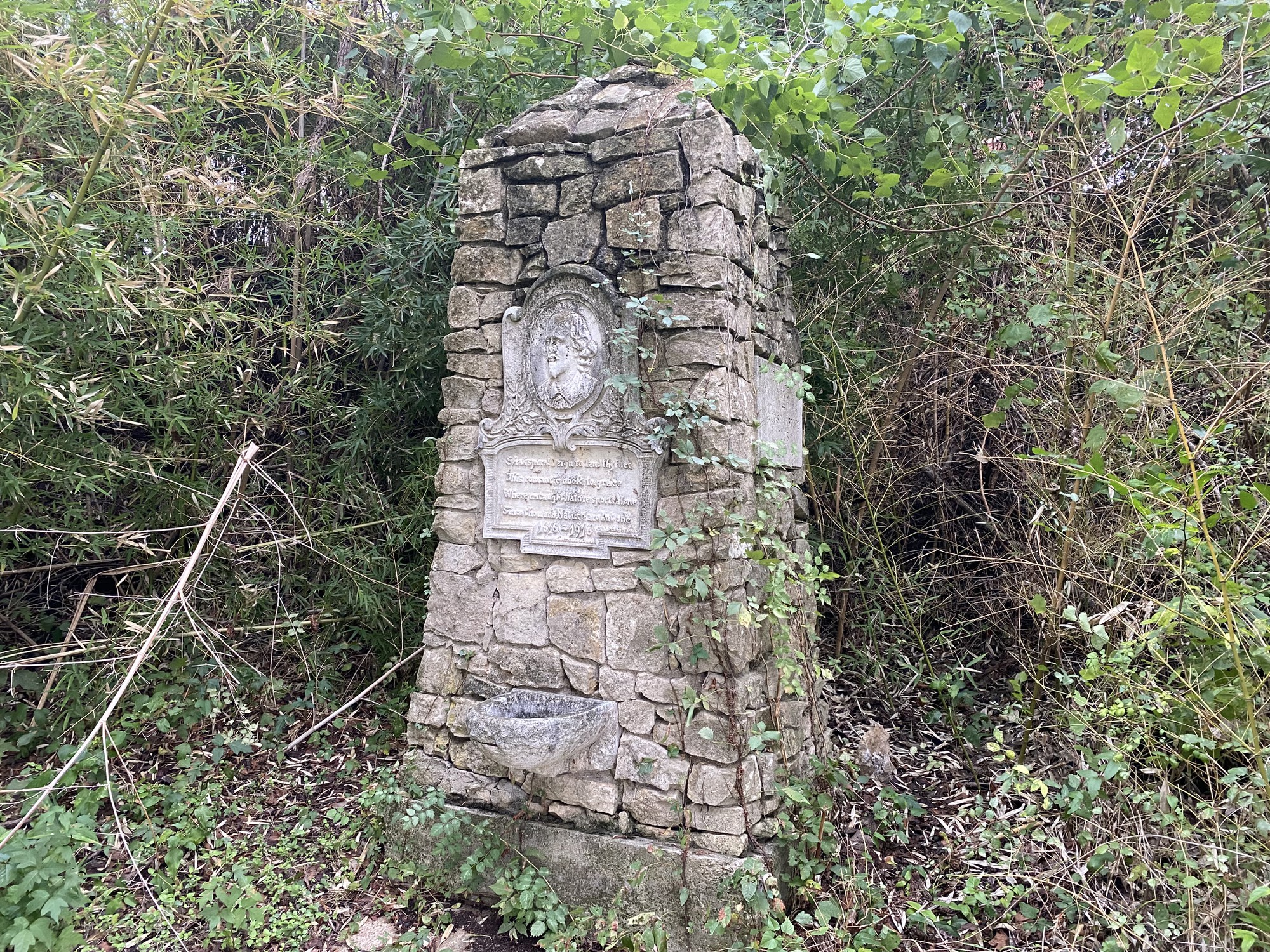
If a pedestrian stops between the lion and giraffe statue at the Waco Sculpture Zoo in Cameron Park and turns to look at the other side of the road through the trees and brush, they will spot a hidden stone monument.
On the front of the statue is inscribed:
“Shakspere! Daign to lend thy face / This romantic nook to grace / Where untaught nature sports alone / Since thou and nature are but one / 1616-1916,”
The Waco Women’s Shakespeare Club erected the monument in 1916 in honor of 300 years since William Shakespeare’s death in 1616.
According the first volume of its history available in the Texas Collection, Kate Friend, a Shakespeare scholar, taught a class for the single young elite ladies of Waco. Though she had wanted to end the class, she was encouraged by a couple of her students to continue teaching.
And so, on Nov. 19, 1899, Friend, then an editor for Artesia, Waco’s society newspaper, placed a piece in her column letting the women of Waco know that she would be resuming her class the next day in her home.
“I propose to form a regular class with officer, constitution and by-laws, with a view towards joining the [women’s] federation and taking with the other Shakespere clubs of Texas,” Friend wrote.
That class would become the Waco Women’s Shakespeare Club, and Friend would become its director.
According to the Texas Collection description for the club’s records in the Baylor Archival Repositories Database, the club existed from then until the records ended “rather abruptly” in the 1980s, though the records focused more of the overall Waco Federation of Women’s Clubs that the Shakespeare club was a part of after Friend’s death in 1949.
Starting out, the club met 3 p.m. the first and third Thursday from October through May in the Federated Club House Shakespeare. The minutes from each meeting were recorded in a series of notebooks. The club would discuss Shakespeare and host events.
According to “She Hath Been Reading: Women and Shakespeare Clubs in America,” a book by Katherine West Scheil, this club was one of more than five hundred Shakespeare clubs formed across America.
“Women were reading Shakespeare in astonishing numbers and in surprising places,” Scheil writes.
Helen Hopkins, a visiting research fellow at Birmingham City University, did a project titled “International Responses to Shakespeare in the Shakespeare Birthplace Trust’s Collections.” In her research, she came upon letters from Friend to the trust.
“Obviously I was interested in Kate Friend’s insistence on being recognized by the people of Stratford-Upon-Avon and people related to Shakespeare,” Hopkins said. “Obviously, very clear the passion for Shakespeare.”
Hopkins said she views Friend’s passion through the lens of cultural capital.
“It’s about that sense that this is the epitome of culture,” Hopkins said. “So if I am aligned with Shakespeare, if I can show that I love and appreciate Shakespeare, then I come to have some sort of cultural superior, I am myself prestigious and I carry that intellectual capital, cultural capital with me as well … She is desperate for that kind of reinforcement from Stratford that she’s part of this exclusive club. She is one of the important, prestigious people who know about and talk about Shakespeare.”
She also said that the club element is significant.
“They were really important … for bringing people together, for creating a space in which women in particular could be intellectual, could engage with intellectual questions where there wasn’t necessarily space for them to do so in mixed companies or in the academy, in universities and things like that quite so much,” Hopkins said.
However, as the club was only for the “elite” women of Waco, Hopkins said it would have been limited.
“There is a real sense that she was a representation of women, but it was women like her,” Hopkins said. “So, absolutely, it’s limited. It’s limited by wealth. It’s also limited by, obviously, race and I suppose class as well.”
While the Waco Women’s Shakespeare Club no longer exists, those with a love for Shakespeare’s work continue to find its place at Baylor.
Dallas senior Caleb Griffin performed in “A Midsummer Night’s Dream” with the Honors Residential College Drama Society in 2025. He played Oberon and helped with costumes and set design for the production.
“It was really enjoyable,” Griffin said. “I met a lot of people and got to know people that I already had met a lot better over the course of that play. It involved a lot of cooperation and a lot of teamwork and moving parts that all came together into one coherent whole.”
Griffin said he is a big fan of Shakespeare.
“I think the way he’s able to keep his writing both very poetic and very dynamic in how he expresses characters is really well done,” Griffin said. “The characters feel realistic while still having that air of high art.”
The other remaining reminder of the club is the monument to Shakespeare’s passing, which, much like one of its side inscriptions suggests, lives on.
“’Immortal be his name’ / Waco Shakspere club,” it reads.