By Reagan Hunter | Reporter
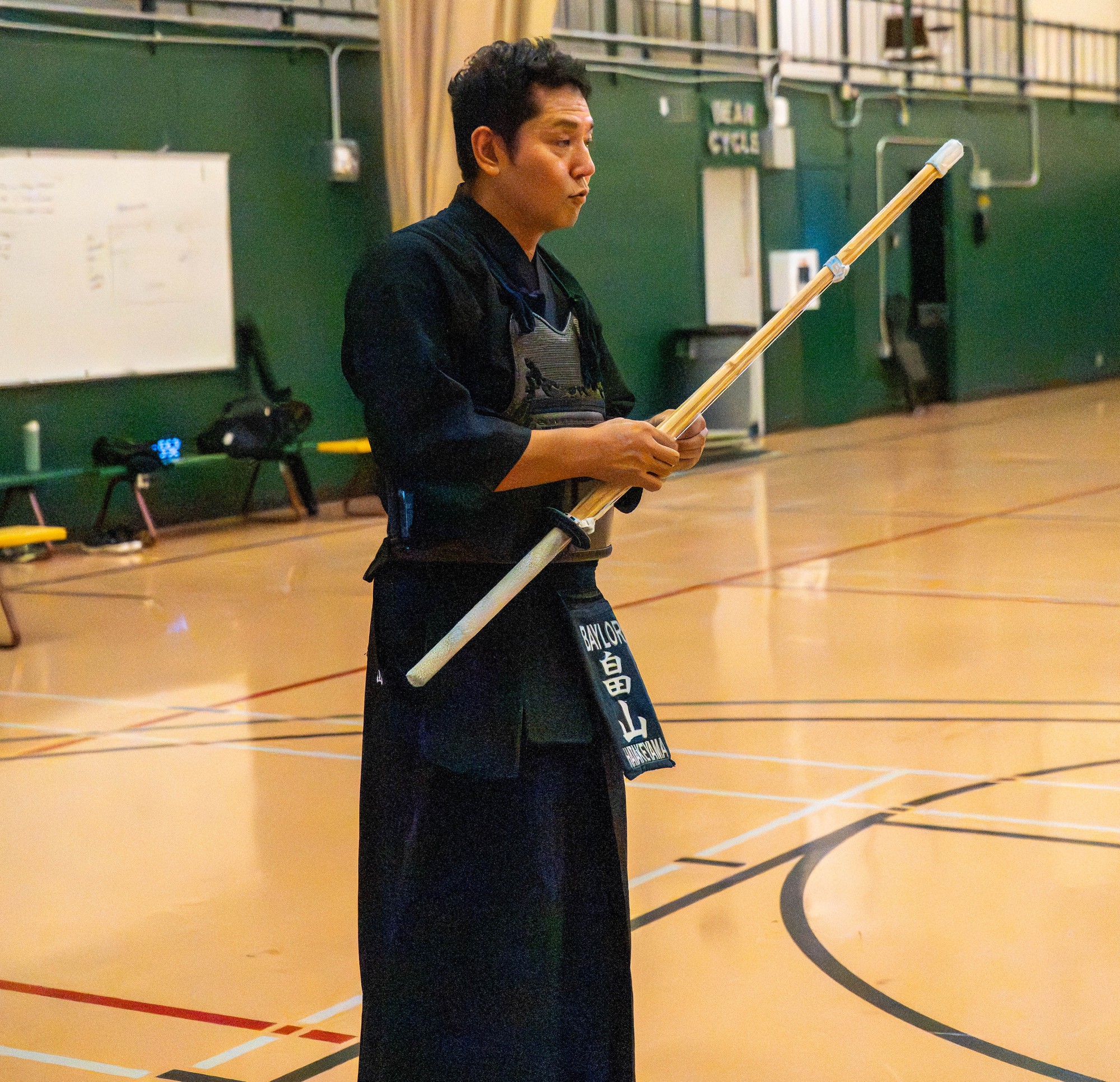
Baylor physics professor Dr. Kenichi Hatakeyama spends his time searching for answers to some of the biggest questions about the universe. Outside the lab, he trades particle detectors for a shinai, the bamboo sword used in the Japanese martial art of kendo.
For Hatakeyama, professor and co-graduate program director in the physics and astronomy department, the two worlds are not as different as they may seem.
Hatakeyama has spent his career studying experimental high-energy physics. His research has taken him from laboratories in the United States to the Compact Muon Solenoid (CMS) experiment at European Council for Nuclear Research’s (CERN) Large Hadron Collider, where he contributed to research surrounding the 2012 discovery of the Higgs boson.
At the same time, Hatakeyama has continued practicing kendo, something he first started as a child in Japan.
His philosophy connecting the two is “文武両道,” or “bunbu ryōdō,” a Japanese concept centered on pursuing both intellectual and martial development.
“’文武両道’ is my motto,” Hatakeyama said. “I enjoy kendo along with academic pursuits in physics, and I encourage students to balance kendo with school obligations.”
That balance has taken years for Hatakeyama to develop.
Growing up in Japan, Hatakeyama said his interest in physics began through science books and journals written for people outside of the field. He remembers reading about particle physics experiments in the United States and Europe and becoming interested in understanding the fundamental parts of the universe.
Eventually, those experiments became his career.
Hatakeyama earned his bachelor’s and master’s degrees in physics from Waseda University in Tokyo before earning his doctorate from Rockefeller University in 2003. He joined Baylor’s faculty in 2009 and helped integrate the university into the CMS experiment at CERN.
That work eventually placed him inside one of the biggest discoveries in modern physics.
In the months leading up to the announcement of the Higgs boson discovery, Hatakeyama remembers researchers working long hours as experiments raced to analyze their results.
“The whole collaboration was really not sleeping at night,” Hatakeyama said. “We were all excited.”
Hatakeyama said his work included jets and missing energy, areas he helped describe for the paper announcing the discovery. The research helped experimentally establish the existence of the Higgs boson, with François Englert and Peter Higgs later receiving the 2013 Nobel Prize in physics for the theoretical mechanism associated with the particle.
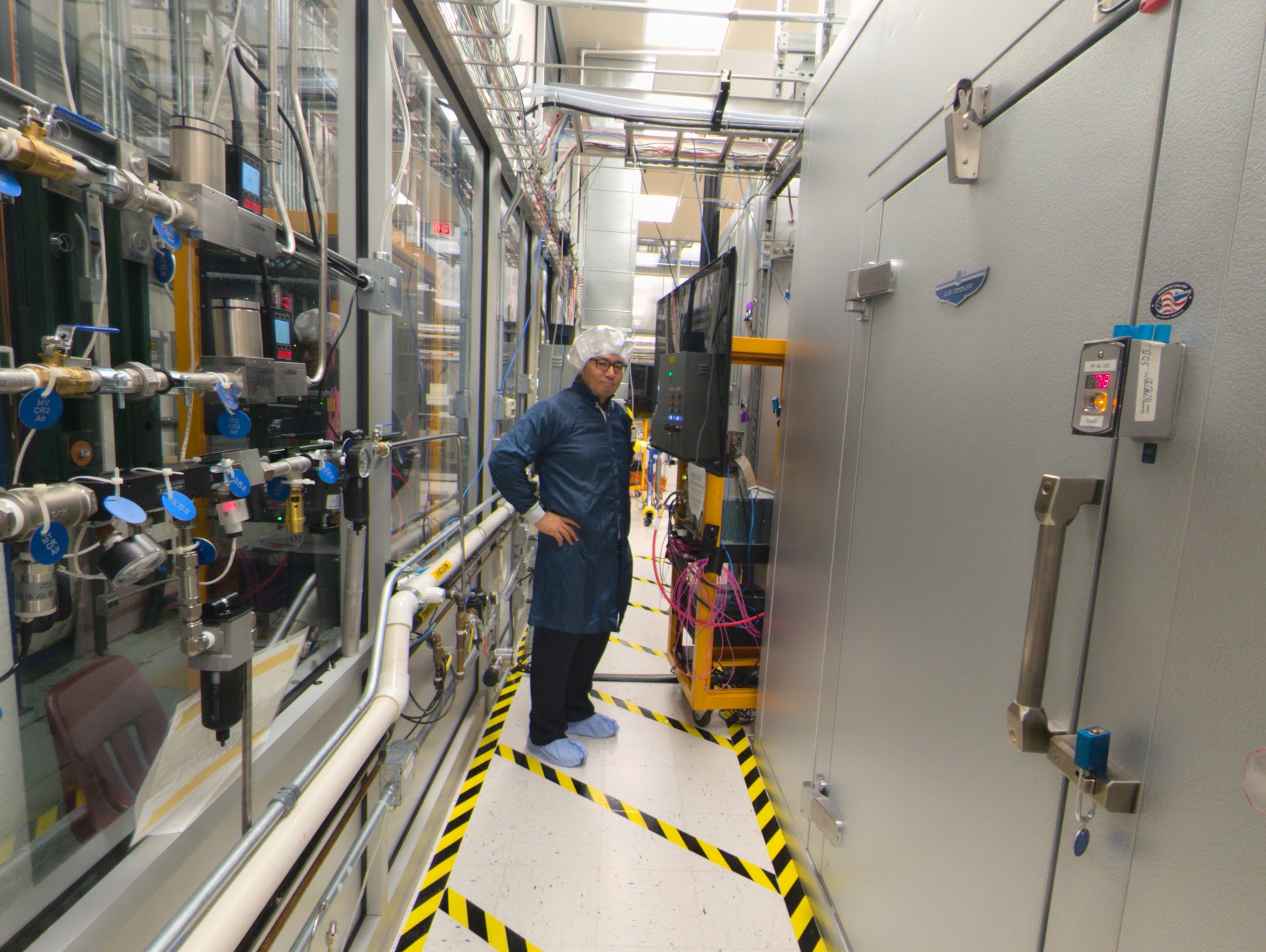
More than a decade later, Hatakeyama is still looking for answers. One of the biggest involves dark matter.
“We know that dark matter exists because that can explain many astronomical observations,” Hatakeyama said. “But we don’t really know what it is made of.”
His work now includes searches for possible dark matter candidates and continued research involving the Higgs boson. In 2025, Hatakeyama and other Baylor physicists were among more than 13,000 CERN researchers recognized with the Breakthrough Prize in Fundamental Physics for research at the Large Hadron Collider.
But Hatakeyama’s impact is also visible through the graduate students working alongside him at Baylor.
Physics doctoral candidate Jonathan Samudio began working with Hatakeyama after meeting with him regularly during his first semester. Those conversations eventually turned into years of research together.
Samudio said Hatakeyama gives students room to take ownership of their work.
“It’s very nice to be able to pick a direction and have that trust,” Samudio said. “You get to a point where it’s like, ‘Hey, I trust you. You know this better than me. Just keep going.’”
Hatakeyama said watching his students reach that point has become one of his favorite parts of teaching.
“At some point, they become technically much more competent than I am,” Hatakeyama said. “Sometimes they even come up with a better idea than I originally had. It’s such a joy to see how students actually grow.”
The lessons Hatakeyama teaches his students are not always about physics.
“One of the main things is that family and health really come first,” Samudio said. “A Ph.D. is demanding. It’s really easy to forget that you need to take care of yourself, and you also need to be there for the people that rely on you.”
Hatakeyama had to learn that balance himself.
He first began kendo around first grade in Japan. He stepped away from the sport during college to try rowing but returned after moving to New York for graduate school. There, he saw other graduate students finding ways to pursue their research while still having lives outside of the lab.
“I initially thought that’s how it has to be,” Hatakeyama said of spending nearly all his time in the laboratory. “It was kind of eye-opening how people actually find a good balance between what you do in the lab and try to be productive, but also try to do something outside.”
He brought that mindset with him to Baylor.
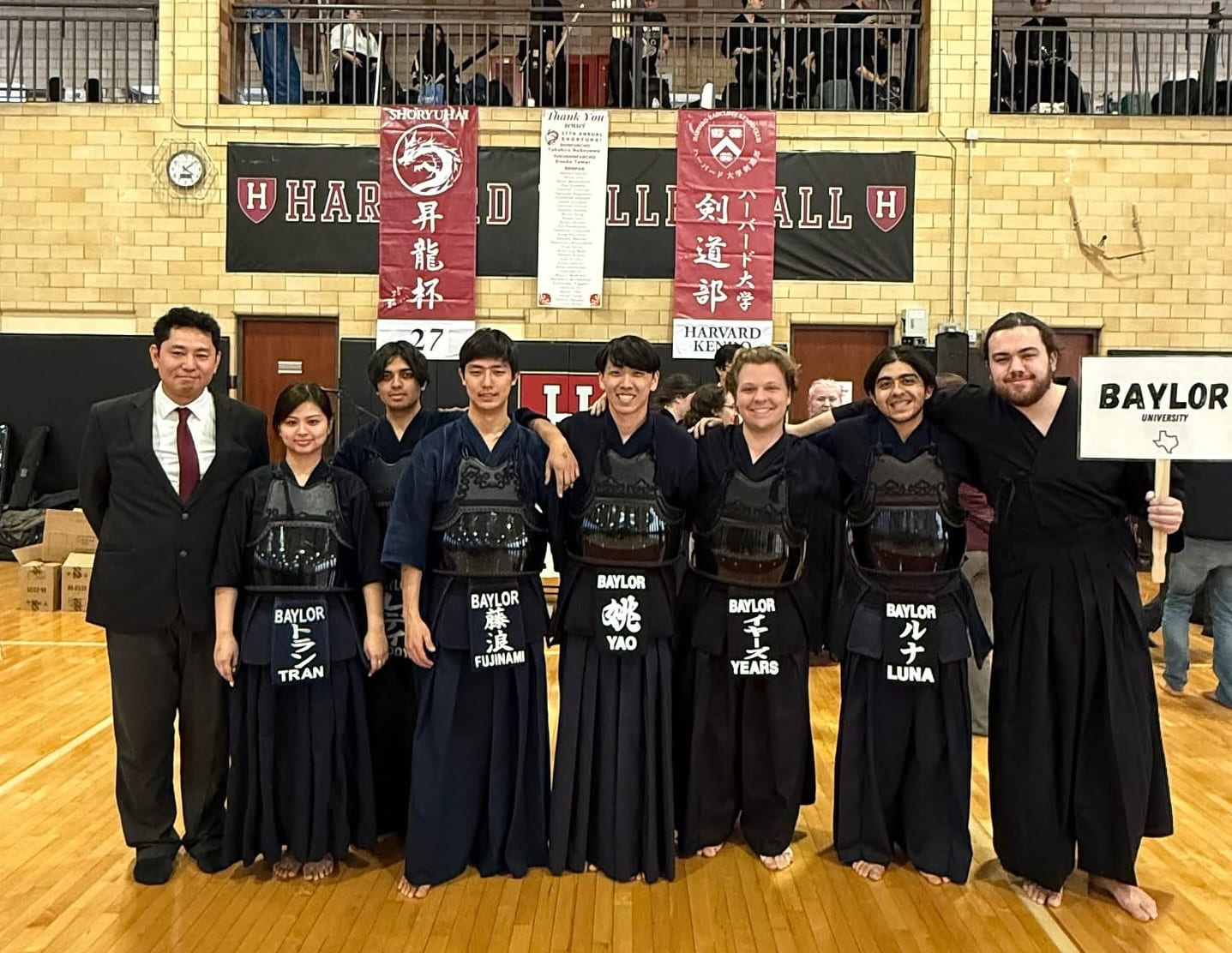
The Baylor Kendo Club began in 2012 and has introduced generations of Baylor students to the martial art. This year, Hatakeyama competed in the All United States Kendo Championships in Las Vegas, returning with medals in individual and team competition.
But the medals were not his favorite part.
“The most memorable part was that I had two Baylor alumni and my daughter on the same Southwest region team, and we could compete together,” Hatakeyama said.
Samudio said that side of Hatakeyama may surprise people who only know him as a physics professor.
“For the amount of effort that he puts in for all of his students, he’s still got a life, still got a family and still somehow makes it all work,” Samudio said.
For Hatakeyama, whether he is searching for dark matter, mentoring a graduate student or practicing kendo, that balance remains at the center of it all.
“I am looking forward to working with more students at Baylor,” Hatakeyama said, “for both physics and kendo.”