By Josh Siatkowski | Lead Writer
Over their nearly 50-year friendship, Baylor film professors Dr. Corey Carbonara and Dr. Michael Korpi have stayed at the cutting edge of media technology. One of their latest projects is no different, developing into a business with nearly $10 million in investor funding, over 140 patents and — if things play out right — a revolution in the way the world sees color.
6P Color, a Waco-based software company, aims to solve a well-documented issue plaguing today’s digital world: displays built with traditional red, green and blue pixels capture less than half of the visible color spectrum.
The project began in 2018 after Gary Mandle, a former Sony engineer and friend of Carbonara and Korpi, reached out to the pair with a new strategy to tackle the longstanding challenge. While previous attempts to improve color displays were squashed by the insurmountable task of overhauling every camera and screen on the planet, Mandle had an idea that could improve color representation on screens, even without replacing the RGB display.
“There are gaps when you have only three colors of red, green and blue, and you’re trying to make all the other colors with those,” Carbonara said. “[Mandle’s] idea was to fill in those gaps, and by having more primaries than red, green and blue, you get to fill it in.”
In the last eight years, 6P has grown into a team of more than a dozen members and partnered with some of Waco’s most prominent investment groups, hoping that someday 6P’s technology will be the gold standard for color.
“Color is really the new frontier,” Carbonara said. “Its time has come, and we’re happy at 6P Color to be able to say that we’ve got a solution for the problem.”
Passing the eye test
Korpi and Carbonara have conducted numerous studies to prove that 6P’s technology isn’t just statistically superior, and their results show that people actually prefer 6P’s outputs, too.
“We actually published a paper in 2023 that talks all about this,” Carbonara said. “And what we did was we showed RGB, and then RGB just with one more primary, cyan, and the results were clear and statistically significant. People preferred the four primaries, the one with cyan, rather than just the RGB.”
The positive response to increased levels of cyan in the image has to do with a protein called melanopsin that the retina releases in the presence of the color. Because it elicits emotion, Carbonara called it “the awe factor.”
“It’s the reason why when we go to the Caribbean, and we look at it, and we just get mesmerized by it,” he said.
Another example of the technology’s success can be found in images of another view of the ocean: 200 miles above the Earth on the ISS.
“One of the best anecdotes we have is the astronauts who’ve been on the ISS,” Korpi said. “They take pictures and video the whole time they’re up there, and then every time when they come back, and they look at the pictures and the video, they’re like, ‘That’s not what it looked like. It looks way better than that. Why can’t we see it in the pictures and the video?’ We showed them our system, a video from the ISS, and they were like, ‘That’s it.’”
Partners in innovation
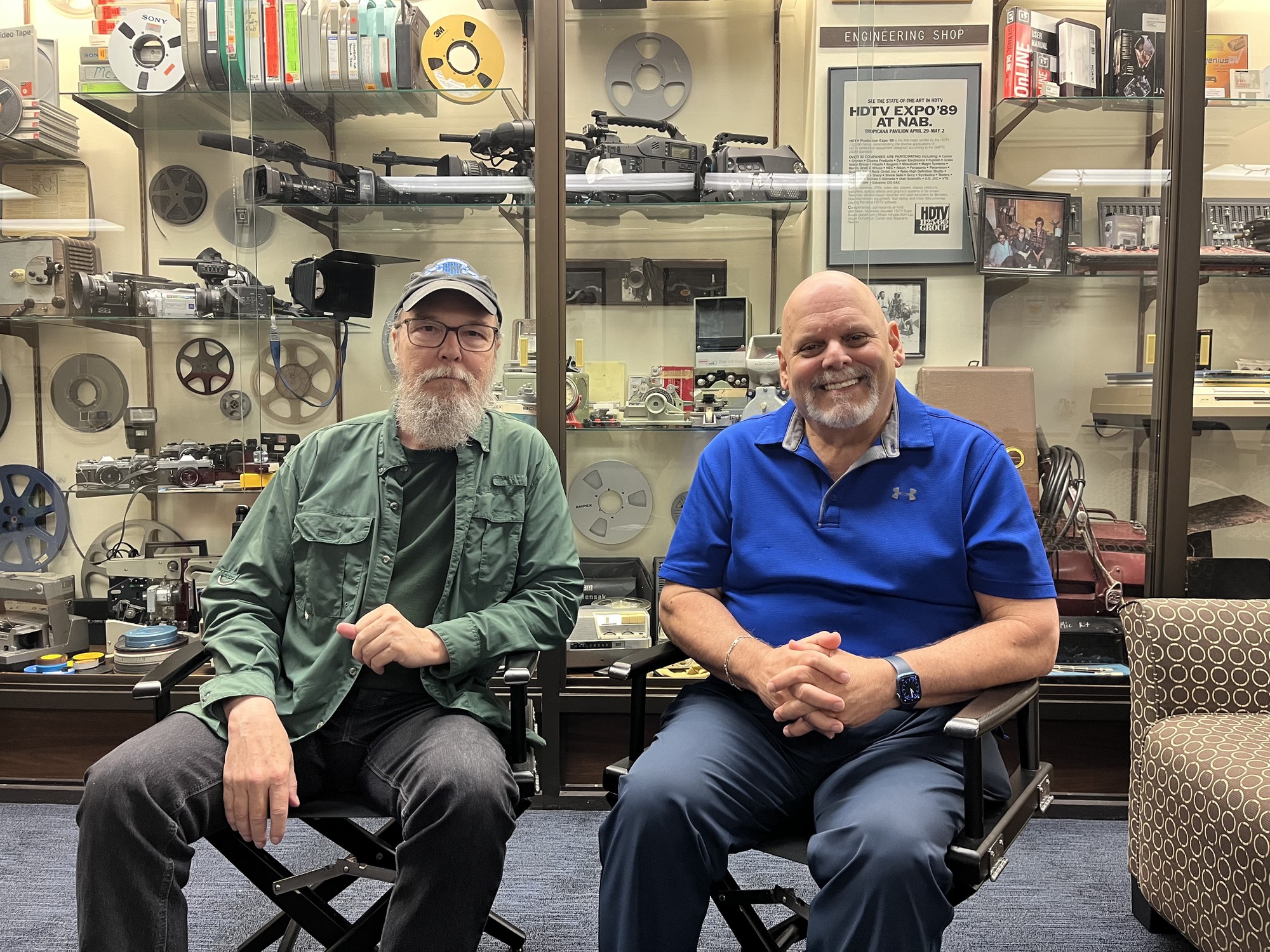
Korpi and Carbonara met in 1978 while they were Ph.D. students at the University of Iowa. In addition to bonding over their faith — something Korpi said was “very rare” in Iowa’s film department — the two shared a passion for the newest technology in the film industry.
“We were also interested in the filmmaking process and the equipment, the new cutting-edge things,” Korpi said.
For Carbonara, who graduated from Iowa’s famous Writers’ Workshop, that interest in innovation continued into his professional career. In the 1980s, he was Sony’s product manager for a technology that would quickly catch on: high-definition TV.
“Nobody had HD at the time, and therefore we were relevant because we had opportunities to really work and experiment with it early on,” Carbonara said.
While Carbonara was with Sony, Korpi came to Baylor. Once Korpi became department chair, however, he recruited his friend to help establish Baylor in an industry dominated by the West Coast.
“Waco, Texas, is not necessarily Chicago, New York or Los Angeles, so how could we compete when we don’t have the same opportunities that students have there,” Carbonara said. “And right away, Dr. Korpi had the notion, ‘Why don’t we get involved in new technologies?’”
That mindset helped cultivate partnerships with companies like Sony, which often let Baylor students use their newest equipment, even before other schools. According to Carbonara, Baylor was the first university to have HDTV technology in its curriculum. And shortly after, Baylor became one of the first places to explore digital nonlinear video editing.
Over three decades later, the pair’s innovative thinking was what brought Mandle, a San Jose resident, all the way back to Waco for the 6P Color project.
“He could have just walked over to Stanford and had somebody do it,” Korpi said. “But no, he remembered us because of the HDTV history and us knowing him for 36 years. We would bring him in to speak to classes and show new Sony equipment.”
Old problem, new solution
The problem Mandle and the Baylor Team sought to tackle — limited color representation due to RGB displays — has been understood for quite a while. In fact, it’s even been partially solved.
Korpi said that numerous demos of new displays have been presented at conferences over the years. Displays built using six or 12 primaries rather than just RGB captured 80%, 90% or even 99% of the visible color spectrum.
The only issue: those displays never made it out of the conferences.
“They always stopped after just showing the demo because … everybody assumed that would mean you needed a whole new standard for displays,” Korpi said. “You needed all the equipment to be changed. You needed new cameras for everything.”
That’s where 6P Color has differentiated itself, the pair said. Rather than require a complete refresh of the color system across all technologies, from cameras to computer screens, 6P’s technology is backward compatible.
The issue with previous attempts to capture more color is that computers and cameras would have to store color as a six-dimensional variable — something incompatible with the trivariate RGB. 6P instead re-maps the color onto a different three-dimensional system that computers can understand, even with old displays.
“I think the elegance of this is we made color a data point,” Carbonara said. “That was the first time that anybody had thought of doing that.”
While the color is superior on a six-primary display, the technology works anywhere, meaning it can be installed without worrying about losing functionality.
“It’s compatible all the way through. It’ll look good on the back of an airplane seat,” Korpi said.
From experiment to enterprise
Not all academic endeavors become businesses, but 6P Color has had adoption in mind from the start. Unlike traditional academic research, which has a 20-plus-year time horizon, Korpi and Carbonara have focused on projects just a few years from commercialization, something Carbonara called “developmental research.”
“Developmental research is really fostering a more entrepreneurial take on where the business opportunity is,” Carbonara said.
According to private markets database PitchBook, 6P has raised $9 million from investors, including Waco-based firms like WAVE Ventures, Brazos Innovation Partners and the university’s Baylor Angel Network. Unlike traditional research grants, 6P’s investors hope to see their money back through business growth and a future sale to a larger company.
To see that money come back, 6P needs to find someone to pay for the product. Thankfully, their applications are broad. Gaming monitors and movie screens are a few possible markets, but it also has applications in essential industries.
“That’s what really warms our heart, knowing that this could be used for a better remote telemedicine experience when you really need to make accurate color decisions,” Carbonara said.
With the investment, 6P has hired a team of technical, operational and financial leaders to run the day-to-day. Carbonara and Korpi are both listed as academic collaborators, and Carbonara remains on the board of directors, but they are also maintaining their faculty positions and stepping into research with AI and film production.
Currently, 6P hasn’t confirmed any commercialization agreements, but the pair said there has been interest.
“Everybody you would think of knows about it,” Korpi said.