By Reagan Hunter | Reporter
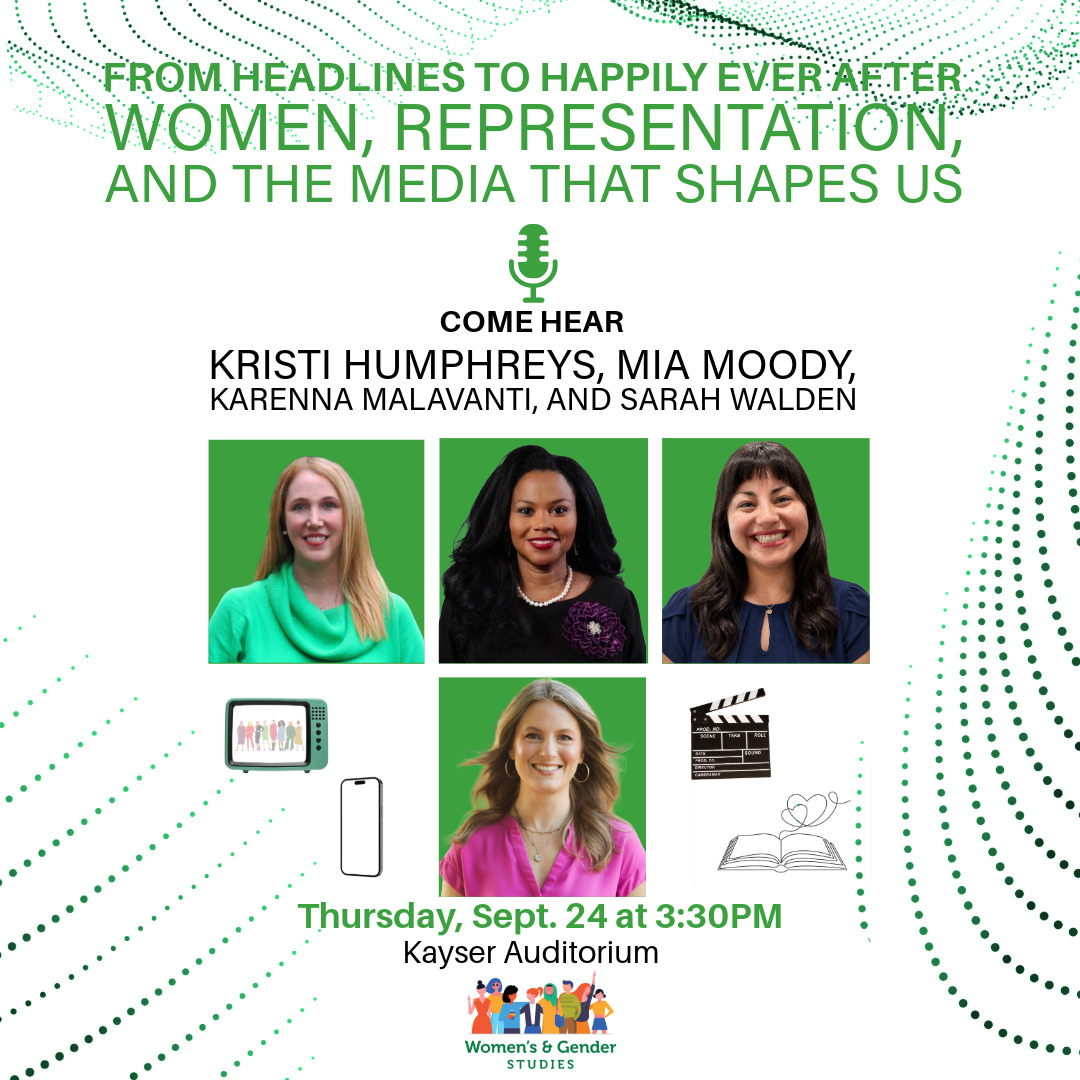
The stories women read, watch and scroll through will take center stage 3:30-4:30 p.m. in Kayser Auditorium Thursday during “From Headlines to Happily Ever After: Women, Representation, and the Media that Shapes Us,” an interdisciplinary panel sponsored by Baylor’s Women’s and Gender Studies program.
The panel will feature Dr. Kristi Humphreys, Dr. Mia Moody, Dr. Karenna Malavanti and Dr. Sarah Walden and will be followed by a discussion.
Each professor will approach women in media from a different direction. Moody will discuss journalism, Humphreys will examine television, Malavanti will explore women in horror and Walden will focus on romance.
Despite those differences, the panelists are asking a similar question: What are the stories women consume actually doing to them?
Walden, director of the Baylor Interdisciplinary Core and associate professor of rhetorical theory and criticism, said the panel’s title reflects its range. It begins with Moody’s discussion of journalism and headlines and ends with Walden’s examination of romance and its familiar “happily ever after.”
“How we’re shaped by those stories is what I think is going to be really interesting on the panel,” Walden said.
Walden plans to challenge assumptions surrounding romance, particularly the idea that the genre is less serious than other forms of literature.
Walden said the predictability of romance novels can lead people to assume the books require less intellectual engagement. She thinks they are asking the wrong questions.
“I think that romance is doing some really interesting emotional work,” Walden said. “It’s doing some interesting psychological work for people who read it.”
Walden said comparing romance to classical or literary fiction can miss the point because the genres are trying to accomplish different things.
“The formula of the happily ever after makes it safe to explore really difficult topics that otherwise could be very traumatizing in a different genre,” Walden said.
For Walden, the way romance is judged also raises questions about whose stories society considers valuable.
“Genres written by women for women tend to be dismissed more than genres that are attractive to men,” Walden said. “There’s just some simple misogyny in there too.”
Social media, however, is changing the way romance readers find each other and talk about what they love.
“I think it has made more people willing to talk about the books they like,” Walden said. “They’re not hiding the covers, but they’re actually having real conversations about some of the difficult topics that romance novels cover.”
Still, the same platforms that create community can shape users in ways they may not immediately notice.
“We are constantly being shaped by the media that we consume and that we’re surrounded by,” Walden said.
Humphreys, a senior lecturer whose research includes gender and media studies, will bring that question to the television screen.
Her presentation examines the recurring “evil twin” trope and what those characters reveal about society’s changing expectations of women. After years of studying those characters, Humphreys said one question remained.
“Why is it always women?” Humphreys said.
For Humphreys, examining those patterns matters because entertainment can influence viewers even when they do not realize it.
“A lot of college students don’t understand the extent to which they are being programmed by what they consume,” Humphreys said. “That doesn’t have to be a negative thing.”
Humphreys said media can shape “our experiences, shapes who we are, how we see ourselves, how we see others.”
She has also watched portrayals of women evolve. Humphreys said strength has become increasingly visible in female characters, whether that strength is physical, emotional or intellectual.
One character stands out in particular: Jessica Fletcher, Angela Lansbury’s mystery writer and amateur detective in “Murder, She Wrote.”
“There was nothing she couldn’t do,” Humphreys said. “All of the things that were normally given to male characters, you know, the intelligence, the logic, the reasoning. She was a rock star in all of those areas.”
For Humphreys, the panel is not about giving students a list of media they should or should not consume. Instead, she wants them to leave asking more questions than when they arrived.
“The whole goal of it is not to tell people what to think, but just to show them an example of people questioning,” Humphreys said. “Why do we see these trends? Why do we see these representations? Why do we see these habits?”
Walden wants audiences to bring that same curiosity to media they might normally dismiss as simple entertainment. She said seemingly fun genres can remain enjoyable while still having an effect on the people consuming them.
Her own relationship with romance is an example. Walden said she begins some mornings with coffee and about 20 minutes of reading because it offers a calm start before the stress of the day.
“I think without realizing it, it kind of causes us to devalue happiness and almost not trust it,” Walden said of some of the more difficult books people read. “And I think romance brings that joy back.”
Whether it comes through a headline, a television character, a TikTok algorithm or a happily ever after, both professors want audiences to consider what happens after a story ends.
“It’s okay to question everything,” Humphreys said. “It’s okay to question what you see, what you experience.”