

Close Menu
The Baylor Lariat
    Facebook X (Twitter) Instagram YouTube LinkedIn
    Trending
    • Taking off the rose-colored glasses
    • Did we forget concerts are a luxury?
    • Let go; it’ll be OK
    • Music school dean replaced following vote of no confidence, Title IX allegations
    • Student organization ‘Healing Harmonies’ hopes to serve, heal community through power of music
    • ‘Created to Create’: VirtuOSO wins semifinal competition
    • Baylor baseball powers up in 16-7 win over Incarnate Word
    • Baylor track turns the page to outdoor season with early momentum
    • About us
      • Spring 2026 Staff Page
      • Copyright Information
    • Contact
      • Contact Information
      • Letters to the Editor
      • Subscribe to The Morning Buzz
      • Department of Student Media
    • Employment
    • PDF Archives
    • RSS Feeds
    Facebook X (Twitter) Instagram YouTube LinkedIn
    The Baylor LariatThe Baylor Lariat
    Subscribe to the Morning Buzz
    Wednesday, March 25
    • News
      • State and National News
        • State
        • National
      • Politics
        • 2025 Inauguration Page
        • Election Page
      • Homecoming 2025
      • Baylor News
      • Waco Updates
      • Campus and Waco Crime
    • Arts & Life
      • Wedding Edition 2025
      • What to Do in Waco
      • Campus Culture
      • Indy and Belle
      • Leisure and Travel
        • Leisure
        • Travel
          • Baylor in Ireland
      • Student Spotlight
      • Local Scene
        • Small Businesses
        • Social Media
      • Arts and Entertainment
        • Art
        • Fashion
        • Food
        • Literature
        • Music
        • Film and Television
    • Opinion
      • Editorials
      • Points of View
      • Lariat Letters
    • Sports
      • Football
      • Basketball
        • March Madness 2026
        • Men’s Basketball
        • Women’s Basketball
      • Soccer
      • Baseball
      • Softball
      • Volleyball
      • Equestrian
      • Cross Country and Track & Field
      • Acrobatics & Tumbling
      • Tennis
      • Golf
      • Pro Sports
      • Sports Takes
      • Club Sports
    • Lariat TV News
    • Multimedia
      • Video Features
      • Podcasts
        • Don’t Feed the Bears
        • Bear Newscessities
      • Slideshows
    • Sing 2026
    • Lariat 125
    • Advertising
    The Baylor Lariat
    Home»News»Baylor News

    On the ground in Ukraine: How local choices shaped the war

    Joana KaroshiBy Joana KaroshiMarch 24, 2026 Baylor News No Comments3 Mins Read
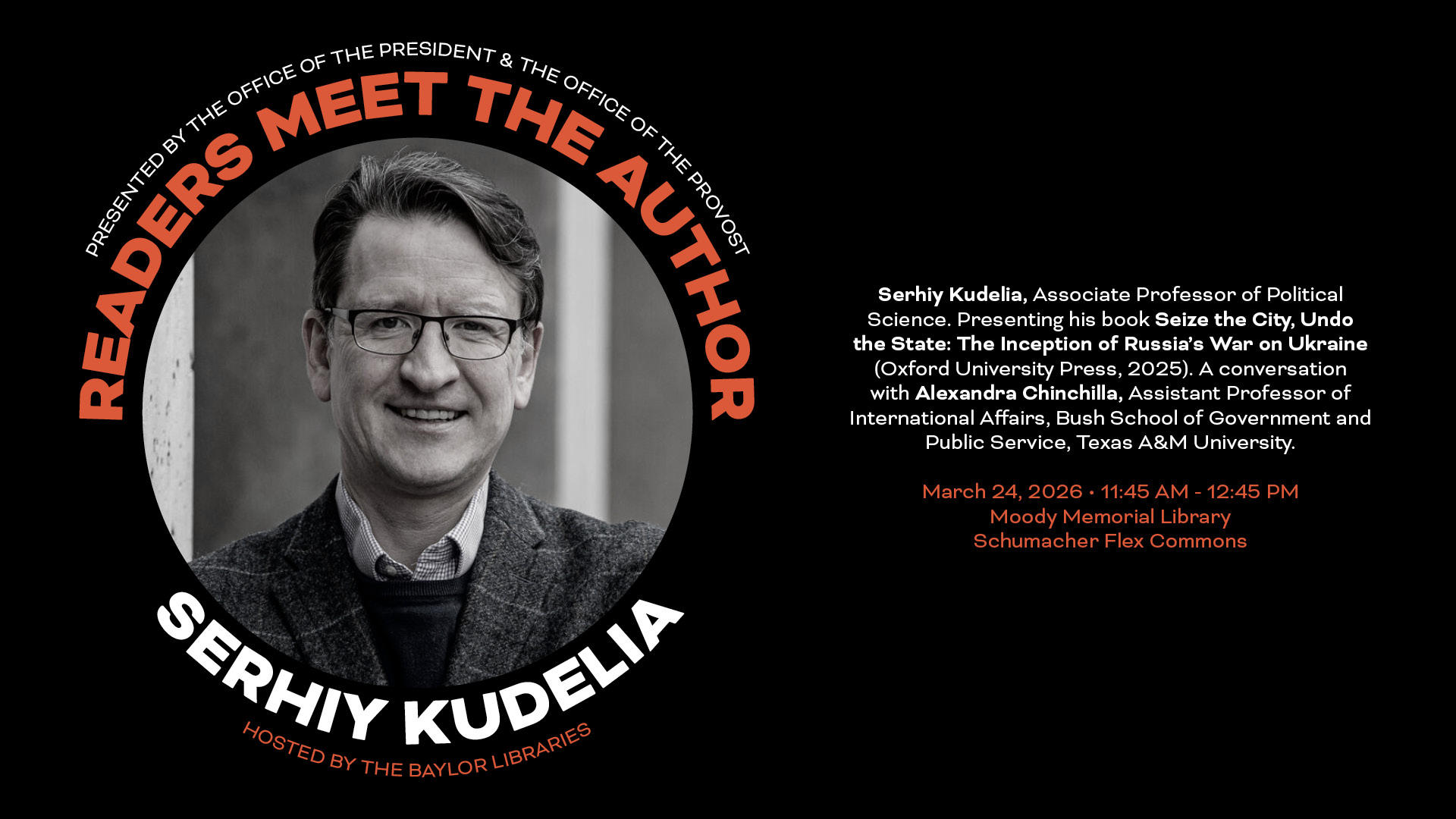
    The Office of the Provost hosted Serhiy Kudelia at Readers Meet the Authors on Tuesday morning to discuss his text, "Seize the City, Undo the State." Photo courtesy of Office of the Provost
    Share
    Facebook Twitter LinkedIn Pinterest Email

    By Joana Karoshi | Staff Writer

    A Baylor professor argued that Russia’s war in Ukraine cannot be fully understood without examining the decisions of ordinary people on the ground, challenging common narratives that frame the conflict solely as a clash between global powers.

    The discussion, part of the Office of the Provost’s Readers Meet the Author series, featured Professor of Political Science Sergiy Kudelia and co-author Alexandra Chinchilla, who discussed their book on the origins of the war in Ukraine, particularly the 2014 conflict in the Donbas region.

    Chinchilla described the book as an effort to explain “how we get to the war in Ukraine today,” emphasizing that the roots of the current conflict extend back more than a decade. Kudelia’s research draws on interviews conducted in Eastern Ukraine, offering a ground-level view of how the war began.

    Rather than focusing only on decisions made by leaders in Moscow or Washington, Kudelia said his work centers on local communities and the choices individuals made as violence unfolded.

    “A lot of [research] has been done at a macro level,” Kudelia said. “But nobody was actually asking people on the ground why they made the choices they made.”

    According to Kudelia, the outbreak of conflict in 2014 cannot be explained by a single cause. Instead, it resulted from a combination of Russian involvement and local participation.

    “You need both paths,” Kudelia said, referring to external influence and internal decision-making. “Russia’s involvement is essential … but you also have local actors making certain choices.”

    Kudelia explained that in some areas of Eastern Ukraine, small groups organized themselves into local defense units before large-scale armed intervention began. In other towns, however, similar movements never formed until outside actors arrived and escalated the conflict.

    He also described how quickly conditions shifted in affected communities, forcing local leaders to make high-stakes decisions under pressure.

    “If someone knocks on your door with a couple of machine guns … what would you say?” Kudelia said.

    A key theme of the discussion was the role of misconceptions about the war. Kudelia pushed back against the idea that Eastern Ukraine was uniformly pro-Russian, noting that some communities actively resisted separatist movements.

    He also highlighted a lesser-known statistic: prior to 2014, many Ukrainians did not view Russia as a threat.

    “In 2014, the majority of Ukrainians would say Russia is a friendly state,” Kudelia said.

    For students in attendance, that detail stood out.

    San Diego junior Grace Youngkin said she was surprised by how Ukrainians historically perceived Russia.

    “I was really surprised about him saying that 70% of Ukrainians didn’t see Russia as a threat prior to the invasion,” Youngkin said. “They blamed communism … as opposed to Russia.”

    Denham Springs, La., junior McKenna Croft said the talk challenged her assumptions about the relationship between the two countries.

    “I thought it was really surprising that so many Ukrainians still viewed Russia in a friendly manner,” Croft said. “I had not previously thought about that.”

    Both students said they attended the event in part because of their experience taking classes with Kudelia, citing his expertise and perspective as a scholar with personal ties to Ukraine.

    Throughout the discussion, Kudelia emphasized that understanding the war requires moving beyond simplified narratives and recognizing the complexity of local experiences.

    By focusing on individual choices and community dynamics, Kudelia said his book aims to provide a more complete explanation of how the conflict began — and why it continues to shape global politics today.


    international conflicts International politics Lecture Office of the Provost Readers Meet the Author Russia russia and ukraine conflict Ukraine War
    Joana Karoshi

    Keep Reading

    Music school dean replaced following vote of no confidence, Title IX allegations

    Administration cites internal, external pressures for recent budget decision

    Phi Beta Sigma, Her Campus redefines love with ‘The Art of Loving’

    Baylor celebrates Women’s History Month, female faculty at annual breakfast

    Ignore conflict clickbait: What you need to know about Iran, military drafts

    SAVE America Act may complicate Election Day voting

    Add A Comment

    Comments are closed.

    Recent Posts
    • Taking off the rose-colored glasses March 24, 2026
    • Did we forget concerts are a luxury? March 24, 2026
    About

    The award-winning student newspaper of Baylor University since 1900.

    Articles, photos, and other works by staff of The Baylor Lariat are Copyright © Baylor® University. All rights reserved.

    Subscribe to the Morning Buzz

    Get the latest Lariat News by just Clicking Subscribe!

    Follow the Live Coverage
    Tweets by @bulariat

    Facebook X (Twitter) Instagram YouTube LinkedIn
    • Featured
    • News
    • Sports
    • Opinion
    • Arts and Life
    © 2026 ThemeSphere. Designed by ThemeSphere.

    Type above and press Enter to search. Press Esc to cancel.