By Giselle Lee | Staff Writer
In Spain, not only do the legacies of slavery and colonialism remain unacknowledged, but a disappearance in cultural memory is also impacting Spain’s modern society. But during Unspoken Histories, a contrasting reality was presented to audience members.
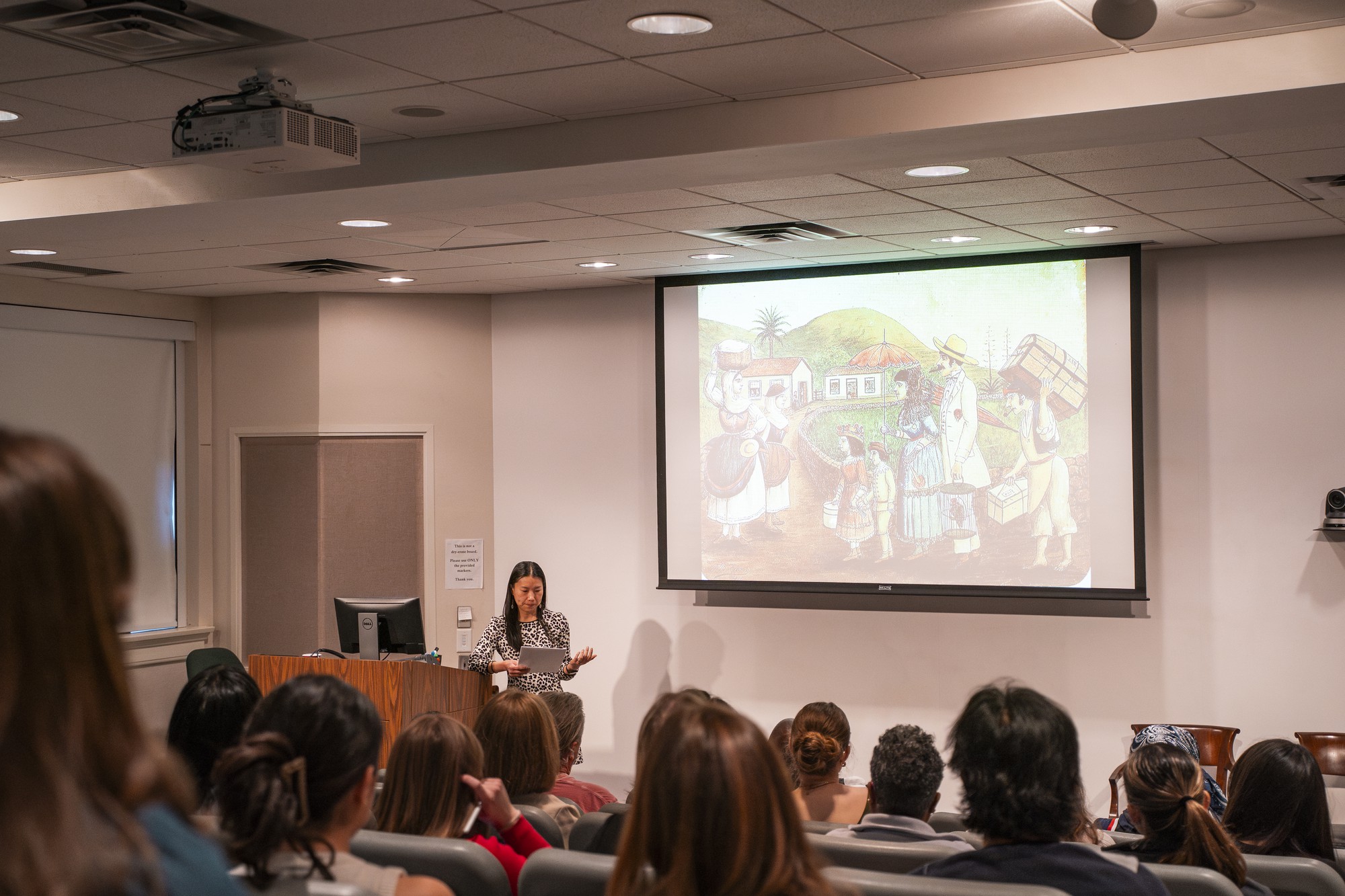
Held from 1 to 2:30 p.m. on Friday in Armstrong Browning Library, Unspoken Histories featured Akiko Tsuchiya, professor emerita of Spanish at Washington University in St. Louis; Aurélie Vialette, associate professor of Spanish at Yale University; and Wan Sonya Tang, associate professor of Hispanic studies at Boston College.
Tang focused on the literary side of Spanish history as outlined in her book “Specters, Monsters, and the Damned: Fantastic Threats to the Social Order in Nineteenth-Century Spanish Fiction.” Tang presented an analysis of short, fantastical stories that perpetuated social prejudices from Spain’s past.
“My mother used to read to me Chinese ghost stories when I was a child; I remember thinking that those ghosts were so different than what I saw in American media,” Tang said. “That’s what got me interested in the way different cultures specifically fear different groups of people or different elements of social change.”
Tang said narrators presented only one version of events, often from the perspective of the most privileged sector of society. In her narrative, Tang hoped to uncover the stories that readers of Spanish fantastical works have left untold.
“[The narrators are] men, from middle or upper middle class,” Tang said. “They are ethnically Spanish. They’re white. How can we read these stories and excavate the experiences of individuals that don’t represent the dominant sector of society?”
Tang urged students to “read between the lines” and to consider the author’s perspectives to avoid narrow-minded conclusions, a skill that can be applied to modern socio-political situations.
“[Students] can criticize the voice that’s speaking,” Tang said. “Today, in a time of fake news, how can you critically evaluate your source? Is it a reliable or unreliable narrator? It’s the same skills we use for literature.”
Tsuchiya and Vialette co-edited “Cultural Legacies of Slavery in Modern Spain,” a book of collected essays and interviews that expose the truth behind Spain’s history, as well as how it affects people today.
“[Spain] has been very slow recognizing the legacies of slavery and colonialism, and there’s been quite a fair amount of denial about these legacies,” Vialette said. “This book talks about a past that has been erased from public discourse. It’s an ugly past.”
Vialette explained the lack of discussion of Barcelona’s architectural history, in which the fortune that supported the great Spanish architect Antoni Gaudí’s buildings was made from slavery in Cuba. However, in present day, the origins of the patrons are rarely explored.
Tsuchiya said their book is aimed at combating “cultural amnesia” about Spain’s ugly colonial past and to generate greater public awareness of these issues in the audience’s everyday lives.
“[It’s] really important to not see colonialism as just something of the past,” Tsuchiya said. “We want to see how the legacies of colonialism and slavery continue to have an impact on the present, not just politically, economically and socially, but also culturally.”
Tang, Vialette and Tsuchiya all agreed that for these legacies to remain impactful, everyone must learn “the truth of history.” As a professor, Tsuchiya said teaching is an important way to help students learn to openly interpret uncomfortable aspects of human legacies, especially when historical facts are erased.
“First of all, you have knowledge of what happened in the past, and secondly, somehow grappling with it, confronting it, recognizing, acknowledging it and its continuing impact on present society,” Tsuchiya said. “I think one of the things we have to do is bring these things out to the public.”
Vialette said Baylor students can also learn about history through areas such as the Memorial to Enslaved Persons, but urged students to slow down and reflect on the reparations surrounding slavery in the public space, which Vialette said could “transform the way in which students experience history.”
Tang noted that students may feel overwhelmed with the abundance of events happening across Baylor’s campus. She suggested a quality-over-quantity method in exploring topics that interest them and may benefit their critical thinking.
“I think making a conscientious effort to attend, [not] every day or even every week, but maybe once a semester if you can attend or hear a speaker or be part of a seminar where the opportunities are out there,” Tang said. “[Be] really mindful about picking one thing and trying to attend.”