By Elliott Nace | Assistant News Editor
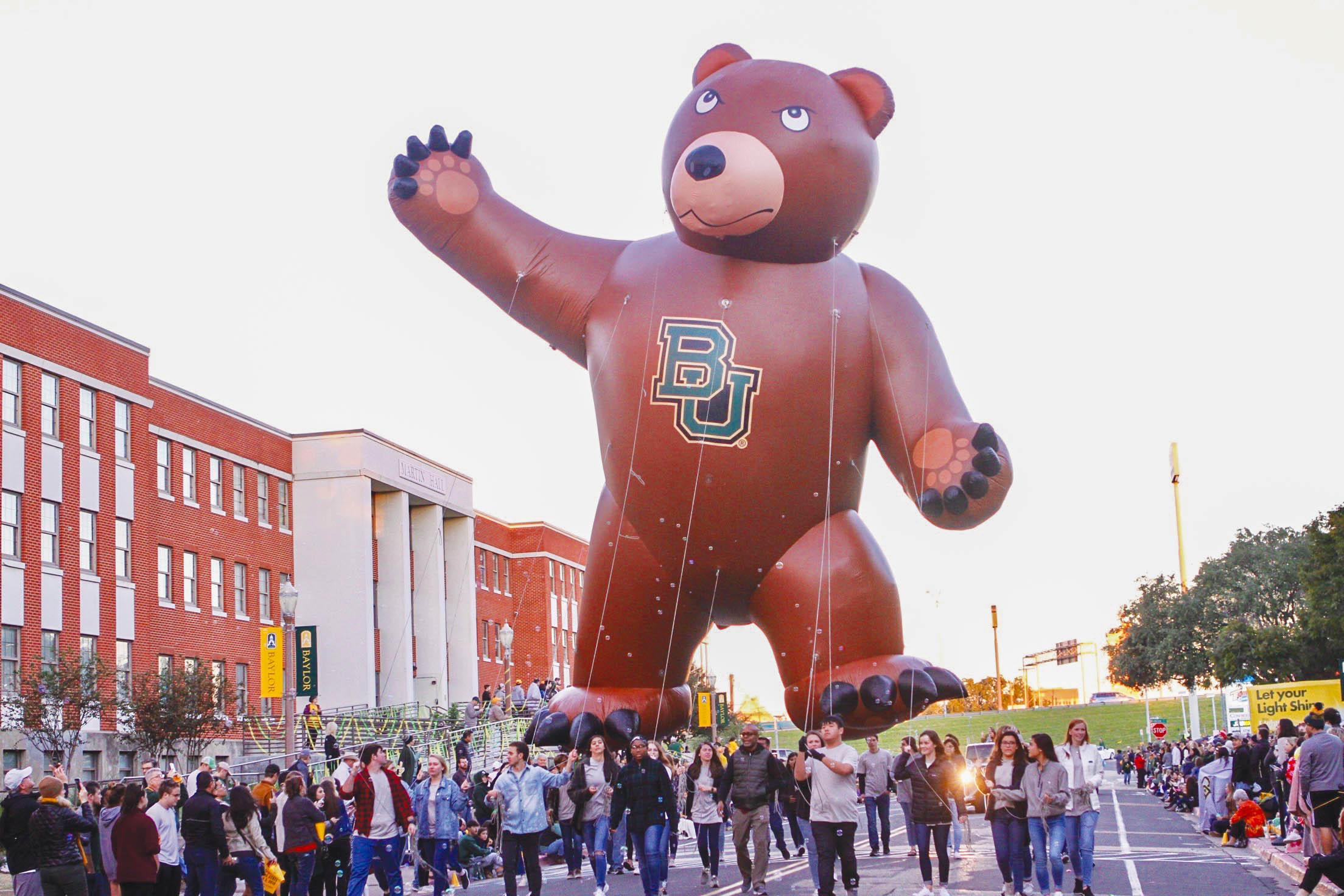
One hundred seventeen years after its inception, Baylor Homecoming remains one of the university’s best-known traditions. Thousands of Bears flock back to campus each year for a lighthearted, generations-spanning reunion.
This has not always been the case, however. From its spotty fledgling years to its ties to tragedy and the two world wars, the classic tradition Baylor shared with the nation began as a chance for students and alumni to combat the hardships of their day.
“I tell people all the time that the birth of the Baylor family was at that first homecoming in 1909,” said Dr. Alan Lefever, director of the Texas Baptist Historical Collection and an adjunct professor of church history.
By 1909, former Baylor President Samuel Palmer Brooks had noticed the university now had two cohorts of alumni: one from the old Independence campus, which operated from its chartering in 1846 until 1886, and the other from the present-day Waco campus. Brooks’ idea of a “home-coming” intended “to call the Baylor family together,” Lefever said.
The inaugural homecoming, held Nov. 24-25, 1909, saw Baylor transport alumni from the Dallas-Fort Worth metroplex via train and amass a cavalcade of over 100 vehicles for the parade. George Washington Truett, a Baylor alum and the contemporary pastor of the First Baptist Church in Dallas, traveled southwest to speak on campus that weekend.
Despite the scale of the festivities, Lefever explained how Baylor funded the entire event out of pocket, and how the cost contributed to homecoming’s hiatus between 1910 and 1914.
“It was so expensive that we couldn’t do it like we did the first time again,” Lefever said.
The latter half of the 1910s, in large part due to the beginning of U.S. involvement in World War I in April 1917, saw Baylor students taken far away from home in service to their country.
Yet Baylor pride continued through campus traditions that remain in place today. After being deployed, a soldier entrusted the university with a bear he owned, named Ted, in fall 1917. Ted, also known as “Bruin,” became Baylor’s first live mascot.
Hardship struck Baylor again Jan. 22, 1927, as the Immortal Ten, a group of 10 basketball players on the road to a game against the University of Texas at Austin, were killed in an automobile collision.
Baylor had only 1,300 students in 1927, which further underscores the scale of the tragedy. The annual Mass Meeting, first held in 1928, commemorates the Ten and their memory by lighting the Eternal Flame torch each homecoming.
“That was the first major athletic tragedy on any campus in America,” Lefever said. “No one had dealt with anything of that magnitude before. Because Baylor was small, chances are you knew one of the Ten if you went to Baylor.”
The loss of the Ten and alumni during World War I motivated the university community to strengthen its spirit further. Homecoming, which was held sporadically and called “Good Will Week,” adopted its modern name and status as an annual event in 1934.
Baylor held annual homecomings until 1943, when World War II deployments increased to the point that the university canceled the event until 1946.
“Celebrating something at a time when our country was at war seemed a little odd to some people,” Lefever said. “You read those lampposts around campus, you look at those names — we lost people that people knew.”
Although hostilities in the Pacific ended in September 1945, Baylor faculty and former President Pat Neff unanimously voted to postpone the event one more year because of the continued displacement of Baylor students come October.
“Neither President Neff nor the faculty members felt that it would be appropriate to name any day this year or any game this year ‘home-coming’ due to the fact that so many Baylor men are still overseas,” according to a brief notice from the Oct. 5, 1945 edition of The Lariat.
Seattle freshman Alma Martinez said she couldn’t picture Baylor culture without its many traditions such as homecoming.
“I had heard about [homecoming] before I even came here, so I feel like without it … Baylor would have some other stuff that we would be able to get involved in that’s just as big,” Martinez said.
Homecoming resumed in 1946 after its second major hiatus, with the 1946 event being the largest in Baylor’s history at the time. While exact attendance numbers for the whole weekend are unknown, the front-page story of The Lariat’s Oct. 29, 1946 edition reported that 19,000 people attended the football bout between the Bears and the Texas A&M Aggies.
“The homecoming of ‘46 is cathartic because the great tragedy [was] over,” Lefever said. “[That] we’ll remember those that were lost, but celebrate a bright future, is why we were so exuberant to have that homecoming in ‘46 as the biggest ever.”
Lefever said that Baylor’s pervasive identity comes from its handing down of history and tradition from past generations to the present.
“That’s [why] homecoming is almost a living, breathing organization,” Lefever said. “Because without it, in fact, I would dare say, if Baylor didn’t have a homecoming, if we hadn’t done it, the very identity and DNA of this school would not be the same.”
Homecoming and Baylor football have also become integral to Waco commerce. When the University of Oklahoma and the University of Texas at Austin announced their departure from the Big 12 Athletic Conference in 2021, Lefever said concerns about the conference’s possible dissolution led local businesses to lobby for Baylor to stay.
“I would say [leaving the Big 12] probably would affect how many people come in on every weekend — except one,” Lefever said. “That would be homecoming because it doesn’t matter. We could be playing six-man football, and it wouldn’t matter to Baylor people on that one weekend. Everybody would be here.”
Martinez, who has cousins who have attended Baylor, said the value of Baylor Homecoming comes not only from the football, but also from being able to “celebrate our school as a whole.”
The type of student who goes to Baylor, she continued, influenced her final decision to enroll.
“I wanted to surround myself with people who were similar to me,” Martinez said. “I feel like Baylor’s culture is pretty significant in the sense of having big social events, and it’s just a happy campus in general.”
When Truett came to campus for the 1909 Baylor Homecoming, Lefever said he tweaked a familiar adage for his speech, saying that “where there is one Baylor person, there is Baylor.”
“For a large majority of the people that come to our university, their lives are changed, and they go on to change the world in whatever they do,” Lefever said. “Homecoming is a reminder of that for me, because I see so many of those people coming back and sharing their stories of how Baylor prepared them for what they’re doing now.”