By Arden Berry | Arts & Life Editor
Academic reading and popular stories find their elusive overlap in Dr. Sarah Walden’s research and class.
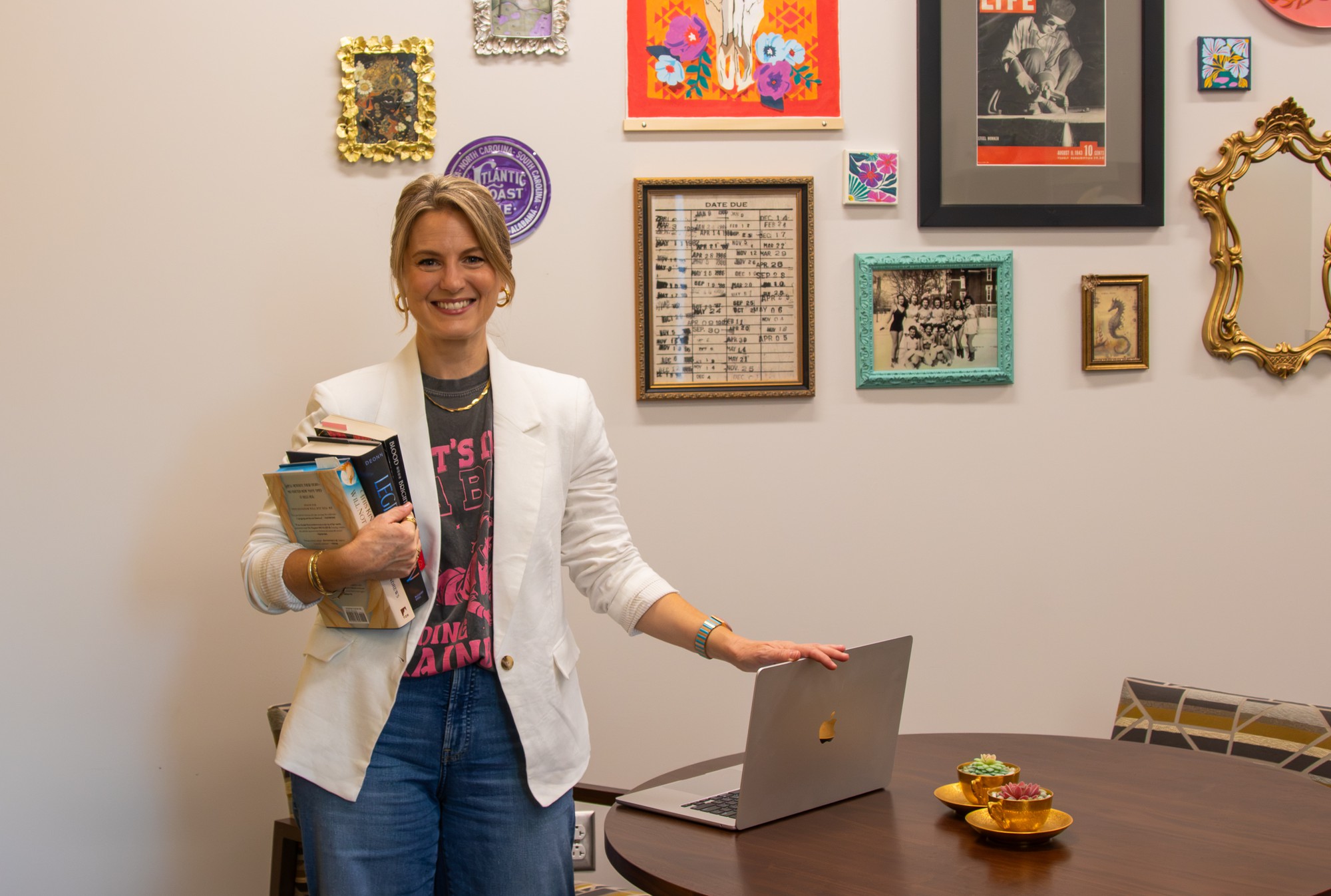
Walden, director of the Baylor Interdisciplinary Core, researches BookTok and Bookstagram. She also teaches Remixing the BIC: Booktok, Literacy, and New Media, a BIC capstone course.
Currently, Walden is working on publishing “Feral: Romantasy and Its Readers” with co-editor Kacy Tillman, professor at the University of Tampa, an edited volume of research that attempts to understand why people read romantasy.
“What kinds of things do they get out of it?” Walden said. “So my research is focused very much on fandoms, it’s on readership and the way that we, in my particular work, the way we access that through social media.”
The collection will include several branches from the central theme of romantasy, with a chapter on how romantasy connects to modern dating practices and a piece on romantasy in terms of therapy. Walden said her focus on social media can be researched in many different ways, and the methods evolve as social media platforms evolve.
“I tend to do a combination of, depending on the questions you’re asking, looking at specific hashtags and how people use them,” Walden said. “I think it’s actually more helpful to do what we call a walkthrough method where you … create a research account in one of these things and then you over time curate
your algorithm.”
However, Walden said there is a tendency in academia to assume that popular things are not worthy of study.
“If something is popular, figuring out why and what it’s doing for people is actually a really interesting way to understand the human condition,”Walden said.
And BookTok is popular. According to Forbes magazine, as of 2025, #BookTok had over 370 billion views combined.
“People are reading,” Walden said. “Reading creates empathy. Reading creates
emotional regulation.”
Walden said students looking to read romantasy should consider what they last read for enjoyment and go from there.
“I think if you like fun ‘Divergent’-type things, if you liked that sort of novel, ‘Hunger Games,’ you’ll probably like something like the ‘Crowns of Nyaxia’ series, so ‘Serpent and the Wings of Night’ by Carissa Broadbent or ‘The Daughter of No Worlds,’” Walden said.
More generally, Walden recommends “Fourth Wing” by Rebecca Yarros, “The Knight and the Moth” by Rachel Gillig and “Legendborn” by Tracy Deonn, which is on her reading list for her capstone class.
“I think Legendborn, while not exactly a romantasy because the romantic part is a little bit more of a subplot, I think it’s a great starter series to get into it because you really get this well-built fantasy world,” Walden said.
Walden also recommends “The Adventures of Amina al-Sirafi” by Shannon Chakraborty, another book on her class reading list.
One student in the class, Prosper senior Bella Cloud, said the class has group debriefs to connect books to previous BIC readings halfway through reading, and then students complete a book review project in a form of their choosing once the book is complete.
“A big emphasis from Dr. Walden is how to engage with pop culture,” Cloud said. “… We’ve had a group do a podcast, I did a mix between making an inspired playlist and also some TV show recommendations … it’s just a way of seeing how we can engage with literature that we’re reading outside of the classroom, and how it realistically manifests in popular spaces.”
Chicago senior Carter Wright, another student in the class, said he read a lot of fantasy growing up.
“I read ravenously growing up, and then whenever I got to like college and like later high school, I started to have to read for school instead of for pleasure and then that kind of killed the reading for pleasure bit,” Wright said.
He said the class allowed him to read for fun while also doing his classwork.
“It merged those two things and I was like, ‘Oh man, I get to do fun stuff, but say it’s for like schoolwork,’” Wright said. “… It was a bunch of books that I hadn’t heard of before and were fantasy vibes which is just something I’m into in general.”
Walden said one of the main things she wants students to know is that “fun doesn’t mean not academic.”
“We forget that things that are exciting, things that are enjoyable are also valuable, and they’re not just valuable because they’re enjoyable, but because you’re learning something about yourself,” Walden said. “… It doesn’t mean you throw academics out the window, but it also means that you don’t dismiss things that are fun.”Academic reading and popular stories find their elusive overlap in Dr. Sarah Walden’s research and class.