By Giselle Lee | Staff Writer
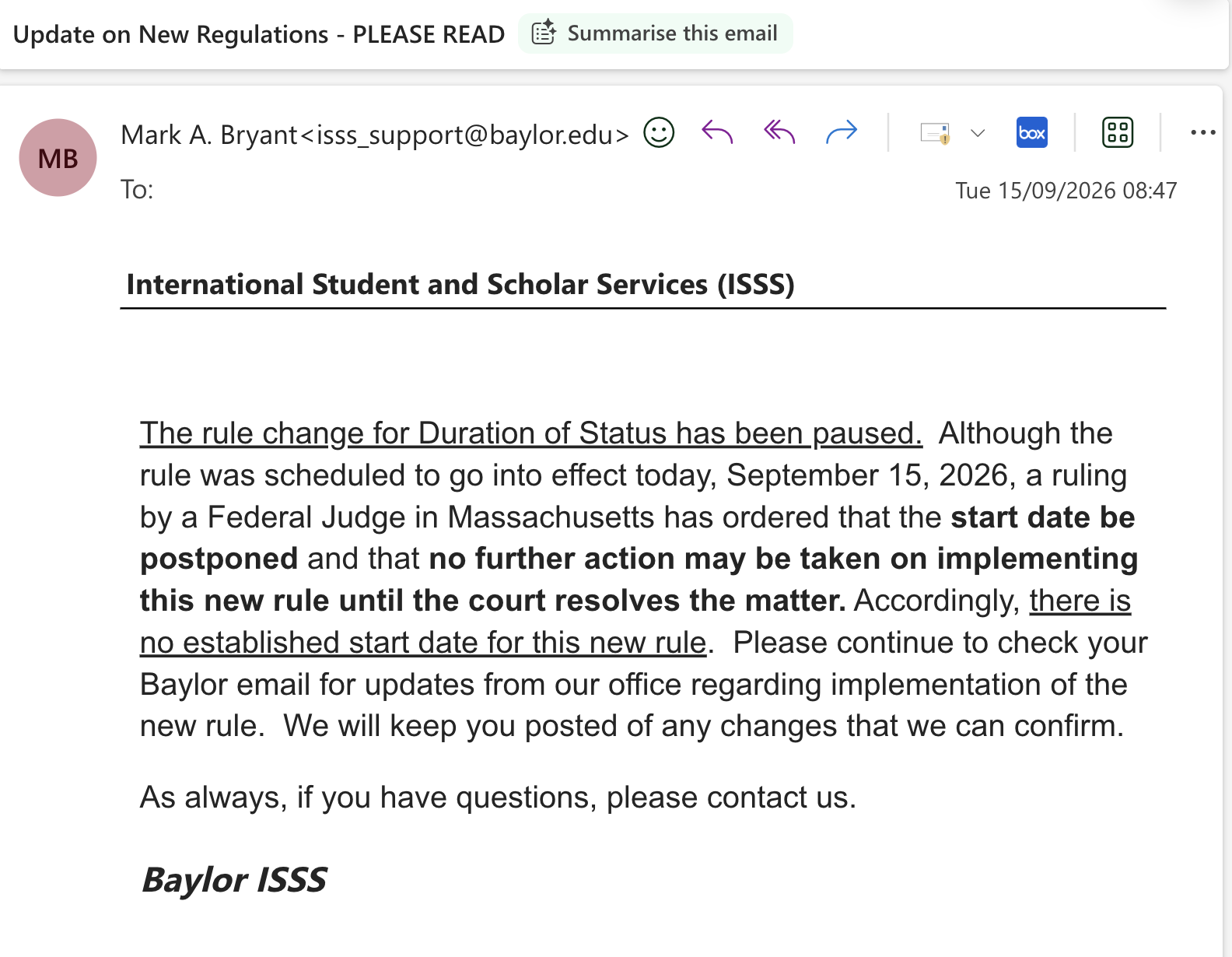
More uncertainty looms over international students after a federal judge in Massachusetts ordered the postponement of the “Duration of Status” (D/S) rule change Sept. 14, leaving the policy without a new start date.
The Baylor International Student and Scholar Services Office issued a statement on the matter via email to all international students Sept. 15, the day the rule change was originally set to take effect.
The policy update published by the Department of Homeland Security earlier this year was introduced to increase oversight of nonimmigrants, particularly international students’ length of stay in the U.S. and changes to academic programs. One of the largest shifts would replace D/S with a fixed admission period, generally capped at four years.
Barranquilla, Colombia, sophomore Mauricio Escorcia said he believes the postponement is beneficial for international students who may need additional time to complete their academic programs.
“I think it makes absolutely no sense to have this policy implemented on students who have programmed themselves and scheduled their classes in a way that they have a reasonable workload,” Escorcia said. “They might have to study here for a little bit longer and not graduate on time, but they initially had that trade-off, and now they don’t even have the option to do that.”
Santiago, Chile, sophomore Charu Muruganandam said that although she has little personal concern about the rule change, she believes it “imposes a restriction” on international students and worries about friends looking to graduate this academic year.
“Now [international students] have to find a way if they want to stay in the U.S. or go back home,” Muruganandam said. “There’s a lot of students that I know who work hard for their visa, and with these regulations make it harder for them to technically have an F1 visa or come back to the U.S. after going home and finishing their studies.”
Escorcia said it’s “weird,” as international students would benefit the U.S.’s academic prowess, given the talents that brought them to the country in the first place.
“It would be better for the United States if they were able to maintain that inside the country,” Escorcia said. “It’s better than having them study here and prepare themselves here before leaving to use their talents elsewhere and grow the economy in a different place that they weren’t educated in.”
Muruganandam said she believes changes to immigration policy can create fear and uncertainty among international students.
“You can’t just kick out every international student of the U.S.,” Muruganandam said. “They benefit [from] us if we think about it. Whatever it is, it’s also about how the government deals with things and how they act on things. But if you read closely, there are certain rights to you, and there are certain values to you that you can keep.”
Despite dealing with that uncertainty, Makassar, Indonesia, sophomore Annika Theos said she remains grateful to the ISSS Office and other Baylor staff for giving her “a lot of comfort.”
“Knowing a person and knowing that person will actually answer your question benefits all international students — I know it did for me,” Theos said. “When all these regulations occur, there is a resource and people waiting for me there willing to really help me out beyond giving me textbook answers … but having that real person helping me seeing my situation would help me as an international student.”
Muruganandam echoed the sentiment, saying the ISSS Office has helped keep international students informed as immigration policies change.
“We would never get this information if it wasn’t for [the ISSS Office] sending us that email,” Muruganandam said. “I also have my Designator School Officer who always responds and she tells me what to do. When these things happen, there’s also meetings that they tell us to come so they can inform us about it, where they can tell us about it, where they can educate us with it.”
The rule change, Muruganandam said, is “how life goes.” Despite this, she said Baylor and its ISSS Office helped students navigate the uncertainty.
“This would affect harshly on some, but not that much on other people,” Muruganandam said. “But Baylor has done a really good job and try and navigate us. There are so many resources for us to see and contact whoever we need to.”