By Joana Karoshi | News Writer
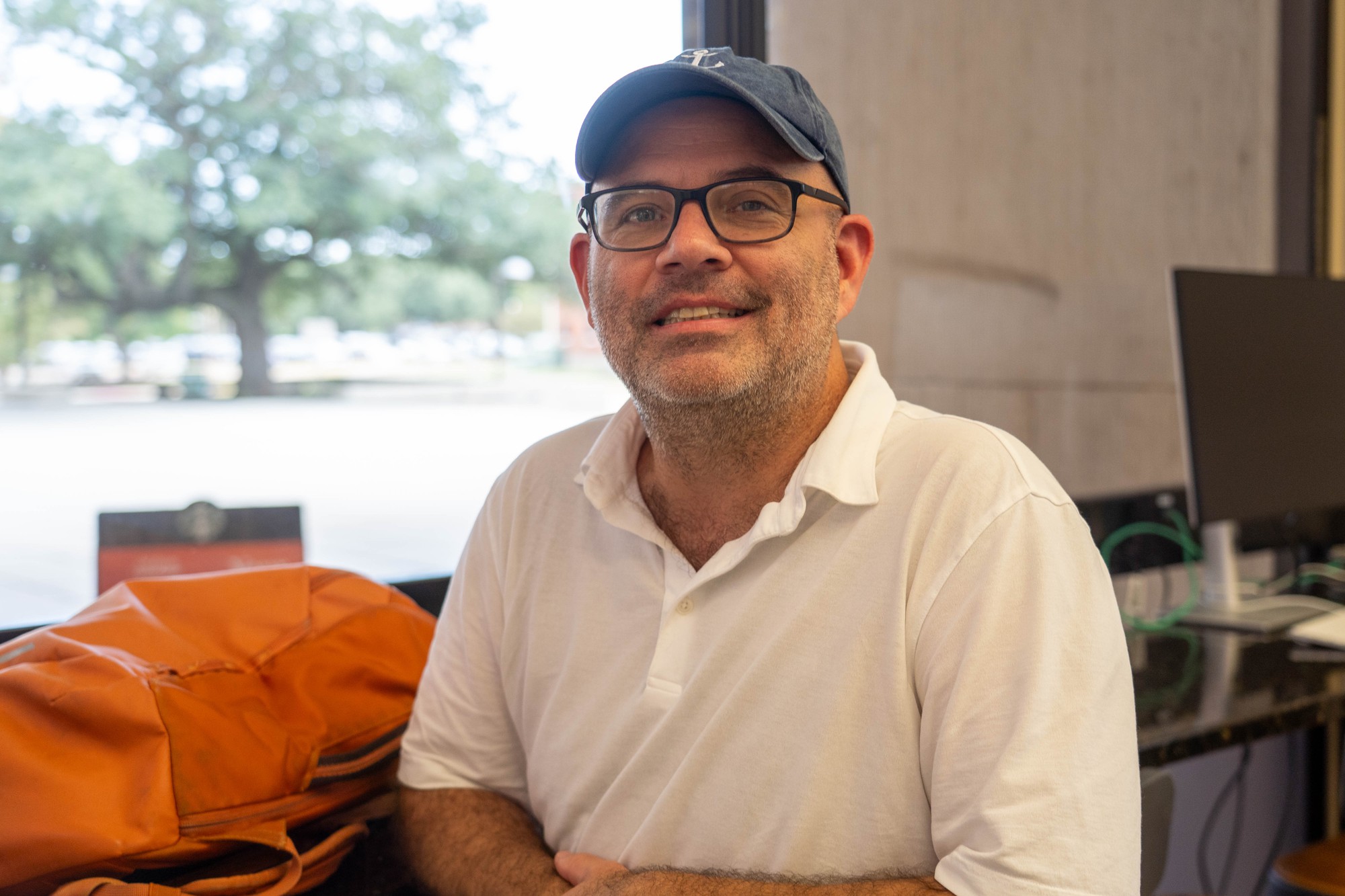
Economics can seem like a field of numbers, markets and money. For Dr. Scott Cunningham, it is also a way to study sex work, drug policy, mental health and artificial intelligence.
Cunningham, a Ben H. Williams Professor of Economics at Baylor, has always been fascinated by people and their stories from their own perspective. After graduating, he didn’t achieve his goal of becoming a poet and instead worked in market research in New Orleans, where he was inspired by Gary S. Becker’s Nobel Prize speech, “The Economic Way of Looking at Life.”
“He was using economics to study crime, marriage, divorce, education and racial discrimination,” Cunningham said. “It was very strange to hear that economics might be a behavioral science.”
Causal inference methodology has shaped most of Cunningham’s career. He has published a book called Causal Inference: The Mixtape, which links economic theory with real-world data, and has also hosted virtual workshops on the same topic.
“You have to figure out how to separate things just being coincidence from things being directly caused by it,” he said. “It’s really important to know if one thing causes another thing, or if they’re both just coincidentally connected.”
Rather than confining himself to one area of economics, Cunningham describes himself as an “eclectic applied researcher without a natural field.” His research has taken him into areas including sex work, drug policy, abortion, mental illness and suicide.
“I study things even if nobody else thinks it’s interesting,” he said.
Cunningham has conducted substantial research on sex work, using empirical microeconomics to examine the economic and social effects of the industry. His research has explored how the decriminalization of sex work relates to rape, sexually transmitted infections, violence and market shifts, as well as how fracking affects prostitution markets. He has also studied the relationship between illegal female prostitution and education, among other things.
“Sex work was interesting because I felt like I was working on topics that no other economist would touch,” Cunningham said. “I don’t like competition.”
In a recent project with Dr. Jared L. Black, Cunningham examined the effects of psychedelic decriminalization in California. The researchers compared cities that legalized psychedelics with similar cities that had not, estimating what would have happened in the cities without the policy.
The study found increases in emergency department visits for psychosis following legalization, contrary to claims that the policy would be harmless or beneficial for mental illness, Cunningham said.
His research on suicide in jails and prisons has given that question a more immediate human dimension. Working with Baylor economics professor Jonathan Sewer, Cunningham has used machine-learning models to identify incarcerated people who may be at risk of suicide using existing prison records. The researchers have worked with the Texas Department of Criminal Justice and Travis County Jail, where suicide is among the leading causes of death.
Cunningham sees this work differently from some of his other research. Rather than simply pursuing a question that interests him, he sees an opportunity to use skills that might otherwise be applied in the technology industry to help people in prisons.
“I want to be a good neighbor,” Cunningham said. “Try to do things to help find them before they get hurt.”
Roanoke senior Parker Glynn took Cunningham’s causal inference class and said Cunningham adapted his teaching to students from different academic backgrounds.
“The thing that I really liked about it was he didn’t force [students] to gain knowledge that they didn’t have,” Glynn said. “He was very understanding of where the class was at, and he changed how he was teaching to that.”
Glynn said Cunningham is a “very dynamic” professor who often has many ideas going through his head at once. Sometimes, Glynn said, Cunningham would arrive at his 8 a.m. class and immediately begin talking about whatever had caught his attention that day.
“He’s very enjoyable,” Glynn said. “He’s a fun guy to listen to.”
One topic that frequently comes up in Cunningham’s classes is AI. Glynn said Cunningham talks about AI even in his History of Economic Thought class, where students study economists from hundreds of years ago.
Over the past year, Cunningham has written about AI agents and their use in research, publishing about 70 essays on the topic on Substack. His writing led to invitations to speak and teach at institutions including the Federal Reserve, MIT and Harvard.
“I have found it to be incredibly intuitive,” he said. “And utterly transformative for our research.”
His essays on AI are how Dr. Cunningham thinks he got Harvard’s attention this year, and he has been invited to serve as a visiting professor for a second year at the Kennedy School. During the 2025-26 year, he taught three classes in the government department: Gov 50 and Gov 51, both undergraduate classes, and Gov 2001, a PhD course.
On his website, Cunningham describes Gov 2001 as a “rigorous introduction to probability theory, statistical inference, and linear regression” for first-year PhD students. He said the course took a “population-first” approach, where students first define what they want to know about a population before focusing on estimation.
Unlike his usual undergraduate courses at Baylor, none of the students he taught were economics majors.
“None of them were economists,” Cunningham said. “So it was a little hard to teach a 200-person undergraduate class in a field that wasn’t causal inference.”
Cunningham said teaching students outside of economics was challenging because causal inference is his primary area of expertise. At the same time, he found the experience rewarding, particularly when teaching probability to PhD students.
His time at Harvard also exposed him to a different academic environment.
“You know, I was in the world’s best political science department,” Cunningham said. “So that was kind of intense too, to be around people like that.”
Despite researching a wide range of topics that are often outside the traditional boundaries of economics, Cunningham said he has never been particularly interested in limiting himself to one field.
“I just enjoy asking questions and trying to answer them,” he said.