By Josh Siatkowski | Staff Writer
In a hectic, creative and highly-caffeinated 24 hours, about 50 Baylor students competed for thousands in prize money during Saturday’s Wacode Hackathon.
Coordinated by Computing for Compassion, the Association of Computing Machinery and Baylor Cyber, the event challenged contestants to develop software with a positive social impact and a solution to a real humanitarian problem, all in the time-constrained environment of a hackathon.
By Saturday night, Dallas sophomore and member of the winning team “Bear Bites” Erick Martinez was running on one 30-minute nap.
“This was an all-night thing,” Martinez said. “But we did it because we loved it.”
Thirty minutes after receiving their socially-conscious prompt, 15 teams began coding at 7 p.m. Friday, and most relied on Red Bull and coffee to work through the night and up to the 6 p.m. Saturday deadline.
Projects included disaster response technologies, sublease matching apps, pothole mapping systems and more. While all were developed with the goals of improving lives, students also fought for a share of over $7,000 in prize money.
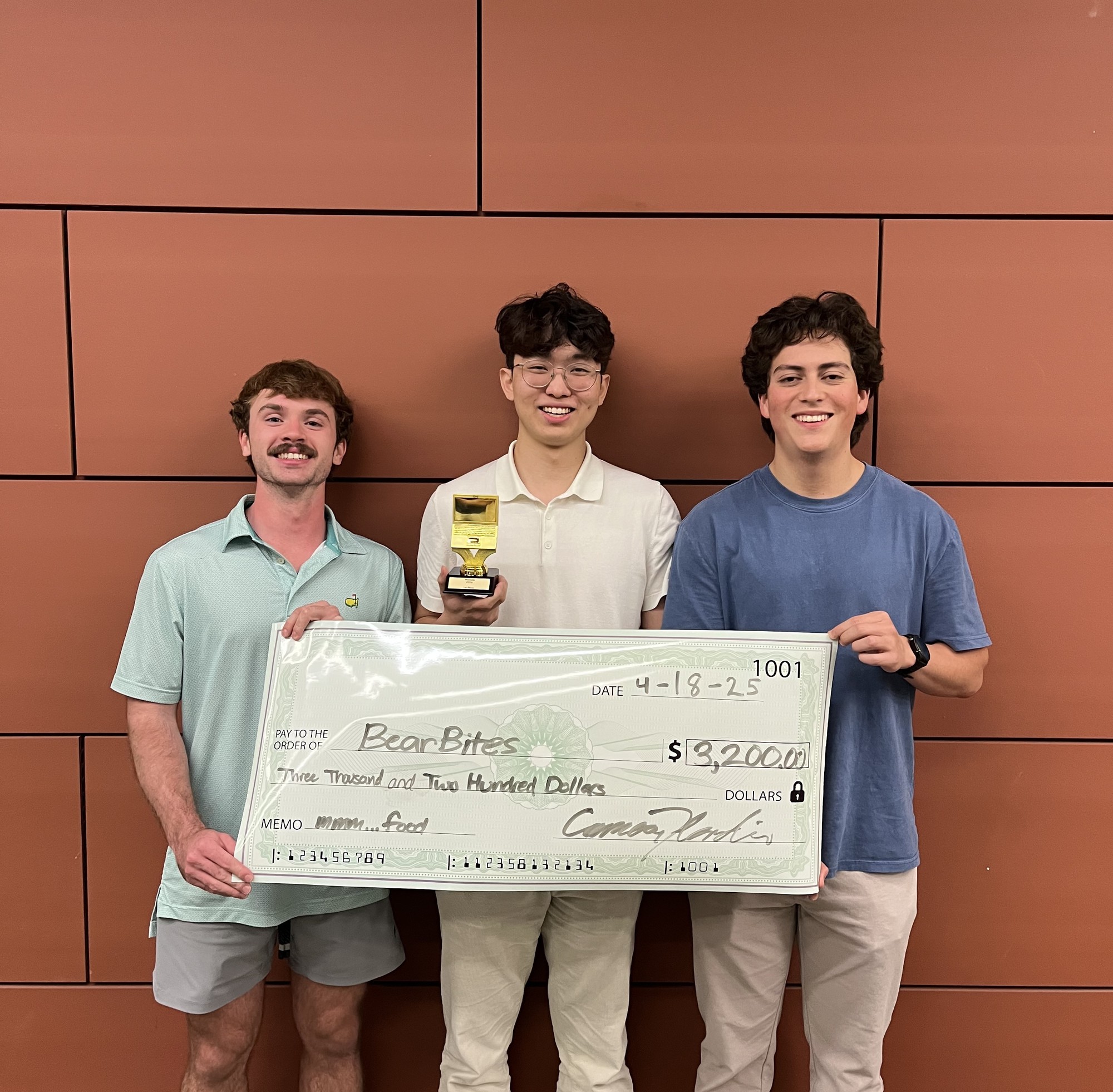
Sponsored by Texas Farm Bureau Insurance and Startup Waco, the competition gave $3,200 to the main field winner and another $4,000 across runners-up, beginner field entries and pop-up challenges.
In a close race, the overall winner was a food waste tracker called Bear Bites. The app, developed by Martinez alongside Cypress sophomore Aaron Evans and Austin junior Warren Huang, allows dining workers to track which food items are going to waste by having students take photos of their finished meals.
Huang, a member of Baylor’s University Innovation Fellows, had been thinking about Baylor’s food waste challenges before with UIF, and he said the hackathon provided a great opportunity to dive deeper.
“I was loosely thinking about this idea,” Huang said. “I knew that this hackathon was for social good, and when the prompt came out, it just sort of fit perfectly.”
Projects were graded on both technological merits and commercial defensibility. Judges considered security and code base, while also factoring in innovation and business model strength.
Because of this holistic review, Bear Bites opted for a diverse team. While Evans and Martinez are both computer science majors and handled much of the technical code, Huang, an economics major, took the lead on the business side.
“A big part of the hackathon is building an app, but probably just as big of a part is ideating an app,” Martinez said. “If you’re building an app and it’s not a good idea or it doesn’t have any market space, it’s probably going to be a bad competition.”
A recurring event since 2018, this year’s hackathon offered a number of new improvements, according to Cypress senior Peter Stewart and Woodway senior Cameron Hardin, both officers for Computing for Compassion.
For novice coders, a beginner track was added with the same prompt and its own $1,500 prize pool. Contestants used AI tools like Lovable to “vibe-code” apps, opening the contest to chemistry majors, mechanical engineers and more. The $700 grand prize for the beginner pool went to a web app that allows immigrants to study for the U.S. Citizenship Test in different languages.
“Something like a hackathon … is super intimidating,” said Hardin, the official “Chief Coffee Officer” of the Wacode Hackathon. “Everyone’s intelligent, and they already know what they’re doing. They already know languages and technologies, and so it’s hard to have a foot in and get started.”
Additionally, with help from officers at Baylor Cyber, coders were also able to compete for a combined $1,000 through four pop-up “capture the flag” cybersecurity puzzles written by members of the club.
But the biggest difference this year was the turnout. Historically hosted only by Computing for Compassion, a small service-based club that offers free software development for nonprofits, the hackathon struggled to attract more than just a few competitors.
“Cam and I have done the [hackathon] the last two years, and it was very small,” Stewart said. “We were kind of like, ‘Five people, this is major.’”
At one point this year, the club was down to just Stewart and Hardin, and because they are both seniors, its future seemed bleak. But after tabling and collaborating with other clubs to spread awareness, Computing for Compassion not only saw its highest attendance in years, but it also found multiple underclassmen to take over as officers next year.
“It’s an honor,” Stewart said. ”It really was such an incredible team effort. So many people worked really hard.”
In the future, Computing for Compassion and other clubs plan to hold hackathons every semester.