By Mackenzie Grizzard | Assistant News Editor
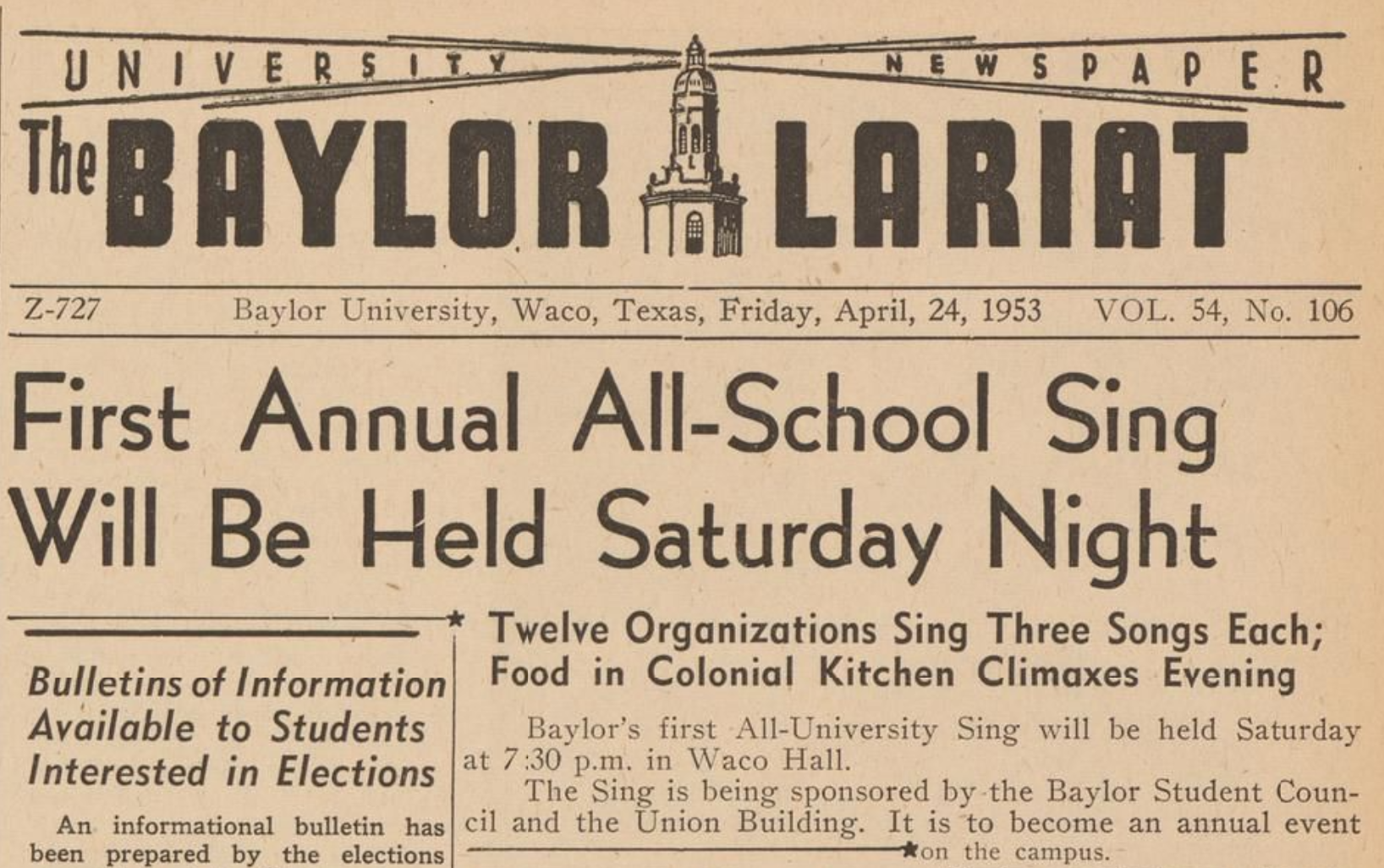
Nearly 75 years ago, Baylor’s All-University Sing had little the pomp and circumstance it does today. On a rainy spring night in April 1953, a meager 13 souls gathered into Waco Hall to watch just eight groups perform after the weather had relocated them from their original location at the SUB Bowl.
There, amongst rows and rows of empty seats, a handful of Lariat staffers sat pen to paper, who had no idea they were covering the start of one of Baylor’s most iconic traditions.
Since then, generations of Lariateers have covered Sing alongside Waco news outlets, looking for new and innovative ways to describe this yearly tradition.
Ryan Brinson, former Roundup editor and Sing Alliance chair from 2009-2010, said student media entities worked in tandem, and the Baylor community often looked to The Lariat for coverage of the event before the age of social media.
“The Lariat would go to cover Club Night and when the edition would come out the next day, people would flock to read it,” Brinson said.
In the spring of 1969, The Lariat covered a Sing conflict of “High School Musical” proportions. The 16th annual All-University Sing was scheduled for March 1, 1969 – the same day as the Baylor vs. TCU basketball game. At the time, Baylor was tied with both TCU and the University of Texas for the lead in the Southwest Conference, and Baylor’s then-assistant director of the student union, Mrs. L.H. York, told The Lariat it wouldn’t be possible to reschedule Sing.
“There’s no way to switch Sing,” York told The Lariat. “Three of the judges don’t come until Saturday afternoon.”
Almost two decades later, another Sing controversy would arise, giving The Lariat yet another chance to switch up its traditional Sing coverage.
In the fall of 1986, Baylor announced official Sing rules would undergo several changes for the upcoming 1987 performance. Several of the rules we know Sing for today were implemented then, including that any club chartered by Baylor could participate and that co-education acts were encouraged.
However, some of the other rules implemented generated strong opinions on campus. This change resulted in the traditional Thursday night show being replaced by a Saturday matinee, and groups were limited to only 12 hours a week for practice. During this time, several students, including Sing chairs, wrote letters to the editor to express their disagreement, according to the Texas Collection.
“The Lariat got people interested in things like Sing, and people read it not just for the review but for what [they] should think as well,” Brinson said.
For historical traditions such as Sing, the Texas Collection archives serve as an excellent research resource, said University Archivist Dr. Elizabeth Rivera.
Rivera emphasized that for Sing records, oftentimes some of the older decades of newspaper clippings, some are not available on the Baylor libraries website yet, making it easier for in-person research.
“That’s the value of still coming back here and looking at the physical collection because not everything is digitized,” Rivera said.
From rule changes to controversy, The Lariat has reported and covered Sing since its introduction in 1953.
“[Roundup] and The Lariat would work in tandem to cover Sing,” Brinson said. “It was an important part of every year.”