


Skye Duncan | Lariat Photo Editor
By Rachel Leland
Staff Writer
Though one would struggle to find evidence of persecution of Christians on Baylor’s campus, students and researchers can visit the archives of the Keston Center for Religion, Politics and Society to learn what living in a society without religious freedom is like.
The center holds thousands of books, journals, documents and testimonies on the persecution of churches and religious expression in former communist countries, mostly in the former USSR.
The Keston Center hosted a lecture and panel discussion Thursday about religious persecution in the Russian Federation and former USSR titled “Defenders of the Faith: Then and Now.
Featured speaker Xenia Dennen traveled to Waco from England to speak about the origins of the institute and the religious oppression of the Soviet era.
Dennen has chaired the Keston Institute, a research organization that documented religious persecution in the USSR, since 2002. The institute’s extensive archive and library were moved to Baylor in 2007. The Keston Center is housed in the third floor of Carroll Library.
Dennen spoke of Michael Bourdeaux, founder of the institute and the man who the Michael Bourdeaux Research Center is named after. Bourdeaux traveled from England to the Soviet Union in 1959, where he found heavy religious persecution despite the Soviet Constitution, which guaranteed freedom of conscience and religion, Dennen said.
He said his trip inspired him to found the Keston Institute in 1969 to document human rights abuses suffered by the many religious groups in communist countries.
The institute relied on books, journals and samizdat, which were copies of censored documents secretly distributed by dissidents.
“You felt as you read this material you were directly in touch with the persecuted and called to widely spread the details of what was happening to them,” Dennen said.
Three panelists spoke at the event: Dr. Stephen Gardner, Baylor’s chairman of the Baylor economics department; Dr. Wallace Daniel, a former Baylor professor; and the third panelist, Dr. James Warhola is chair of the political science department at the University of Maine.
Daniel honored Soviet dissident and priest Gleb Yakunin, who was sent to Lefortovo prison for five years on the charge of anti-Soviet agitation for his activism to expand freedom of conscience. Yakunin, who wrote many materials which can be found in the archive, died on Dec. 25, 2014.
Though the talks all referenced the suppression of churches and religious expression during the Soviet-era, Dennen, Gardner and Warhola said they felt the religious situation today is more promising than it was before the collapse of the USSR in 1991.
Warhola and Gardner even said they were concerned that the Russian Orthodox Church is beginning to serve as an agent of the Russian government.
“This is one aspect that seems to be in which religious freedom is if not outright threatened, at least compromised in Russia today by the pervasive use of religion to justify power,” said Dr. Warhola. “It is certainly not alone in this. It is a temptation that political
A Q&A with Keston lecture featured speaker XENIA DENNEN
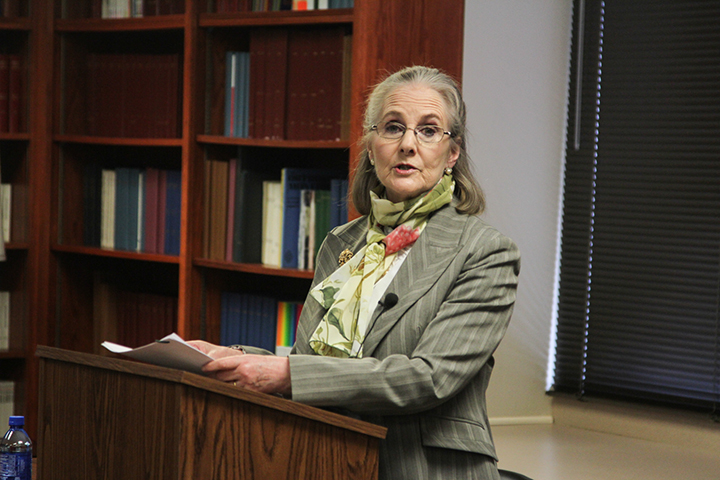
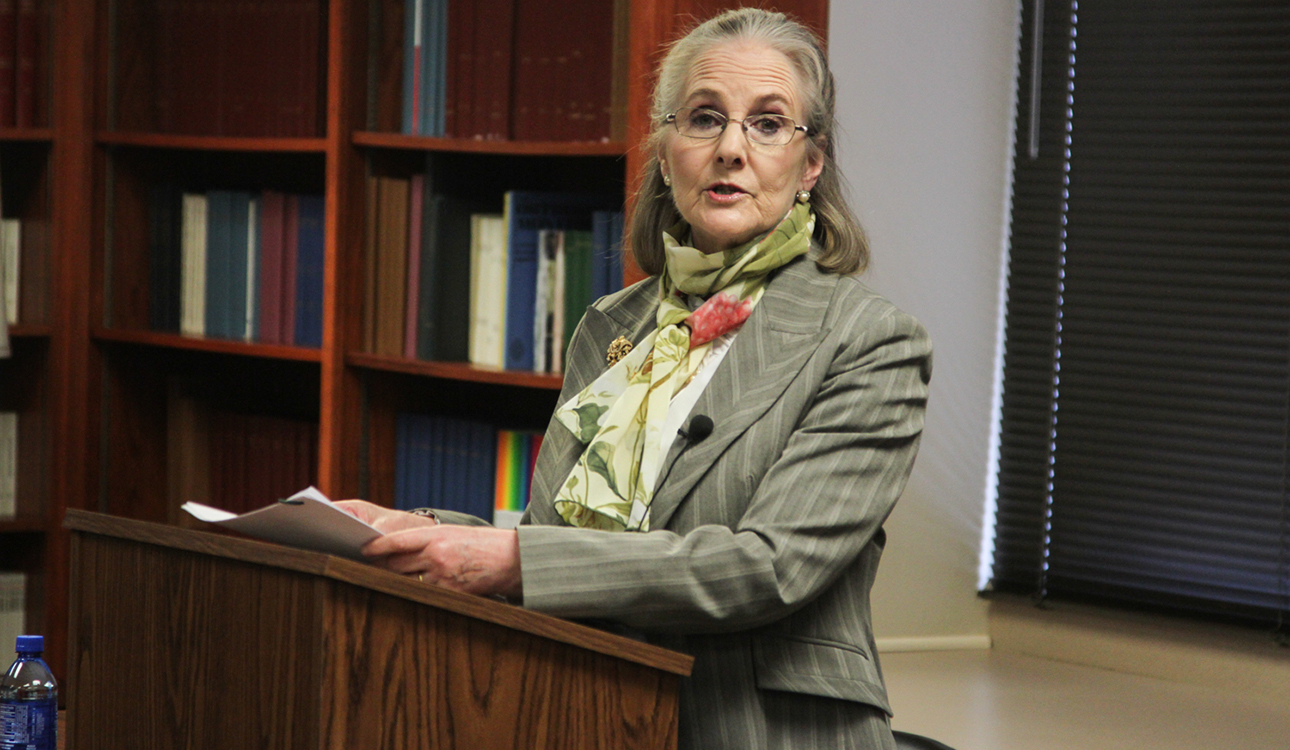
Xenia Dennen, chairman of the Keston Institute, speaks about the history of her organization and the religious climate in Russia and the former USSR.
How did the institute gather data in societies that are tightly controlled?
We were sent masses of unofficial literature called samizdat, which means literally self-published material that are types of scripts that were produced clandestinely and distributed secretly. You would have a top sheet of paper which impressed the letters into the sheet underneath. I suppose Michael, people just found out he was interested so he started getting masses of this stuff. I met him in 1966. I just finished my course at university and he was receiving a lot of material of Russian Baptists who were critical of their own leadership because of compromises with the state. He also read the Soviet press and once Keston was founded we expanded and covered all the countries of central and Eastern Europe and the Soviet Union. We got local newspapers and made cuttings, articles in the western press, articles from journalists in communist countries. This is the data we use and the basis of the archives.
Was the work Keston did used for a political purpose?
We are a nonpolitical organization and we are a charity, and under English charity law we could not get involved in political campaigns. But that doesn’t mean people didn’t look at us in a political light and anything involving a communist country was politicized, so yes. I think the battle for religious freedom could be used as a weapon of criticism but I don’t disagree with that. I think it’s a well-founded criticism. But we were certainly accused of being right wing. We were accused of political bias, but that wasn’t. We were trying to provide the facts. That was why right from the beginning we based our writing on documentary evidence wherever possible. And we would compare unofficial documents with official published articles. So we were very rigorous in our research. You can use the truth in different ways can’t you. And that wasn’t our responsibility. We couldn’t stop people presenting our material in another way. We wrote and provided information and other organizations could make use of it as they wished.
Where did the criticism come from? The West or behind the Iron Curtain?
We were certainly criticized by left wing parties in the West. Obviously the criticism was from various communist parties that didn’t like what we were revealing. Revealing the fact that there are all these prisoners in prison. For the prisoners themselves it was incredibly important for them to know that they were known abroad, and do you remember when Alexander Ogorodnikov was here last year and he gave a lecture? He was in prison for eight years. Setting up a Christian seminar for young people who wanted to study theology and find out about the Christian faith. He at one point in prison was really falling into despair. He then heard there was a whole prayer circle in the West. We organized it. There was a vicar who put himself in a cage and lived on Soviet prison food for the whole season of Lent. All of this was an encouragement to Alexander Ogorodnikov to know that people in the West cared and knew about his situation and that lifted his situation and enabled him to keep going.
Can you describe the evolution of the church and the Christian faith since the breakup of the Soviet Union?
First of all there is every sort of denomination and of course the Russian Federation is a multi-faith polity. You’ve got Buddhism, Judaism, Islam, as well as Christianity and a whole lot of strange sects. But if you look at the main Christian churches, the Russian Orthodox Church is the main church, the Roman Catholic Church, The Baptist Church, The Adventists, Pentecostals. There’s a distinction in Russia between Pentecostals and charismatics.
I think the real growth in the Christian church is actually within the charismatic movement. I’ve been part of a research team looking at the current situation of the religious situation in the Russian Federation. I’ve been a member of this team since 1996. You see enormous variations.
In a particular administrative area relations between the different Christian churches depends very much on the policy of the local Russian orthodox Bishop. And if he is Anti-Protestant or anti catholic that will be reflected in how the parishes are relating to other groups. And a lot depends on the security services, known as the FSB is what the KGB is now called. They are particularly concerned about Protestants and about Catholics because they have loyalties to the Vatican.
So there are lots of variations. I personally don’t talk about persecution, but there is definitely discrimination against some Christian denominations. But again there are variations, for example in Siberia in a city called Krasnoyarsk. I was talking to the local bishop and he referred to Catholics and Protestants as his brothers. In that bit of Siberia there are large communities of Catholics because so many Poles and Lithuanians were exiled there under the Communist system. Somehow it’s part of that area. But there is a lot of suspicion particularly of the Charismatic movement. Baptists have been in Russia since the early 19th century, so they are seen as somehow part of Russian society. They are not sort of strange and Pentecostals too but it’s particularly the charismatics that are seen as a threat.
