


Associated Press
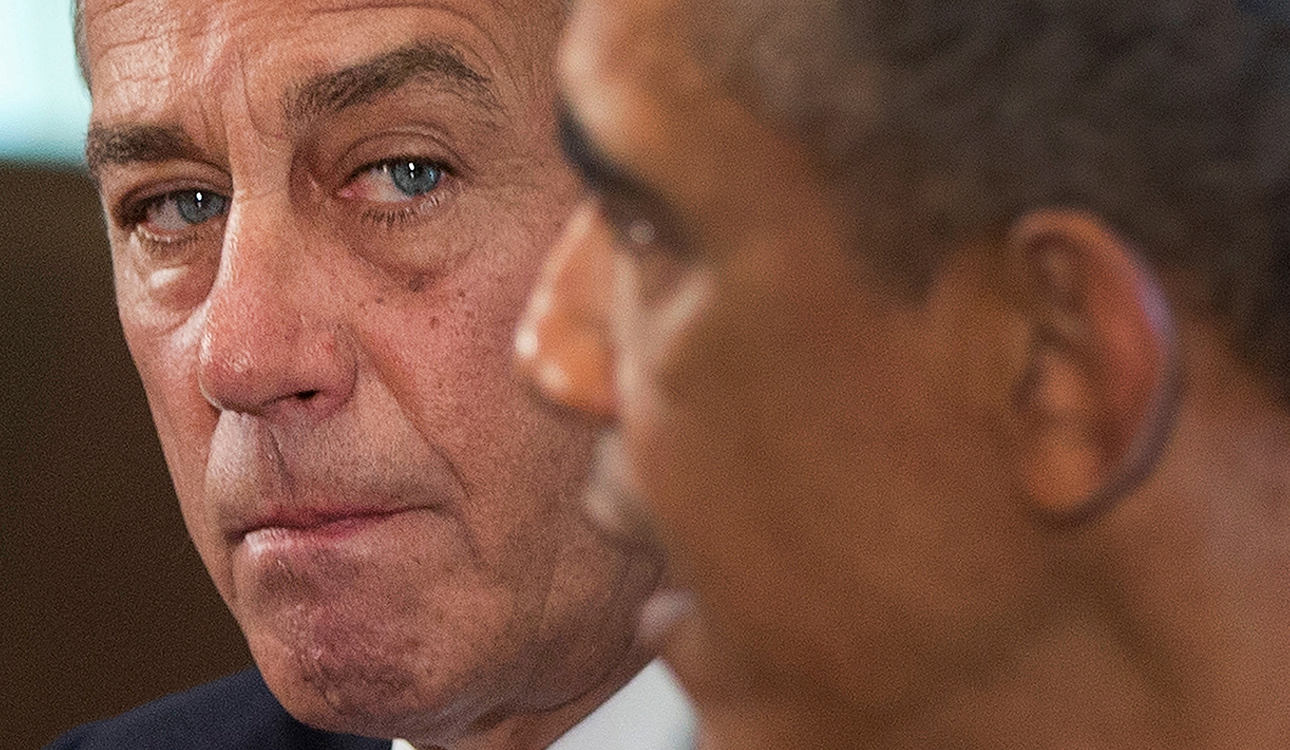
WASHINGTON — President Barack Obama gained ground Tuesday in his drive for congressional backing of a military strike against Syria, winning critical support from House Speaker John Boehner while key Senate Democrats and Republicans agreed to back a no-combat-troops-on-the-ground action in retaliation for a chemical weapons attack.
Officials said the emerging Senate measure would receive a vote Wednesday in the Senate Foreign Relations Committee. Approval is likely.
“You’re probably going to win” Congress’ backing, Sen. Rand Paul of Kentucky, a conservative and likely opponent of the measure, conceded in a late-afternoon exchange with Secretary of State John Kerry.
The leader of House Republicans, Boehner emerged from a meeting at the White House and said the United States has “enemies around the world that need to understand that we’re not going to tolerate this type of behavior. We also have allies around the world and allies in the region who also need to know that America will be there and stand up when it’s necessary.”
Boehner spoke as lawmakers in both parties called for changes to the president’s requested legislation, insisting it be rewritten to restrict the type and duration of any military action.
In the Senate, the compromise was the work of Sens. Bob Menendez, D-N.J., and Bob Corker, R-Tenn., among others. They are the chairman and senior Republican, respectively, on the Foreign Relations Committee, which held a lengthy hearing during the day on Obama’s request for congressional legislation in support of the military reprisal he wants.
The measure would set a time limit of 60 days and says the president could extend that for 30 days more unless Congress votes otherwise.
The measure also bars the use of U.S. ground troops for “combat operations.”
The White House had no immediate reaction to the Senate measure, although Kerry, testifying earlier before the committee, signaled that the troop restriction was acceptable to the administration. “There’s no problem in our having the language that has zero capacity for American troops on the ground,” he said.
“President Obama is not asking America to go to war,” Kerry said in a strongly worded opening statement. He added, “This is not the time for armchair isolationism. This is not the time to be spectators to slaughter.”
Obama said earlier in the day he was open to revisions in the relatively broad request the White House made over the weekend. He expressed confidence Congress would respond to his call for support and said Assad’s action “poses a serious national security threat to the United States and to the region.
The administration says 1,429 died from the attack on Aug. 21 in a Damascus suburb. Casualty estimates by other groups are far lower, and Assad’s government blames the episode on rebels who have been seeking to overthrow his government in a civil war that began over two years ago. A United Nations inspection team is awaiting lab results on tissue and soil samples it collected while in the country before completing a closely watched report.
The president met top lawmakers at the White House before embarking on an overseas trip to Sweden and Russia, leaving the principal lobbying at home for the next few days to Vice President Joe Biden and other members of his administration.
Kerry, Defense Secretary Chuck Hagel and Gen. Martin Dempsey, chairman of the Joint Chiefs of Staff, sat shoulder-to-shoulder at the Senate committee hearing while, a few hundred miles away, United Nations Secretary-General Ban Ki-moon urged caution. He said any punitive action against Syria could unleash more turmoil and bloodshed, and he advised that such strikes would be legal only in self-defense under the U.N. Charter or if approved by the organization’s Security Council. Russia and China have repeatedly used their veto power in the council to block action against Assad.
In the Middle East, Israel and the U.S. conducted a joint missile test over the Mediterranean in a display of military might in the region.
Obama set the fast-paced events in motion on Saturday, when he unexpectedly stepped back from ordering a military strike under his own authority and announced he would seek congressional approval.
Recent presidents have all claimed the authority to undertake limited military action without congressional backing. Some have followed up with such action.
Obama said he, too, believes he has that authority, and House Democratic leader Nancy Pelosi said during the day that even Congress’ refusal to authorize the president wouldn’t negate the power of the commander in chief.
Still, the president also has stated that the United States will be stronger if lawmakers grant their support.
But neither Obama nor his aides has been willing to state what options would be left to him should Congress reject his call.
As Obama has often noted, the country is weary of war after more than a decade of combat deaths in Afghanistan and Iraq, and there is residual skepticism a decade after Bush administration claims went unproven that Saddam Hussein possessed weapons of mass destruction. Additionally, a spate of polls indicates the public opposes a military strike against Syria, by a margin of 59-36 percent if the United States acts unilaterally, according to a new Washington Post-ABC survey, and a narrower 46-51 if allies take part.
Among major allies, only France has publicly offered to join the United States in a strike, although President Francois Hollande says he will await Congress’ decision. The British House of Commons rejected a military strike last week.
Yet the president’s decision to seek congressional approval presents lawmakers with a challenge, as well.
Even some of Obama’s sternest critics in Congress expressed strong concerns about the repercussions of a failure to act.
House Majority Leader, Eric Cantor, R-Va., said after Tuesday’s White House meeting that a failure to respond to the use of chemical weapons “only increases the likelihood of future WMD (weapons of mass destruction) use by the regime, transfer to Hezbollah, or acquisition by al-Qaida.”
America’s largest pro-Israel organization, AIPAC, also announced its support for legislation to authorize a military strike.
Apart from the meeting with Obama, the White House provided closed-door briefings for members of Congress.
Sen. Jeff Flake, R-Ariz., said after attending one session that administration officials told lawmakers that the targets the military had identified last week were still present, despite the highly public discussion of a possible attack. “Seems strange to see some targets still available several weeks later,” Flake said, adding that he was “still listening” to the administration’s lobbying.
Dempsey addressed the same point later in the day. “Time works both ways,” he told the Senate panel. He said the United States has significant intelligence about Assad’s actions, and “we continue to refine our targets.”
Others were firmly opposed. Sen. Jim Inhofe of Oklahoma said on Fox News, “It may sound real easy when people like Secretary Kerry say that ‘it is going to be quick and we’re going to go in, we’re going to send a few cruise missiles, wash our hands and go home.’ It doesn’t work that way. This could be a war in the Middle East, it’s serious.”
Paul, the Kentucky Republican who has close ties to tea party groups, said he probably would vote against authorizing Obama to use force. But he said it also wouldn’t be helpful to amend the resolution in a way that constrains the president too much to execute military action, if authorized.
He made his prediction that the White House would get its way in an exchange with Kerry in which he said Obama should agree to abide by Congress’ decision, rather than reserve the right to order a strike even if the vote goes against him.
Democrats, too, were divided, although it appeared the administration’s biggest concern was winning support among deeply conservative Republicans who have battled with the president on issue after issue since winning control of the House three years ago.
The United States maintains a significant military force in the eastern Mediterranean Sea. The U.S. Navy released one of the warships that had been in the region, leaving four destroyers armed with cruise missiles, the USS Stout, USS Gravely, USS Ramage and USS Barry. Also in the area was an amphibious warship, the USS San Antonio, with about 300 Marines aboard.
In addition, there are two aircraft carriers in the region — the USS Nimitz strike group, which is in the southern Red Sea, and the USS Harry S Truman, which is in the Arabian Sea.
