

Close Menu
The Baylor Lariat
    Facebook X (Twitter) Instagram YouTube LinkedIn
    Trending
    • Hispanic concert in Foster Pavilion rescheduled due to World Cup Final
    • Board of Regents approves nearly $1 billion operating budget, new AI-centered master’s degree
    • Foster Pavilion to host rising country star Braxton Keith
    • Dog days: Q&A with Wacoan that built hot dog social media brand
    • Country legend Willie Nelson returns after 72 years for night of harmonies, hits
    • Students react to ‘very stressful’ Canvas outage ahead of finals
    • Canvas access to be restored, Friday finals moved to online Thursday
    • Baylor delays finals as nationwide Canvas outage impedes studying
    • About us
      • Spring 2026 Staff Page
      • Copyright Information
    • Contact
      • Contact Information
      • Letters to the Editor
      • Subscribe to The Morning Buzz
      • Department of Student Media
    • Employment
    • PDF Archives
    • RSS Feeds
    Facebook X (Twitter) Instagram YouTube LinkedIn
    The Baylor LariatThe Baylor Lariat
    Subscribe to the Morning Buzz
    Friday, June 26
    • News
      • State and National News
        • State
        • National
      • Politics
        • 2025 Inauguration Page
        • Election Page
      • Homecoming 2025
      • Baylor News
      • Waco Updates
      • Campus and Waco Crime
    • Arts & Life
      • Wedding Edition 2025
      • What to Do in Waco
      • Campus Culture
      • Indy and Belle
      • Leisure and Travel
        • Leisure
        • Travel
          • Baylor in Ireland
      • Student Spotlight
      • Local Scene
        • Small Businesses
        • Social Media
      • Arts and Entertainment
        • Art
        • Fashion
        • Food
        • Literature
        • Music
        • Film and Television
    • Opinion
      • Editorials
      • Points of View
      • Lariat Letters
    • Sports
      • Football
      • Basketball
        • March Madness 2026
        • Men’s Basketball
        • Women’s Basketball
      • Soccer
      • Baseball
      • Softball
      • Volleyball
      • Equestrian
      • Cross Country and Track & Field
      • Acrobatics & Tumbling
      • Tennis
      • Golf
      • Pro Sports
      • Sports Takes
      • Club Sports
    • Lariat TV News
    • Multimedia
      • Video Features
      • Podcasts
        • Don’t Feed the Bears
        • Bear Newscessities
      • Slideshows
    • Sing 2026
    • Lariat 125
    • Advertising
    The Baylor Lariat
    Home»News»Baylor News

    Drug that may save brain cells undergoes tests

    webmasterBy webmasterSeptember 25, 2014 Baylor News No Comments4 Mins Read
    Share
    Facebook Twitter LinkedIn Pinterest Email

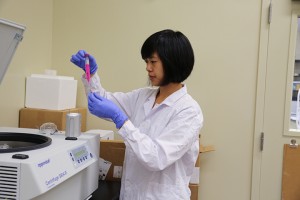
    Dalian, China, doctoral candidate Fan Zhang works in the lab. She is part of the team researching the new drug.Richard Hirst | Lariat Multimedia Editor
    Dalian, China, doctoral candidate Fan Zhang works in the lab. She is part of the team researching the new drug.
    Richard Hirst | Lariat Multimedia Editor
    By Viola Zhou
    Reporter

    A toxicology scientist at Baylor is testing a new drug that may cure traumatic brain injuries for soldiers fighting on the battlefield.

    Dr. Erica Bruce, assistant professor in the environmental science department, said the drug has the potential to treat the oxygen deficient condition of brain cells, which is commonly seen among military personnel living in an extreme environment.

    A total of 27,324 people in the United States armed forces were diagnosed with traumatic brain injuries in 2013, according to U.S. Department of Defense.

    Bruce said the drug being tested, the composition of which is confidential, may increase the oxygen content in brain cells.

    “When you have a traumatic brain injury, oxygen is deprived in that part of the brain,” Bruce said. “The brain does not regenerate cells. When you deprive the brain of oxygen, you kill those cells and you never get them back.”

    She said the drug may also help in the wound healing process, which needs significant amounts of oxygen.

    “Soldiers in Iraq and Afghanistan have all kinds of environmental exposures like pesticides, particulate matters, dust, stress, heat and dehydration,” she said. “Our hypothesis is all of these things together change the way your body heals.”

    Bruce said she decided to do the test after she was approached by Hemotech, the company that invented the drug.

    “There is a large group of military personal in Central Texas that we have opportunities to work with and do some investigations with,” she said.

    Bruce said the research team is trying to induce injuries in brain cell samples with special instruments and give them the drug to see if it can recover the cells.

    She said they have gotten promising preliminary results. The drug proved to help two kinds of brain cells regain viability when the cells are kept separately. The next step is to see how the cells respond to the drug when they are put together.

    Tianjin, China, master’s student Peijin Yang, who has been working with Bruce on this test, said the first step was very successful and the future is bright.

    “We have many steps to complete,” Yang said. “We need to experiment on different kinds of cells and then on animals, before the drug enters clinical trials. But the process will be smooth.”

    But Dalian, China, doctoral candidate Fan Zhang, another team member, said the rest of the test will not be an easy task.

    “It is very hard to work out the testing approaches from scratch,” Zhang said. “We are sometimes overwhelmed by the amount of work ahead.”

    Zhang said the average time for a drug to get from laboratory to the market is 15 years and the team needs more funding and people to speed up the process.

    Bruce said it takes one to three years to complete the laboratory test and the cost is between $3 to $5 million.

    She said the group just got a grant of $97,500 from the Edward N. and Margaret G. Marsh Foundation, which is interested in military medical projects.

    The team is also applying for sponsorship from the U.S. Department of Defense, and the proposal is now under review.

    Bruce said if the drug proves effective, it will be used to help military people who are affected immediately, but later it may be used to treat people who get traumatic brain injuries in car wrecks and sports.

    “We hope we can make a difference in treating traumatic brain injuries, especially for military personnel who have served our country and protect our freedom,” Bruce said.


    webmaster

    Keep Reading

    Hispanic concert in Foster Pavilion rescheduled due to World Cup Final

    Board of Regents approves nearly $1 billion operating budget, new AI-centered master’s degree

    Foster Pavilion to host rising country star Braxton Keith

    Dog days: Q&A with Wacoan that built hot dog social media brand

    Country legend Willie Nelson returns after 72 years for night of harmonies, hits

    Students react to ‘very stressful’ Canvas outage ahead of finals

    Add A Comment

    Comments are closed.

    Recent Posts
    • Hispanic concert in Foster Pavilion rescheduled due to World Cup Final June 22, 2026
    • Board of Regents approves nearly $1 billion operating budget, new AI-centered master’s degree May 21, 2026
    About

    The award-winning student newspaper of Baylor University since 1900.

    Articles, photos, and other works by staff of The Baylor Lariat are Copyright © Baylor® University. All rights reserved.

    Subscribe to the Morning Buzz

    Get the latest Lariat News by just Clicking Subscribe!

    Follow the Live Coverage
    Tweets by @bulariat

    Facebook X (Twitter) Instagram YouTube LinkedIn
    • Featured
    • News
    • Sports
    • Opinion
    • Arts and Life
    © 2026 ThemeSphere. Designed by ThemeSphere.

    Type above and press Enter to search. Press Esc to cancel.