


By The Editorial Board
Baylor’s student body had the opportunity last spring to react to an event organized by the university’s Turning Point USA chapter. Another political event for Democratic senatorial candidate James Talarico will occur at the Hurd Welcome Center this September. Tables add color to Fountain Mall day in and day out, and may or may not be political in nature.
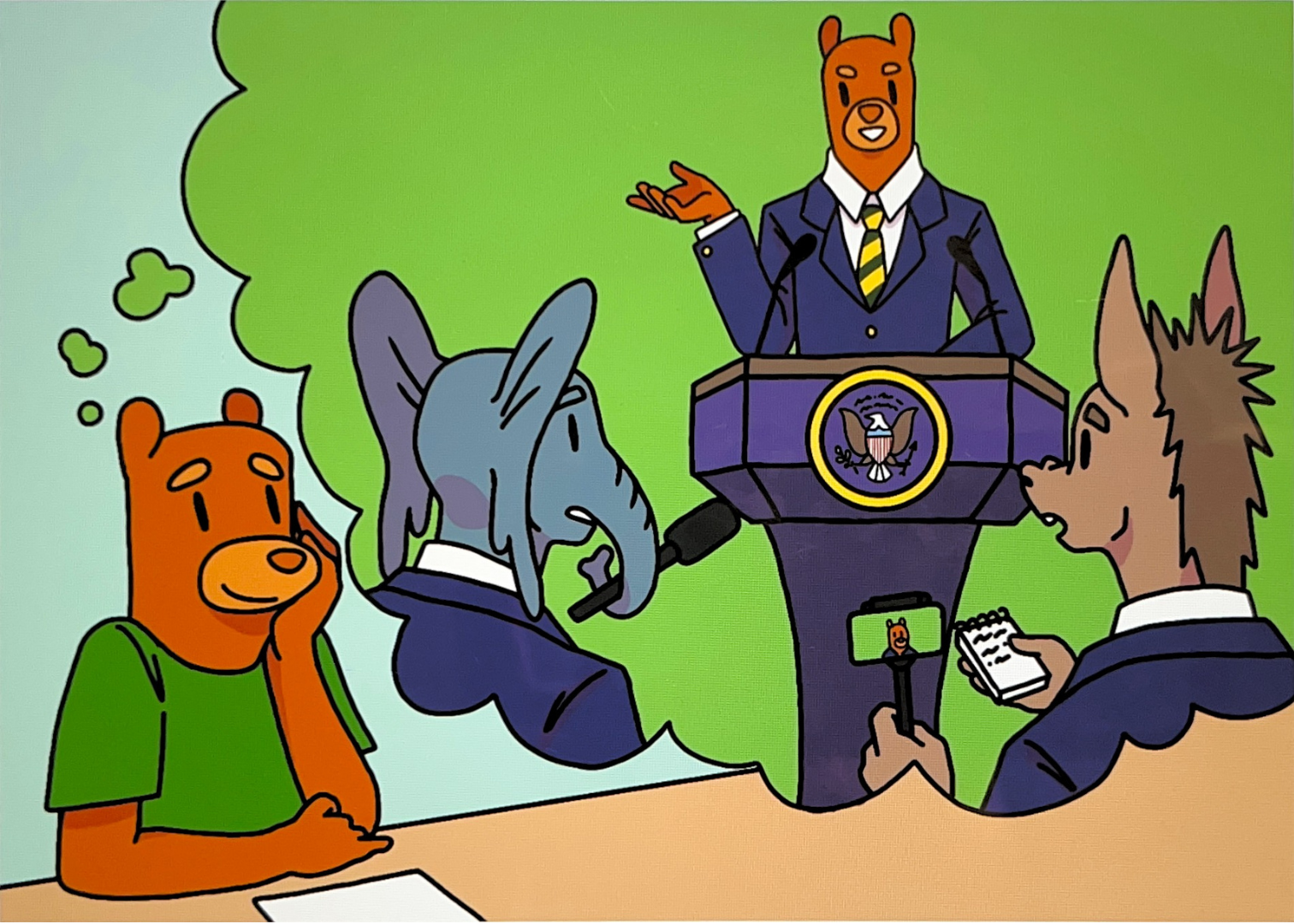
One constant remains, however: Baylor University is not, and ought not to be, directly political.
According to the university guidelines, Baylor independently reviews all political events via both its Office of Governmental Relations and Office of General Counsel for the explicit purpose of not having the university take a side on local, state or national issues.
A summary article published by the Baylor Line provides a window into the history of political and cultural activism at Baylor, most notably its brushes with isolated pockets of racial discrimination in the wake of the 2020 George Floyd protests, the cancelled 1980 visit of a Playboy magazine photographer and the mid-2010s Baylor Athletics sexual assault scandal.
What unites all these past controversies is a conflict between the sensitivity surrounding what were once contentious current events, and the undue association of these small-scale ideas with the university at large.
Yet, Baylor University not being political should have little bearing on how its students become political people, both through their work and their experiences.
From the student perspective, being truly apolitical is especially impossible as a member of a large community like Baylor. Voluntarily entering this community is what makes us political in our very essence, given the English word’s root in polis, the Greek word for city.
The idea of a political student body does not automatically insinuate, however, that inflammatory behavior and protests that betray the university’s guidelines must exist. Baylor never has, and never will, endorse contentious activism surrounding current events or controversies.
Public opinion generally scorns front-facing activism as well. In a 2024 survey conducted by the University of Southern California’s Center for Applied Research in Education, data showed participants largely disapproving of most forms of student activism short of protesting fiscal failures at a given university.
What Baylor should always hope to produce is precisely what the university outlines in its mission statement: faculty, staff and students “[educated] for worldwide leadership service by integrating academic excellence and Christian commitment within a caring community.”
This, for us, is what it means to be political.
However mutable we may think phrases like “academic excellence” and “worldwide leadership” are, their fruits will always be the bright minds scaling Fountain Mall, day in and day out.
Baylor needs, and runs on, ideological people. Some of these people may be activists when at a campaign event or off campus, but at their core, they are simply people with ideas and voices.
The university’s commitment to fostering a multifaceted Christian excellence within its community should manifest itself in the world around us, and that can happen at some juncture through politics.
Just down the road from Hillsdale College’s Washington, D.C. campus is The Heritage Foundation, a mainstay conservative think tank in our nation’s capital. The Atlantic Council and the New York-based Council on Foreign Relations, both of which outsource from elite universities, also tie prestige to the kinds of ideas fostered by a university education.
The revered Oxford Union manages to hold major political significance while remaining unaffiliated, and this is in large part due to its formal weekly student debates on contentious, current issues and hosting of a wide range of high-profile speakers.
What lies at the heart of being active in any of these organizations, political or not, is being a student with the best interest of their community in mind.
No organization is too lofty, nor a scholarship too difficult for Baylor students to obtain. We are political, well-informed students, and it is our duty, as per our soon-to-be alma mater, to share the good news with others through careful reasoning, hard work and a zeal for the communities of which we are part.
