By Jackson Posey | Sports Editor
Ninety-seven years ago, Babe Ruth arrived in Waco.
Pandemonium ensued.
The 1929 New York Yankees were perhaps America’s biggest draw. Wacoans showed up in droves to watch the local Waco Cubs host a preseason exhibition match against the back-to-back World Series champions.
Katy Park typically held about 4,000 fans, but on April 4, 1929, the venue packed in 11,000 spectators, roughly a sixth of the town’s population. Fans jostled for a glimpse of the Babe with such fervor that a New York Times story from the following morning called the event “one of the weirdest spectacles probably ever seen on a baseball field.”
Waco had “never had occasion in all its history to handle a crowd of such proportions,” wrote the Times’ John Drebinger, leaving event organizers scrambling to make room for the crowds. Makeshift outfield benches were immediately packed to the brim, and pretty soon “most of the inhabitants of Waco were swarming all over the outfield.”
Comic hilarity ensued. Officials, overwhelmed by the size of the crowd and apparently unable to fully evacuate the field, gruffly declared that order had been restored. That declaration may have been premature — fans were still overflowing from the stands, “backed against the fence from foul line to foul line,” and the children were getting antsy.
Things came to a head when Ruth jogged out of the dugout to take his place in the outfield.
“As a final demonstration some 300 youngsters, most of them barefooted and in overalls, charged out on right field and surrounded Ruth,” Drebinger wrote. “This caused another ten-minute delay … while the great man shook hands, autographed scorecards and beamed upon his youthful Texan admirers.”
Satisfied, the crowd backed up to a respectful distance for a few innings. But by the third, they were back on his heels; by the fifth, Drebinger noted, “the Yanks were forced to play with their distinguished right fielder completely engulfed in humanity.” Ruth apparently enjoyed the diversion, allowing the kids to climb all over him as he frolicked and rolled in the grass.
During a rare respite from the crowds, Ruth shot a ground-rule double back into right field, where it drilled a kid in the head. The Babe rushed to the outfield to check on the child, who was not seriously hurt, and gave him an autographed baseball as an apology.
It wasn’t needed. The child, by all accounts, was having the time of his life.
“Tonight the proudest youngster in all Texas is a kid with the lump on his head the size of an apple,” Drebinger wrote. “He received this intimate contact with the great man of the Yankees when the Babe smashed a two-bagger into the crowd in right field in the third inning.”
Eventually, the chaos reached a fever pitch, and Ruth was removed from the game. That was too much for the already-frenzied crowd to handle. They charged the outfield and actively harassed the Cubs’ outfielders, attempting to pull the ball out of the players’ gloves after Yankees hits. It was a madhouse only the roaring ‘20s could produce.
“It was a joyful picnic that terminated without the Waco Cubs taking their last turn at bat,” Drebinger wrote. “No one cared what the Waco players did on this day.”
Ruth’s appearance may well represent Katy Park’s enduring legacy, but that game was only one chapter in a storied history. Teddy Roosevelt stopped in April 1905, marking the first presidential visit to Waco. Several baseball teams played there over the years, including the Waco Navigators, who won the Texas League in 1914, and the Cubs, whose diminutive outfielder Gene “Half-Pint” Rye made history in 1930 by becoming the only player in history to hit three home runs in one inning.
The Waco Dons featured one-legged pitcher Monty Stratton, who lost his leg in a hunting accident but continued his baseball career anyway. The one-legged pitcher tossed a shutout for the Dons in 1947, and — a year after his promotion to Waco — served as an adviser for a Hollywood movie about his life entitled “The Stratton Story.”
In 1952, the renamed Waco Pirates finished 29-118, good for a .197 winning percentage and a solid 56 games out of first place, one of the worst seasons in minor league history. The following year, the devastating 1953 Waco Tornado destroyed the ballpark, along with much of the city, prompting the team to relocate to Longview.
The park was soon rebuilt, with minimal financial success, and was eventually razed to make room for a parking lot.
“Baseball just holds kind of a special place in the culture,” said Dr. Stephen Sloan, professor of history and director for the Institute for Oral History. “I think all these things happening around baseball seem real central to who we are as a people.”
The park also played an incidental role in the civil rights movement throughout its history as the site of various Black sports teams and some high-profile integrated sporting events.
The old Katy Park hosted Texas’ Black Little League Championship and multiple Black baseball teams, including the Waco Black Navigators and Waco Black Cardinals. The latter team made history in a May 1930 game against the famed Kansas City Monarchs.
“It’s 1930 that the first night baseball game [in Texas] is played in Katy Park,” Sloan said. “The Kansas City Monarchs, which was a Negro League team, comes to town with their light sets and they put up lights, and it’s wildly popular. And so a few weeks later, the white owners of the white team install lights because it was obvious how much more money they could make if they would stage night games.”
Katy Park also hosted football games for Paul Quinn College, the oldest historically Black college in Texas. In 1949, onlookers watched the Tigers make history, as they defeated the Camp Hood 41st Infantry team 19-6. It was, according to the Philadelphia Tribune, the first game in Texas football history in which an all-Black team played an all-white team.
In 1951, the Waco Tribune-Herald proclaimed that “the greatest Negro baseball attraction of all time will be offered to Waco and Central Texas fans” on Halloween eve, when the “Major League All Stars” — featuring Don Newcombe, Willie Mays and Roy Campanella — would play the “Colored American League All Stars” at Katy Park during a barnstorming trip.
Aside from football and baseball, famous athletes occasionally came to Waco for one-off events, with Katy Park as their venue of choice. Most famously, track and field legend Jesse Owens — three years removed from his historic showing at the 1936 Berlin Olympics — hosted a training clinic in Waco in August 1939, free to attend for any boy under the age of 15.
Joe Louis, one of the greatest American boxers of all time, spent enough time in Waco in 1950 to win a four-round exhibition fight against a soldier from Fort Hood and announce his retirement from the sport. He, too, spent much of his time in that ballpark off Jackson Avenue.
Katy Park no longer exists in its former glory. It was torn down by the forces of nature, then by force of pragmatism. It is physically survived by a Texas Historical Commission marker outside the Silos at Magnolia and a small wiffle ball field on the premises.
Katy Park’s story is riddled with imperfections. Seating was racially segregated, and in many ways, the park fell victim to many of the same issues that plagued the rest of Central Texas over the years. But as a public space shared by Black and white patrons, its role in local racial dynamics is worthy of further study.
After the Pirates left town for good in 1955, business at Katy Park began to wind down. The end looked inevitable. Perhaps fittingly, the historical marker notes that the field’s “last baseball games [were] part of a statewide tournament of African American teams.” Even in its final form, the old Katy Park showcased overlooked icons.
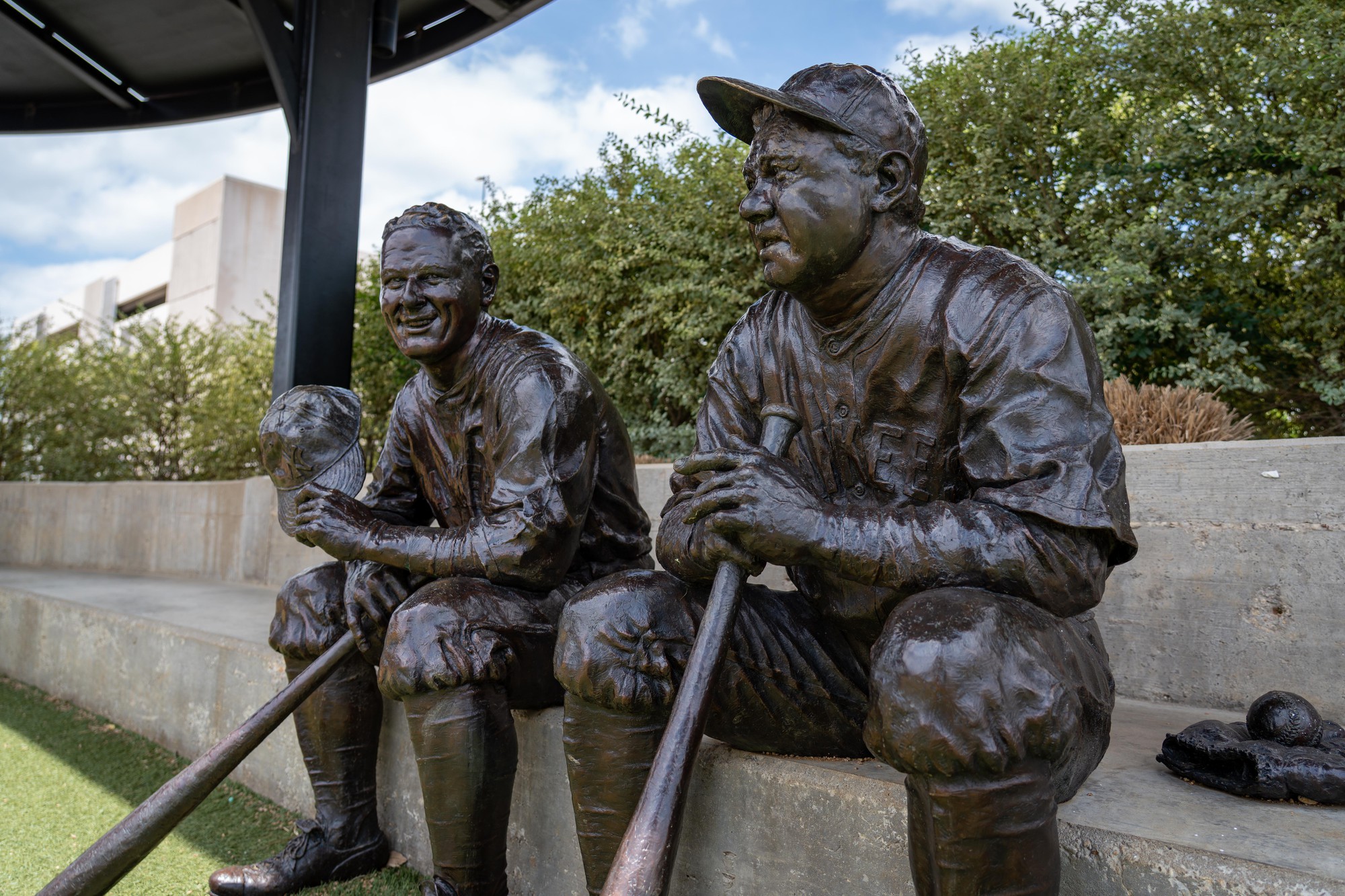
Today, the wiffle ball field on Katy Park’s gravesite stands as a monument to its former glory. Statues of Babe Ruth and Lou Gehrig look on, occasionally still mobbed by children, as home plate remains in the same place it always has.
Katy Park has a complicated legacy. Razed to a parking lot and raised to a wiffle ball field by Waco’s biggest economic attraction, its story shows how far the town has come — and how much further it still has to go.
The field welcomed Babe Ruth and 300 field-rushing children, an undersized slugger, a one-legged pitcher, an Olympic gold medalist, integrated football and Negro League royalty. Heroes, all of them, for as long as they stayed on that field. Through a tornado, a demolition and a century of social and economic change, baseball remained.
From presidential visits and boxing matches to racial integration and all the innings in between, Katy Park stood silently, watching generations of patrons pass by and grow old. Watching, sometimes squinting, but always there. In some ways, the old structure lived multiple lives, shifting with the seasons until falling to the winds of calamity.
Life is like that. So is baseball. Babe Ruth left the Yankees for the Boston Braves in 1935 but never got his old magic back. He hit .181 with six home runs in 92 plate appearances for a team that finished last in the National League. The writing was on the wall. It was time to hang ‘em up.
The same fate befell Katy Park. With the rise of television and other alternative entertainment, minor league teams didn’t seem so interested in moving to Waco anymore. The money dried up. The heart and soul of a community collapsed with scarcely a goodbye.
But perhaps it isn’t all gone. The river still winds through Waco, and the desire for change hasn’t run dry. Maybe there’s still hope for a better tomorrow, for a day when greater harmony and equality reign free. Perhaps the heart of Waco, like America, endures on the dusty corners of local baseball diamonds, patiently waiting for a new generation to approach their hallowed grounds and play ball.