By Rhea Choudhary | Staff Writer
A line graph rises increasingly across one of the first panels students see as they enter the Jesse H. Jones Library. Tall red bars depict how many visas the United States allowed in the late 1930s, and smaller gray bars illustrate how few were actually granted. The gap between the two is noticeable.
For thousands of Jewish refugees fleeing Nazi Germany, that disproportion meant the difference between safety and vulnerability.
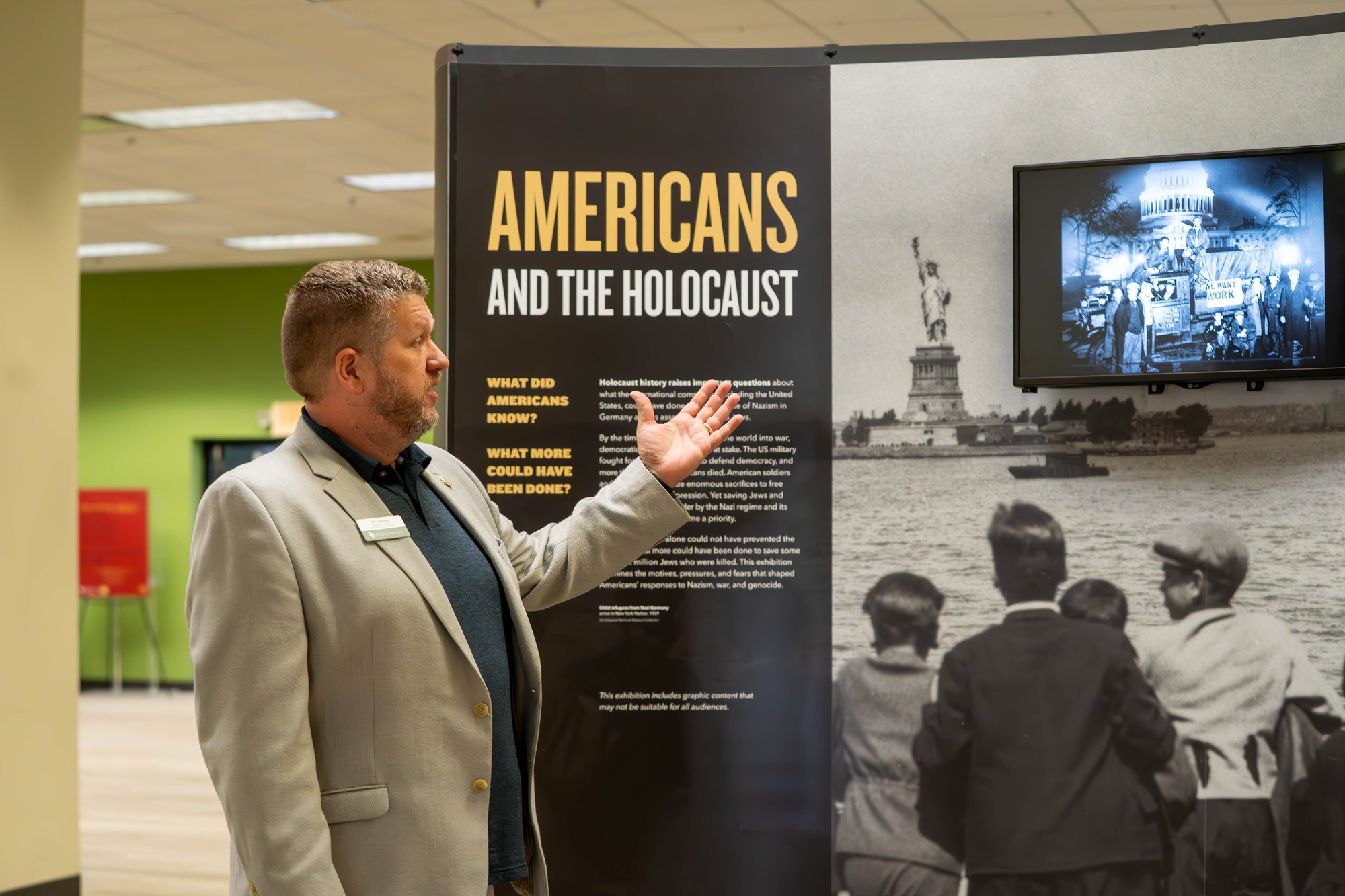
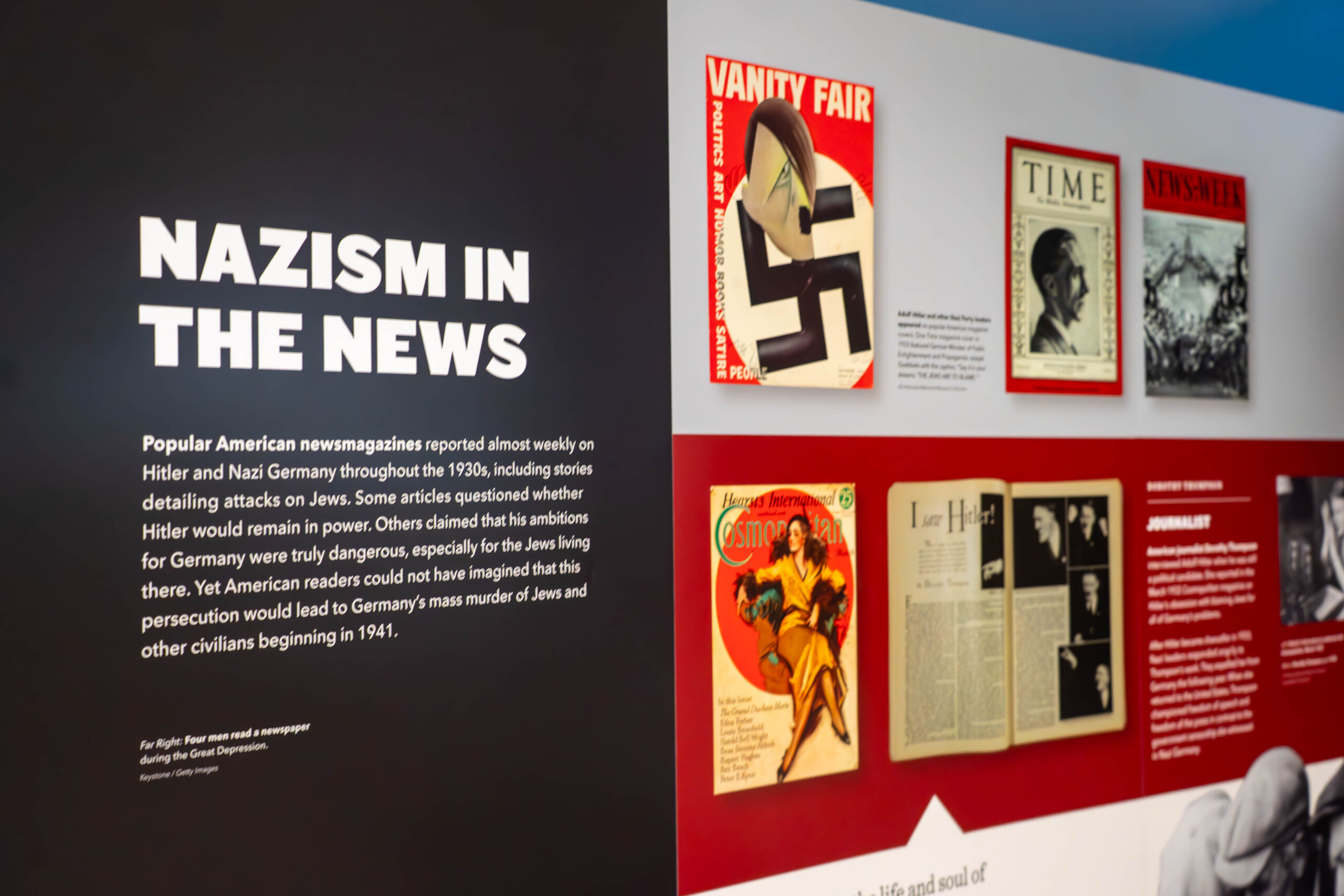
That reality is in the middle of “Americans and the Holocaust,” a traveling exhibit currently on display on the first floor of Jones H. Jones Library from April 11 through May 20. The United States Holocaust Memorial Museum and the American Library Association present the exhibit, examining the Holocaust through America’s evolving awareness of the event.
The exhibit arrived right in time for National Holocaust Remembrance Day on Tuesday, confronting a nationwide conversation regarding memory and responsibility within one of Baylor’s most commonly used academic spaces.
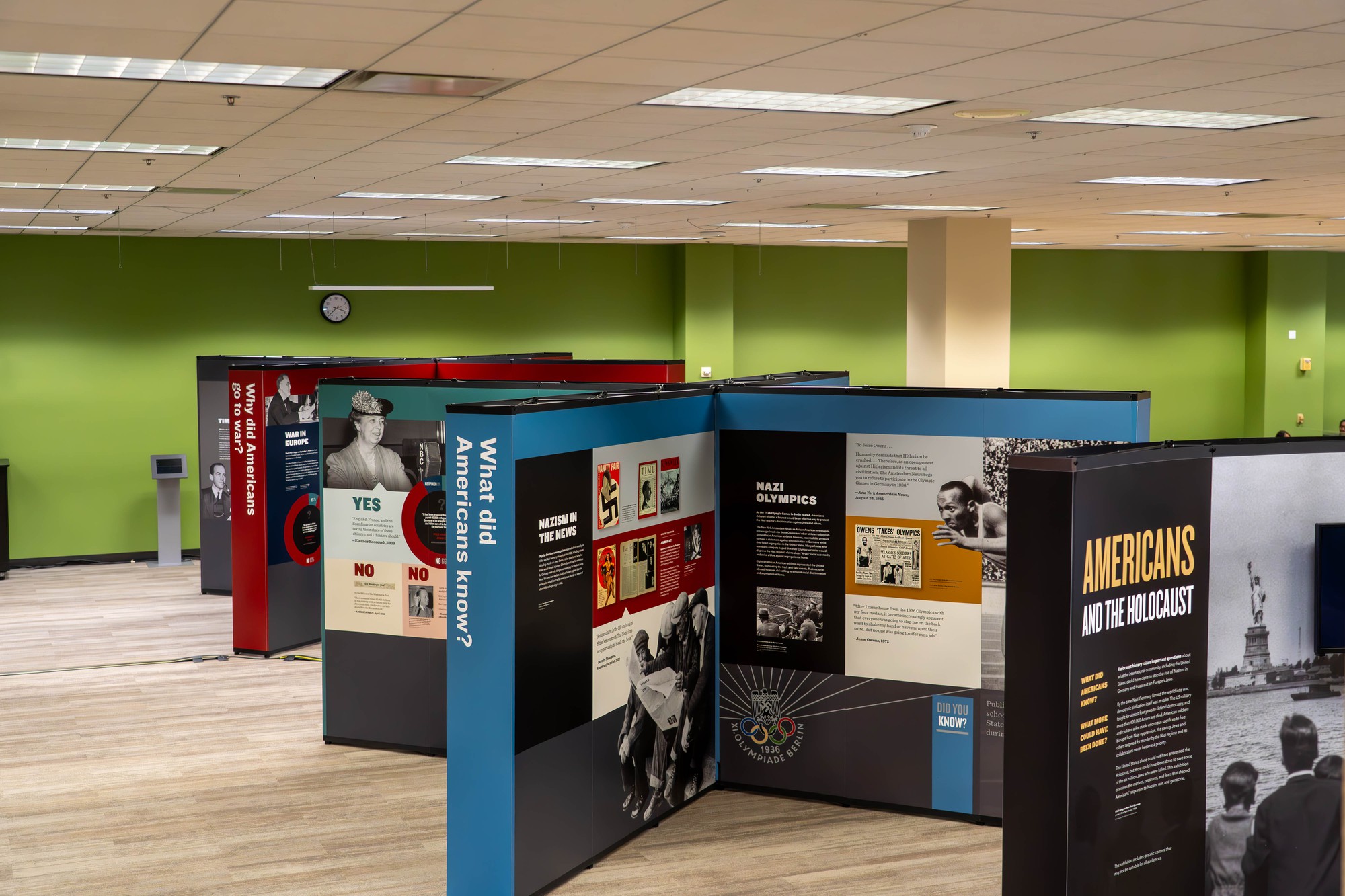
The exhibit includes facts and images spanning the early 1930s through the end of World War II, beginning with the rise of the Nazi regime and the earliest reactions in the United States.
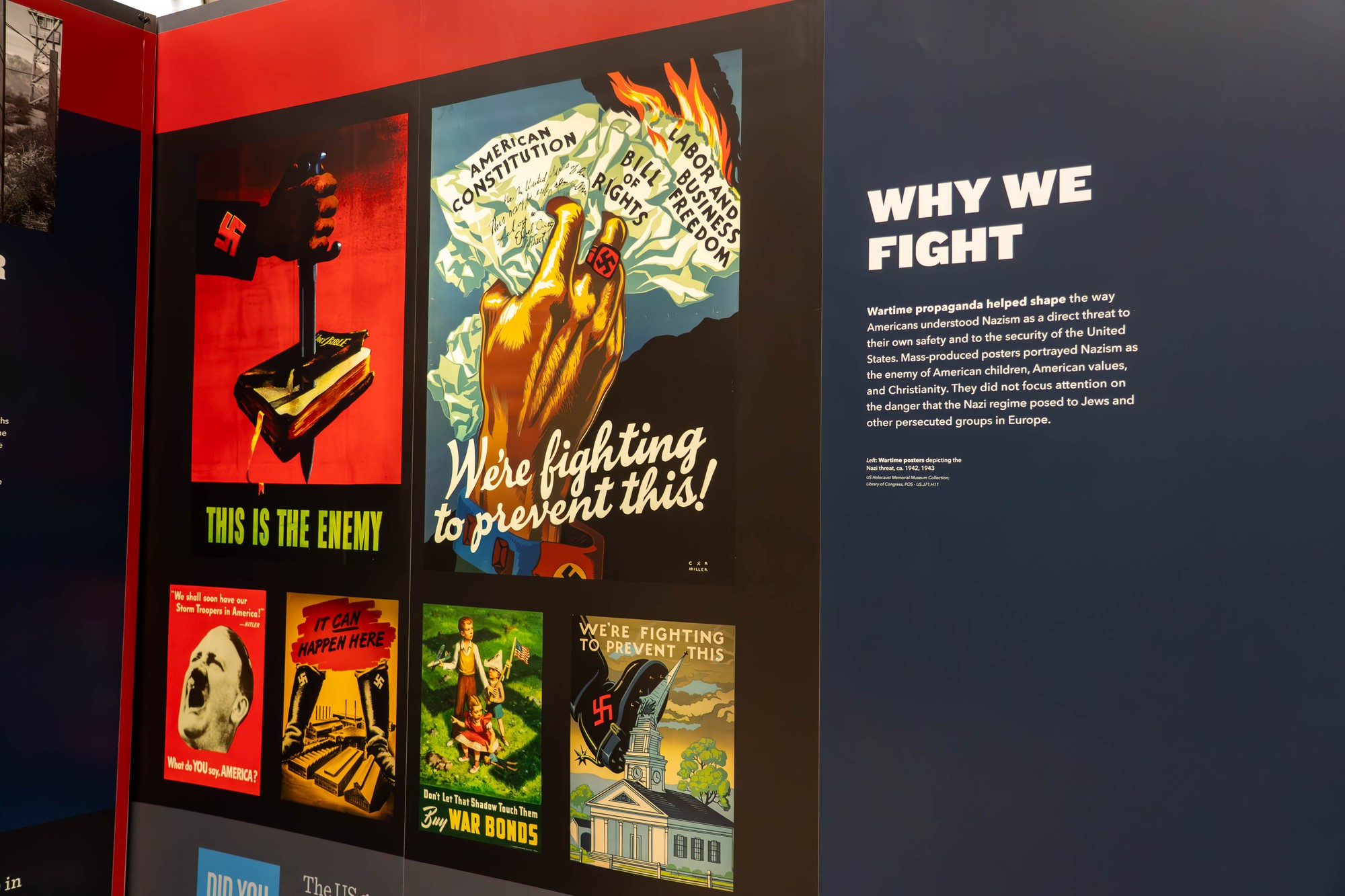
According to the USHMM, the exhibit looks at how Americans responded to refugees, war and genocide, refuting the assumption of American ignorance of the horrors happening overseas. It asks visitors to consider both the challenges individuals faced then and the choices people must make today.
“It starts with the story of the Nazis and their rise to power in the early ’30s and how Americans viewed that regime as it came into power,” said Eric Ames, associate director for Advancement, Exhibits and Community Engagement for Baylor Libraries. “Some people thought it was this amazing new breath of fresh air for Germany. Some people pretty quickly said, ‘Hey, these guys are planning some really awful stuff.’”
Ames described that awareness of Nazi persecution existed earlier than many assume.
“Even as early as 1932, you had reports that the Nazis were extremely anti-semitic,” Ames said. “People knew in the states as early as 1932-33 that something bad was happening.”
From there, the exhibit displays how information circulated in the U.S. and highlights Americans’ response to Jewish refugees seeking entry. Ames described some refugees being turned away even after reaching the U.S. shores.
“There was essentially kind of a debate within the United States about whether we should let them in or not,” Ames said.
The exhibit also focuses on the later discovery of concentration camps, along with how the Holocaust was portrayed to American audiences during and after the war.
A central message the exhibit emphasizes is addressing the belief that many Americans were unaware of the Holocaust until the war’s end.
“There is a perception that no one really knew what was happening until the first American troops went into the camps,” Ames said. “Well, the research shows that people did know and that there was a movement to try to stop things.”
The exhibit depicts how information reached Americans, whether it was through newspapers, radio or newsreels.
“It didn’t happen in a vacuum,” Ames said. “Things got out, and even though it wasn’t as fast as our social media connections now, information was getting out.”
Through primary sources and data collected from public opinions, the exhibit portrays the complexities of the American response, including spreading awareness of Nazi violence and limited support for an increase in the number of refugees.
The exhibit is placed in Jones Library instead of Moody Memorial Library, a decision Ames stated was intentional. The exhibit has interactive elements, including video displays and audio messages, providing viewers with the chance to engage with the material at their own time and pace.
“It is in more of a quiet study space because it might be harder to stand and read an exhibit in a more active environment,” Ames said. “I hope students are willing to walk up, just watch the videos. Some of them have no audio, and others you can pick up a little handset and listen.”
Since installation, Ames said students have already begun interacting with the exhibit.
“Every time I’ve walked through, there’s been at least one person reading something,” Ames said.
The exhibit’s arrival at Baylor follows a lengthy application and planning process that began in 2023 and was led by Humanities Librarian Laura Semrau.
Semrau discovered the opportunity through the American Library Association and helped compile the necessary components for Baylor’s application in 2023. Baylor was selected in 2024 as one of a limited number of host institutions nationwide, and one of only two in Texas.
The preparation included Ames attending training at the Holocaust Museum in Washington, along with Semrau coordinating with faculty across departments and organizing a series of public programs to accompany the exhibit.
“We never could have done it without professors from across Baylor,” Semrau said. “All the programs are free, and everyone’s encouraged to come.”
Upcoming events include a lecture by Dr. Rebecca Erbelding of the Holocaust Memorial Museum on April 16 in Schumacher Flex Commons, along with a documentary screening, various faculty panels and student research presentations to come.
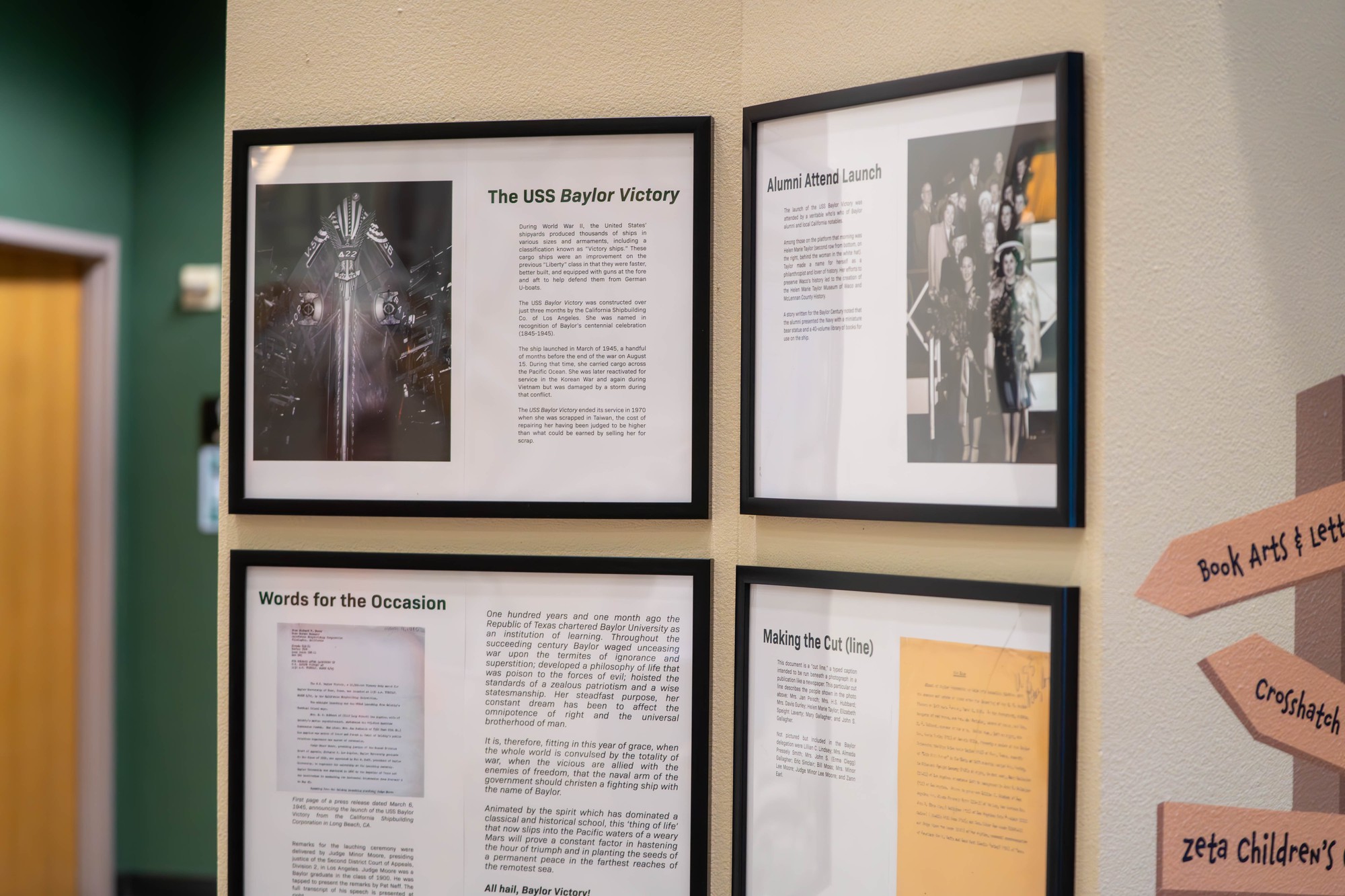
In addition to the traveling exhibit, Baylor Libraries incorporated a Baylor-specific ancillary display featuring pieces from the university’s archives, placed at the entrance to Jones Library.
One featured piece references a 2011 Baylor Lariat article, “Korczak and His Children,” which supports the story about a sculpture connected to Holocaust history.
The piece, discovered by English Professor Dr. Tom Hanks at a Waco synagogue, focuses on Dr. Janusz Korczak, a Polish-Jewish physician who cared for orphaned children in the Warsaw Ghetto. Despite opportunities to escape, Korczak refused to leave the children under his care and ultimately died with them.
The sculpture is a reproduction of a memorial located at Yad Vashem in Jerusalem and is the only copy of its kind. By including materials from Baylor’s archives, the exhibit connects larger-scale global Holocaust history to previous campus reporting.
As one peruses the exhibit, one question recurs: “What did Americans know, and what more could have been done?”
Ames said he hopes students engage with that question as they move through each display.
“I hope students will look at it and see how they went from persecution to ultimately trying to exterminate an entire group of people,” Ames said. “Our hope is viewers will maybe draw parallels between what took place then and things that happen in the world today.”
On April 16, Dr. Rebecca Erbelding of the USHMM will speak at 7 p.m. in Schumacher Flex Commons about how American college students experienced the Holocaust. Additional programs include a screening of “The U.S. and the Holocaust” documentary April 17, an interdisciplinary faculty panel April 21 and a student research event, “Archives and Memory,” April 23.
All events are free and open to the public. The exhibit remains open in Jones Library until May 20, with additional events for students, faculty and the broader Waco community to look forward to as the semester concludes.