By Josh Siatkowski | Staff Writer
Despite a tumultuous start to 2026 for financial markets, Baylor’s endowment has remained strong, buoyed by high-performing private investments, big wins in the energy sector and lower exposure to publicly-traded stocks.
“[The public investments] are up about 50 basis points, and that’s during a time when the equity market has been down about 2.5% from January to now,” said David Morehead, Baylor’s chief investment officer, on Wednesday.
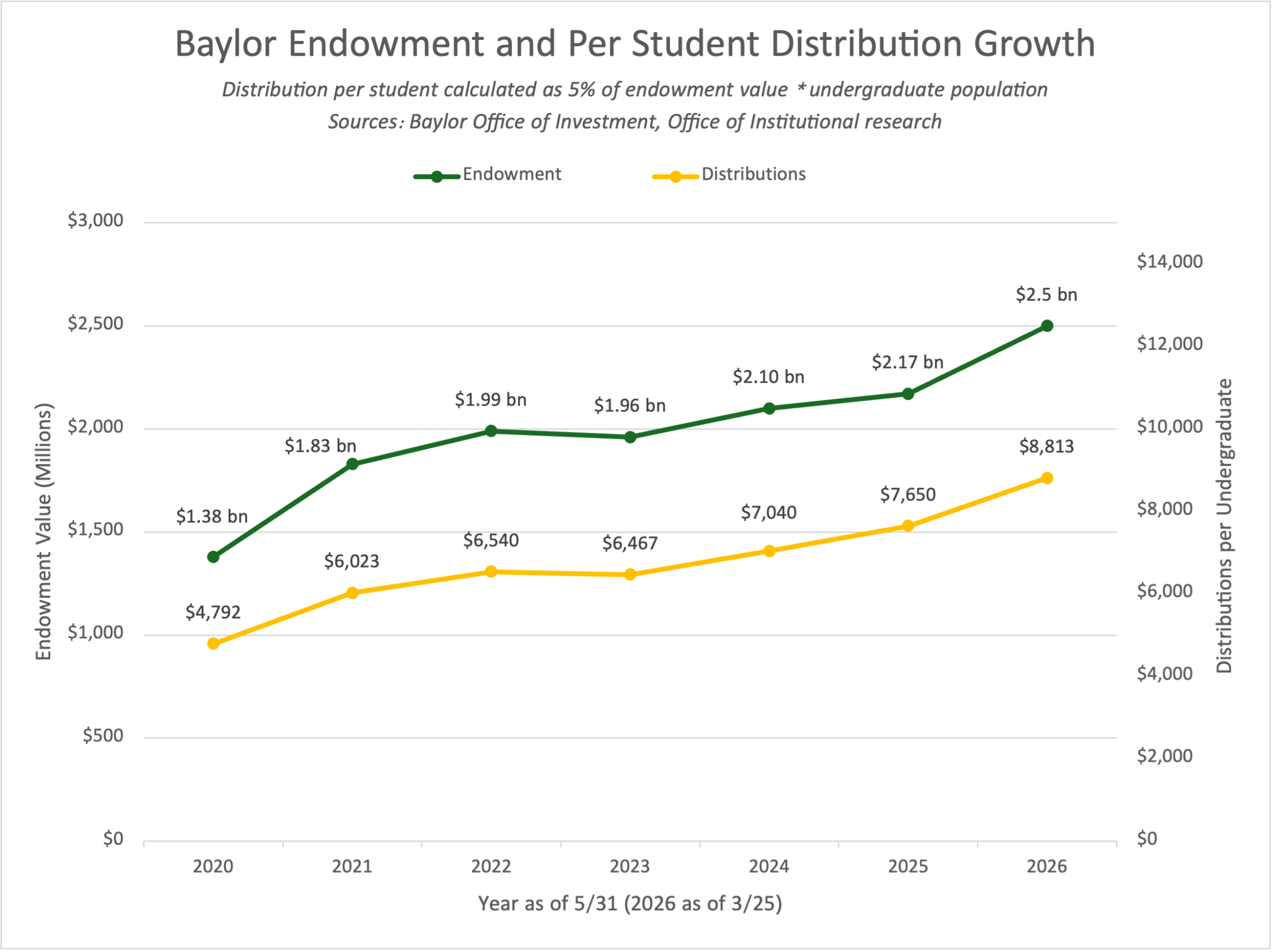
As of Wednesday, Morehead said he expected the endowment to end the month near $2.5 billion, up from $2.4 billion at the end of September and a further increase from its $2.17 billion balance in May 2025. The endowment contributes 5% of its value back to Baylor each year, so each dollar the endowment makes puts five cents into Baylor’s operating budget.
Rough Thursday and Friday trading sessions brought indexes down even lower than what Morehead said earlier in the week, and the benchmark S&P 500 Index has fallen 7% year-to-date as of March 27. Dr. Erik Davidson, Baylor finance professor and former chief investment officer at Wells Fargo, ascribed the downturn to a multitude of challenges.
“There is certainly no shortage of things to worry about these days: the Persian Gulf conflict, high energy prices, political impasse, stubborn inflation, weakening labor market, uncertainty of artificial intelligence implications,” Davidson said via email.
While recent volatility might temporarily push the total below $2.5 billion, Morehead said his team has likely still outperformed other endowments in this period.
“I would guess that Baylor’s returns over this quarter are quite good relative to the other endowments in the country,” Morehead said. “I would guess that most are down in the 2% to 3% range in a time when we’re up 50 basis points.”
Morehead said that, though the endowment sold some holdings in energy assets for a 50% return in the last few weeks, most of its success in public markets has been due to a lack of exposure.
“We have, over the last couple of years, actually found more to do outside the public equity market,” Morehead said. “If you have less exposure to public markets and they go down, then you don’t take that hit. And on the flip side, we’ve been invested in a bunch of idiosyncratic things … that actually have done well.”
The private markets team, which handles investments not publicly traded on exchanges like the New York Stock Exchange, allocates up to 45% of the total endowment’s assets. One of its most successful recent investments was a Canadian helium deposit, which has grown in value since Qatari helium production was curtailed due to the war in Iran.
“About 15% of that production line is going to be offline for three to five years, and they’re the single largest supplier of helium globally,” Morehead said.
The strategy has allowed the endowment to hold what Davidson called an “all-weather” portfolio.
“The best way to navigate that uncertainty is to hold an ‘all-weather’ portfolio which is diversified such that it can participate in favorable markets as well as have a cushion against the downside of adverse markets,” Davidson said.
Davidson also said he is not surprised by the endowment’s resilience.
“When an investment portfolio is well-diversified, like the university’s endowment is, its returns will not move in lockstep with the S&P 500,” Davidson said.
Right now, the endowment covers about 10% of the university’s operating expenses, and its distributions equate to about $8,000 per undergraduate student. In the future, Morehead wants to see those figures rise so that the contribution per student is more noticeable.
“Our goal, obviously, is to grow the endowment faster than the school grows, so that both the absolute number of dollars that are going to the school is going up, but the percentage of the operating budget that’s funded by the endowment also is going up,” Morehead said.