By Abby Rathburn | Staff Writer
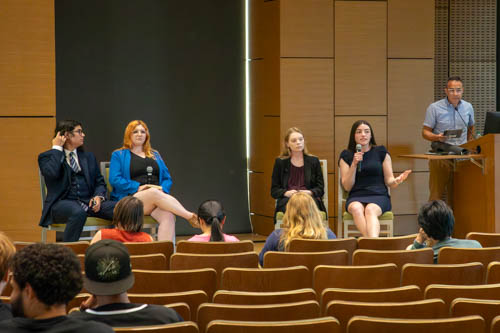
Baylor’s College Democrats and College Republicans held an open debate on Tuesday evening in Foster 240 as an installment in Civil Discourse Week.
Civil Discourse Week was introduced last year through a Student Government bill. Dr. Kevin Villegas, dean of Intercultural Engagement, who served as the debate moderator, said this week was created to help Baylor students learn how to hold meaningful conversations in a polarized society.
“Really, what we’re after is creating an environment, really a culture here at Baylor, where we know how to disagree well with each other,” Villegas said. “It is a critical, critical skill to have.”
The debate featured two panelists from the College Republicans and two panelists from the College Democrats, as well as the moderator, who fielded audience questions coming via a QR code posted at the beginning of the event. Upon hearing the question, each organization had approximately two minutes to answer.
With more than 60 questions submitted as the debate went on, panelists couldn’t answer every one within the time constraints. However, the speakers hit on a variety of topics, including tradeoffs between the environment and the economy, recent U.S. presence in foreign countries, the SAVE Act, voter fraud and TPUSA’s April 22 event.
Although the organizations often held opposing stances on issues, both the College Democrats and the College Republicans acknowledged the other side’s viewpoint.
When speaking on the Paris Climate Agreement, Seattle sophomore and College Democrats social media chair RJ Todd made it her prerogative to acknowledge her agreement with the College Republicans, while staying true to her beliefs.
“Yes, it is a climate agreement, and I say you are correct in the fact that it is a political agreement as well, but if America wants to call itself a leader of these developed nations, then it has to remain a part of that,” Todd said.
Similarly, Denver junior Cadence Ames, the College Republicans vice chair, acknowledged what the Democratic Party has accomplished in the past while maintaining her belief that the Republican Party is currently more for the “common man.”
“I do think historically the Democratic Party has really propped up the everyday American,” Ames said. “I know that my great-grandparents were New Deal Democrats. My family — they were all farmers, and they would not have survived without the Democratic Party.”
Villegas closed the event by having each speaker reflect on what they wished their party did differently, recognizing differences of opinion within the parties themselves. College Republicans President and College Station senior Lindsay Flanigan said humanizing the moment was important.
“When we don’t communicate with each other, stop looking at each other as individuals with beliefs and start looking at each other just as political points or stances, that’s really dehumanizing,” Flanigan said.
Colleyville senior and Vice President of the College Democrats Nicholas Kienker echoed this belief, stressing the importance of admitting when he or his party has misspoken.
“It’s the absolute unwillingness to admit that the Democratic Party is completely tripping over themselves … and refusal to have constructive debates like this one, and I’m personally trying to change that with this,” Kienker said.
Students of various political backgrounds attended, often interrupting with remarks, laughter and other vocal commentary. Medina, Minn., freshman Delaney Flanigan said this is an inevitable part of attending open debates discussing controversial topics.
“I think in debates there will always be people that react a certain way because people are passionate about their beliefs and that’s just kind of how it goes,” she said. “We just kind of move on and keep the debate going as smoothly as we can.”