By Joana Karoshi | Staff Writer
A Baylor professor argued that Russia’s war in Ukraine cannot be fully understood without examining the decisions of ordinary people on the ground, challenging common narratives that frame the conflict solely as a clash between global powers.
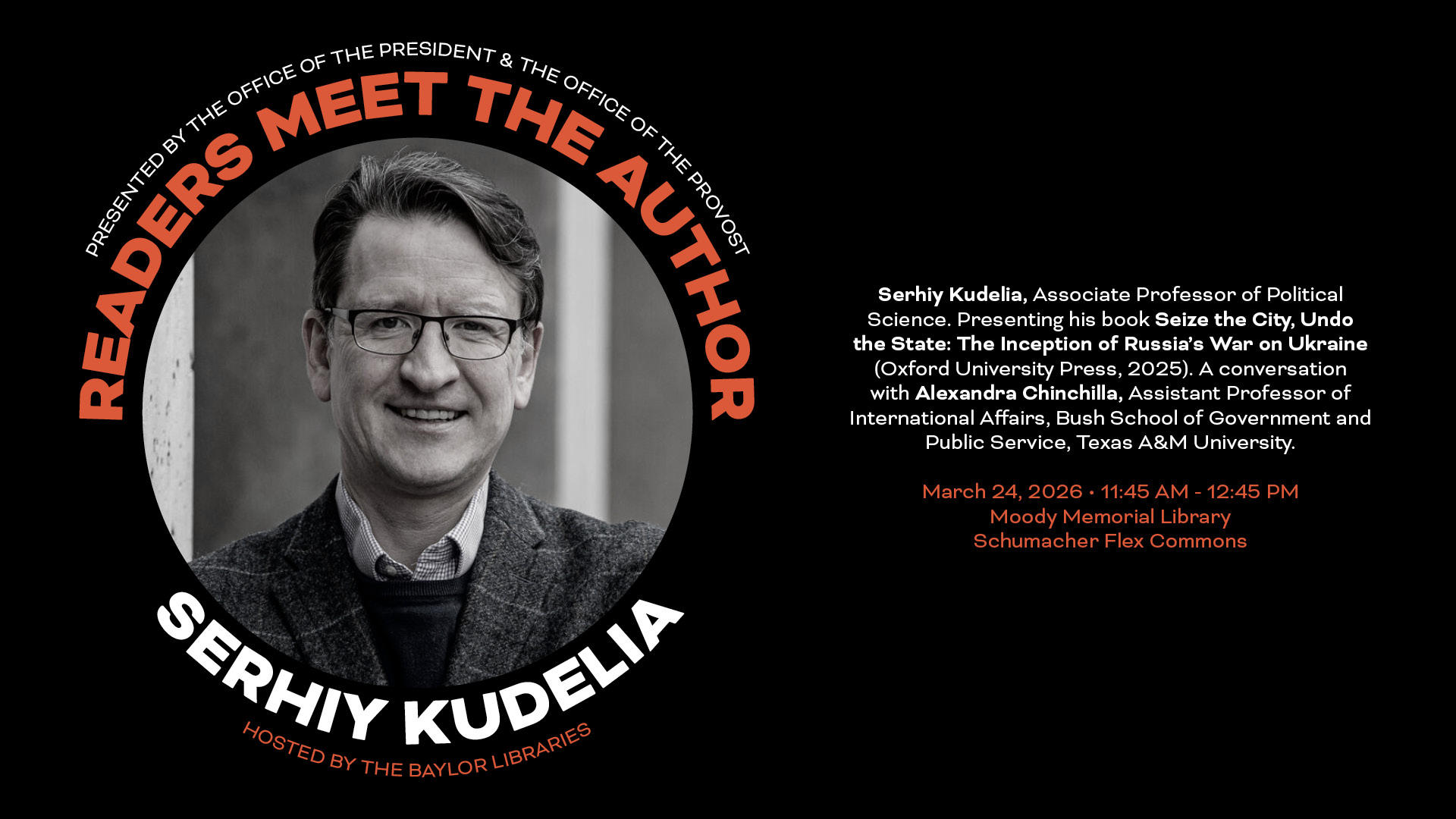
The discussion, part of the Office of the Provost’s Readers Meet the Author series, featured Professor of Political Science Sergiy Kudelia and co-author Alexandra Chinchilla, who discussed their book on the origins of the war in Ukraine, particularly the 2014 conflict in the Donbas region.
Chinchilla described the book as an effort to explain “how we get to the war in Ukraine today,” emphasizing that the roots of the current conflict extend back more than a decade. Kudelia’s research draws on interviews conducted in Eastern Ukraine, offering a ground-level view of how the war began.
Rather than focusing only on decisions made by leaders in Moscow or Washington, Kudelia said his work centers on local communities and the choices individuals made as violence unfolded.
“A lot of [research] has been done at a macro level,” Kudelia said. “But nobody was actually asking people on the ground why they made the choices they made.”
According to Kudelia, the outbreak of conflict in 2014 cannot be explained by a single cause. Instead, it resulted from a combination of Russian involvement and local participation.
“You need both paths,” Kudelia said, referring to external influence and internal decision-making. “Russia’s involvement is essential … but you also have local actors making certain choices.”
Kudelia explained that in some areas of Eastern Ukraine, small groups organized themselves into local defense units before large-scale armed intervention began. In other towns, however, similar movements never formed until outside actors arrived and escalated the conflict.
He also described how quickly conditions shifted in affected communities, forcing local leaders to make high-stakes decisions under pressure.
“If someone knocks on your door with a couple of machine guns … what would you say?” Kudelia said.
A key theme of the discussion was the role of misconceptions about the war. Kudelia pushed back against the idea that Eastern Ukraine was uniformly pro-Russian, noting that some communities actively resisted separatist movements.
He also highlighted a lesser-known statistic: prior to 2014, many Ukrainians did not view Russia as a threat.
“In 2014, the majority of Ukrainians would say Russia is a friendly state,” Kudelia said.
For students in attendance, that detail stood out.
San Diego junior Grace Youngkin said she was surprised by how Ukrainians historically perceived Russia.
“I was really surprised about him saying that 70% of Ukrainians didn’t see Russia as a threat prior to the invasion,” Youngkin said. “They blamed communism … as opposed to Russia.”
Denham Springs, La., junior McKenna Croft said the talk challenged her assumptions about the relationship between the two countries.
“I thought it was really surprising that so many Ukrainians still viewed Russia in a friendly manner,” Croft said. “I had not previously thought about that.”
Both students said they attended the event in part because of their experience taking classes with Kudelia, citing his expertise and perspective as a scholar with personal ties to Ukraine.
Throughout the discussion, Kudelia emphasized that understanding the war requires moving beyond simplified narratives and recognizing the complexity of local experiences.
By focusing on individual choices and community dynamics, Kudelia said his book aims to provide a more complete explanation of how the conflict began — and why it continues to shape global politics today.