By Giselle Lee | Staff Writer
At the annual Women’s History Month Roundtable, three speakers in the history department shared their research on women who contributed to the fields of journalism and health.
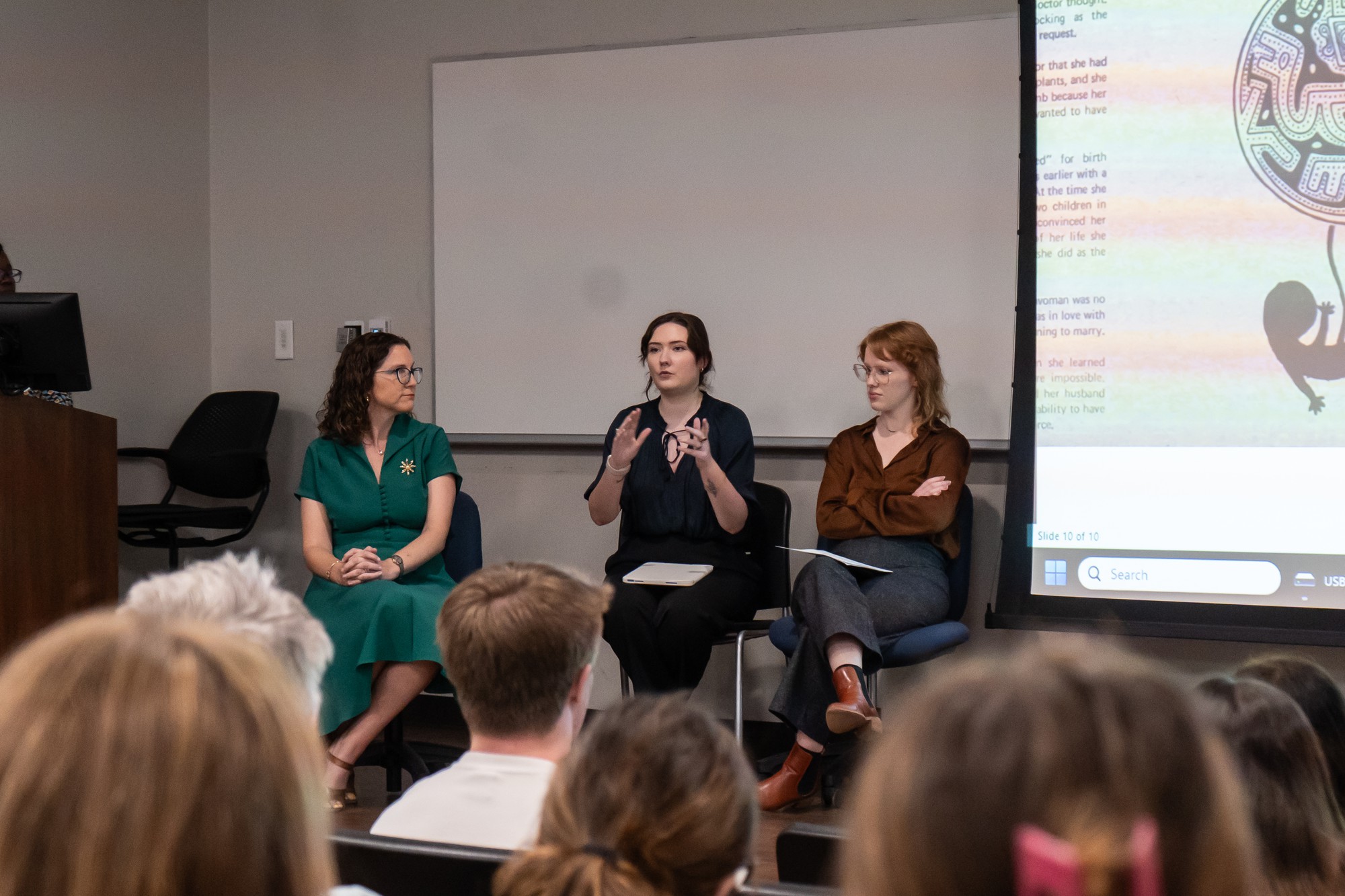
The event — themed “Mind, Body, Spirit: American Women in Journalism and Health” — featured History Professor Dr. Elesha Coffman and PhD candidates Savannah Flanagan from Waco and Brooke LeFevre from Snohomish, Wash.
The featured speakers presented their findings on topics such as U.S. religion and media, the reproductive healthcare practices of religious communities and the history of professionalization surrounding reproductive medicine in the American West.
Coffman focused on the legacy of Lillian Block, an editor of the Religious News Service in New York. Block’s work helped shape the public’s knowledge of religion by managing all archived and incoming information at the Religious News Service and by professionalizing religious journalism through teaching others.
Block served as managing editor of RNS after the death of Louis Minsky. But Coffman said she was only highly respected among people “who knew who she was.”
“Because she worked behind the scenes, her name may not be known to the public at large,” Coffman said. “This may explain why they didn’t immediately name her managing editor after Louis Minsky died. It didn’t occur to them that the woman who was already doing the job could, in fact, do the job.”
Coffman related her findings of Block to her personal experiences as a woman in the history department, where she described herself as the only woman in the room.
“I was assistant editor of a magazine,” Coffman said. “The editor left. I went on running the magazine by myself for several months, and then I saw an ad posting for the job I was doing. That was in the 21st century, and it might as well have [been] 1957.”
Flanagan outlined the personal history of Dr. Rebecca Lee Crumpler, the first Black woman in the U.S. to earn a medical degree. In the 1800s, Crumpler expanded access to medical knowledge by writing about maternal care.
“She avoids dense, medical jargon that might make the book inaccessible to non-physicians,” Flanagan said. “At the same time, she avoids the overly sentimental language that appeared in many health manuals directed towards mothers at the time. Instead, her writing is direct, it is practical and it is educational.”
Flanagan said Crumpler’s emphasis on the mother getting rest after emancipation was a form of advocacy. Many Black women were historically forced to perform intense physical labor soon after childbirth.
“She emphasized dignity, preservation and rest for women whose bodies had historically been exploited,” Flanagan said. “At a time when Black women’s bodies were frequently used as sites of medical experimentation, Crumpler’s work offered a radically different vision of healthcare … grounded in community care, education and respect for the well-being of Black mothers and children.”
LeFevre presented medical abuses that Black women in the South endured during the late 19th century, which involved forced and permanent sterilization operations. LeFevre quoted physician E.M. Buckingham, who argued that women avoiding having children was “an issue of citizenship and racial preservation,” which contributed to the enactment of Eugenic policies in the U.S.
“The term race suicide was coined by Eugenicists who sought to preserve the white race through selective breeding,” LeFevre said. “Women in the United States, particularly Black and indigenous women, continued to be coerced into sterilizations well into the 1970s. By 1977, likely more than a quarter of all indigenous women in the United States have been sterilized, many of them unaware of the operation they underwent.”
LeFevre urged the cruciality of not only celebrating Women’s History Month, but also to “mourn” it.
“It is important to ask ourselves why these wrongs against women ever happened, what ideas and fears allowed us as a society to justify abuse and violence against women,” LeFevre said. “Fear is a powerful thing, and it is so often women who bear the brunt of society’s fears.”