






By Alexandra Brewer | Arts & Life Writer
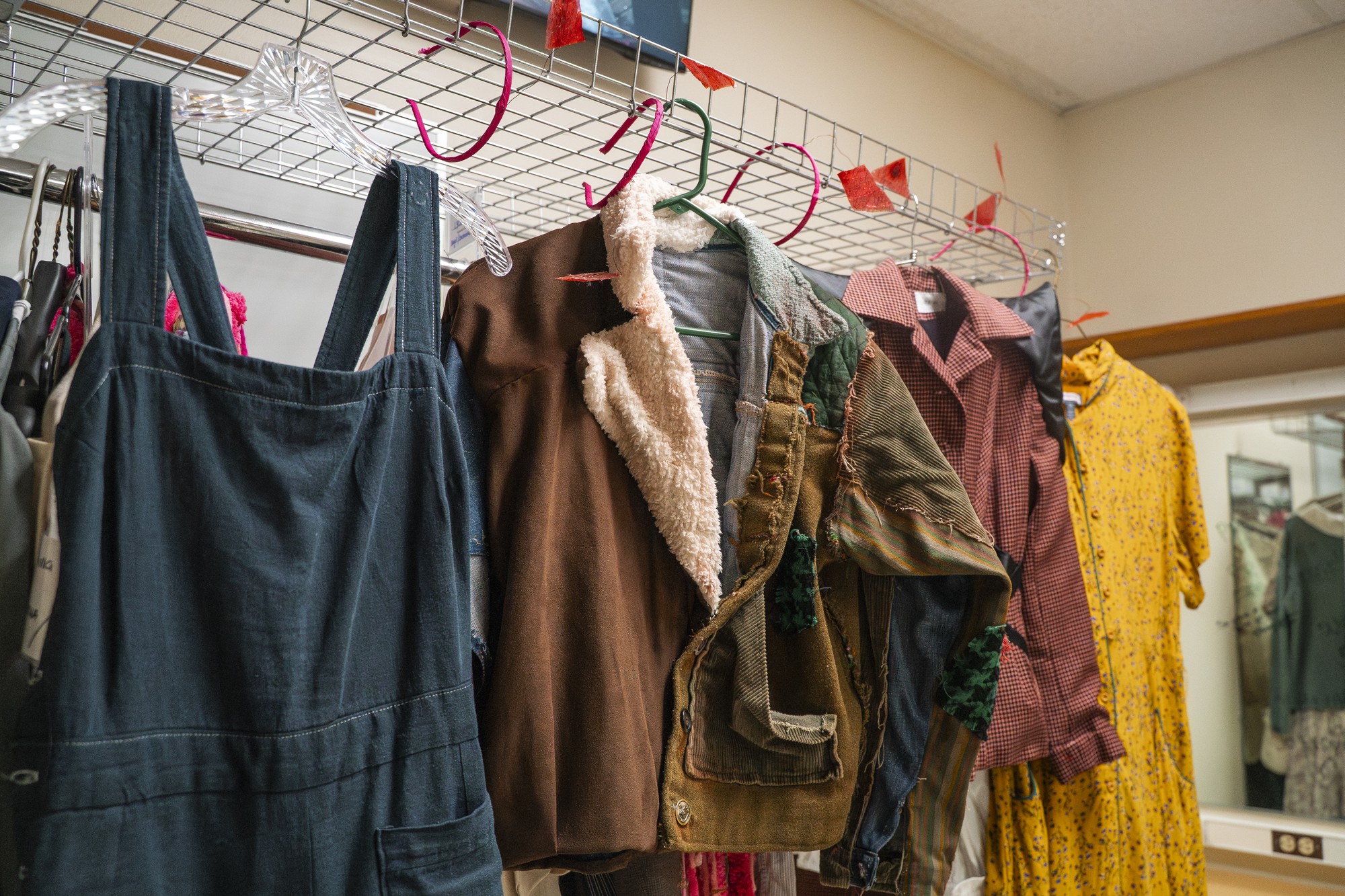
“Alice By Heart” takes place in 1940s London during the Blitz and in a fractured version of Wonderland. The underground scenes stick close to historical reality, while Wonderland is wild, fractured and a little chaotic. The costumes reflect that shift, moving from realistic jackets and dresses to pieces stitched, layered or completely reimagined.
Some look like they came straight out of 1940s London, while others are completely fractured and strange, like Wonderland itself. Pieces get patched together, colors clash and tiny details tell stories about each character’s past fears and personality.
Sarah Mosher, the show’s costume designer and an associate professor of costume design at Baylor, said the concept was inspired by that transition between worlds. She wanted the costumes to show how reality gradually breaks apart.
“For ‘Alice By Heart,’ the director was really interested in this idea that happened from the underground into Wonderland,” Mosher said.
In the underground scenes, Mosher said the team focused on historical accuracy. The 1940s silhouettes and textures anchor the characters in wartime reality. When Wonderland emerges, the costumes become more playful and fragmented, reflecting the chaos of that world.
One of the biggest design challenges was the Queen of Hearts. Mosher wanted the character to feel larger and more imposing with each appearance.
“I pitched the idea of having a crown that descends as a set piece that also lights up,” Mosher said.
The crown functions as both a costume and a stage piece, scaling her presence without limiting her movement.
Mosher also incorporated bioplastics into some garments, a process she has been developing for years. She explained that the material is made from natural substances, such as algae or seaweed, which are melted down and shaped into costume pieces.
The bioplastic pieces were used for costumes such as the Jabberwocky and for the Knaves’ headpieces.
Woodway junior and assistant costume designer Savannah Ortiz said the work began months before rehearsals. The team started meeting in September, although design ideas had been forming even earlier.
“The designer has been curating these ideas, probably since last year when the show got announced,” Ortiz said.
Ortiz said the two-world structure shaped how costumes were sourced and built. Most of the 1940s clothing came from existing stock, while Wonderland pieces were built specifically for the show.
“Almost all of the realistic clothing was pulled,” Ortiz said. “Almost all of the Wonderland stuff was built specifically for this show.”

Ortiz also mentioned how budget constraints required creativity. Some materials were thrifted, donated pieces were repurposed, and when the team couldn’t find red mittens for the lobsters, a community member knit them.
“We were very creative and resourceful,” Ortiz said.
Riesel senior Eduardo Perez plays Harold Pudding and the Mad Hatter, and said the costumes changed how he approached his characters. Seeing the full outfits made the show feel more real.
“The first rehearsal where you actually get to do a run in your costume … It just makes things so much more real,” Perez said.
Perez said his Mad Hatter jacket reflects his character’s fractured mental state.
“My Mad Hatter jacket is a collection of different coats stitched together, just to show how fractured my sense of self is even in Wonderland,” Perez said.
Perez said subtle imperfections in his costume help him stay in character, reflecting the inner struggles of Harold Pudding, a veteran dealing with trauma.
“A lot of my costume elements are kind of askew, because I’ve lost that sense of self-care and grooming in the process of going through my shell shock,” Perez said.
Perez described how those details create “idiosyncratic habits” — small, almost meaningless gestures that ground him in character.
“I’ll notice if the buttons are undone, I, as my character, will be like, oh, I need to fix that,” Perez said.
The show opened on Feb. 18 and runs through March 1. Tickets can be purchased here.


