By Hannah Webb | News Editor
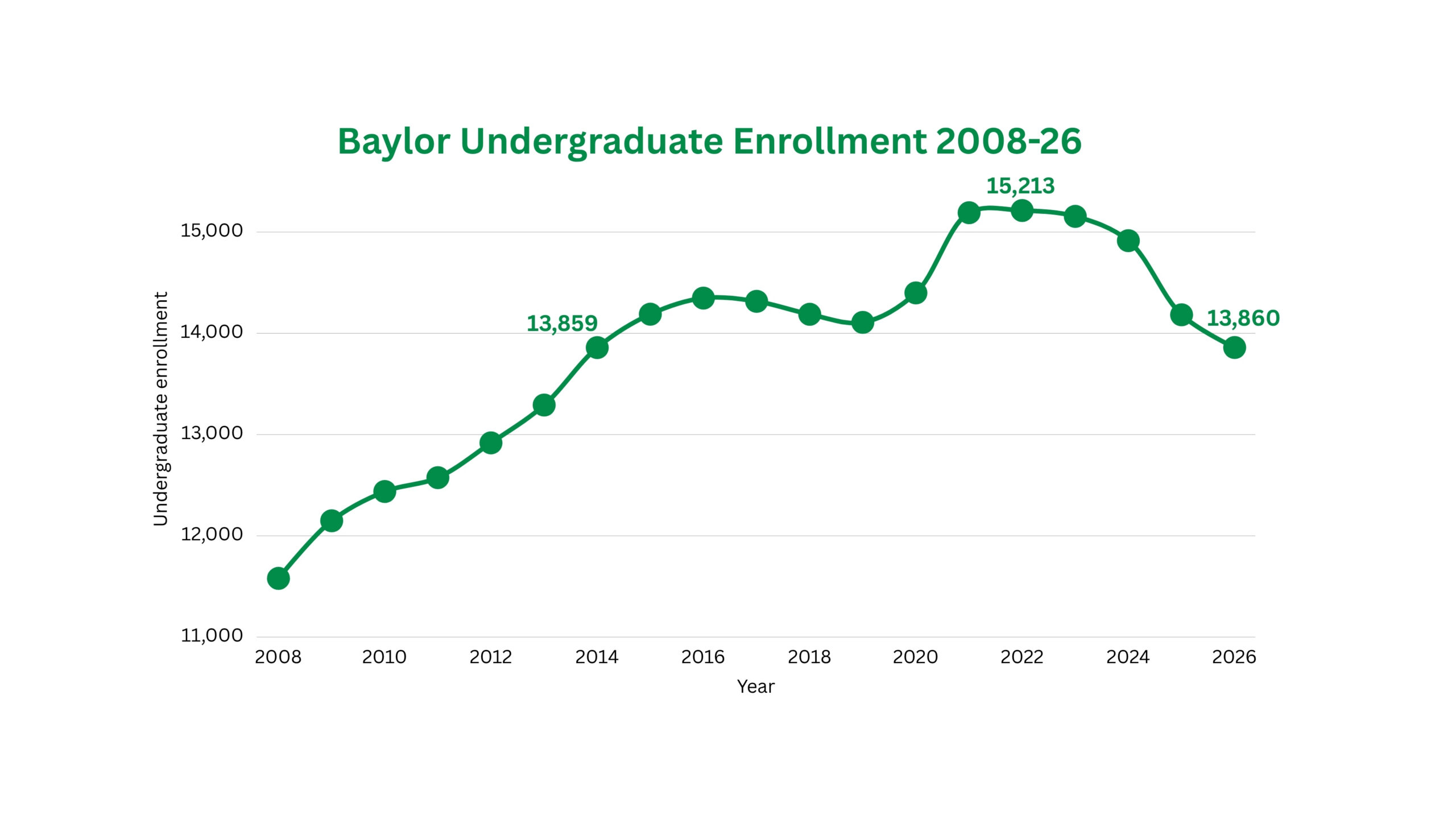
Baylor enrolled 13,860 undergraduates this fall, its lowest total since 2014 and 323 fewer than last year. The decline marks the fourth consecutive year of falling undergraduate enrollment, while graduate enrollment continues to grow.
Undergraduate enrollment peaked at 15,213 in 2022. Since then, Baylor has lost 1,353 undergraduates, an 8.9% decline. This fall’s count is just one student above the 13,859 enrolled in 2014.
According to data published by Institutional Research, the incoming class size dropped from last year: Baylor enrolled 3,340 first-time freshmen, compared with 3,352 in 2025. Graduate enrollment rose from 5,675 to 5,888. Together, undergraduate and graduate enrollment brought Baylor’s total to 19,748 students, down 110 from last year.
President Linda Livingstone cited a smaller pool of college-age students, difficulties for international students seeking visas and the cost of college as pressures on enrollment.
“We know that affordability is a huge issue right now among students going to college,” Livingstone said.
Baylor’s published tuition has risen steadily, reaching $67,756 for the 2026-27 school year at a 6.5% increase.
At that rate, losing 323 students represents about $21.9 million in tuition. That figure is a calculation based on the enrollment difference, not an estimate of lost revenue: Many students receive scholarships or other aid, and the enrollment figures do not show how much each student pays.
Dr. Jackson Barth, assistant professor of statistical science, said tuition increases could make it harder to recruit students, though he did not know whether Baylor’s increases were a response to declining enrollment.
“If you raise tuition, less people are going to enroll in general,” Barth said. “So there is a little bit of a trade-off there.”
Livingstone said Baylor is looking at scholarships, fundraising and student work opportunities to address affordability. The university is also working to recruit more transfer students, veterans and active-duty military members, and to retain students already enrolled.
Another priority is bringing prospective students to campus. Livingstone said about 35% of students who visit Baylor on a tour ultimately enroll, a higher rate than among students who do not visit.
“Because when they come to campus, they experience the culture here, they experience all that makes Baylor great that you can tell people about,” Livingstone said.
Baylor’s decline stands out alongside undergraduate growth at two other private Texas universities. TCU enrolled 11,452 undergraduates this fall, up 300 from last year and 929 from 2022. SMU enrolled 7,668, up 123 from last year and 612 from 2022. By comparison, Baylor has lost 1,353 undergraduates since 2022.
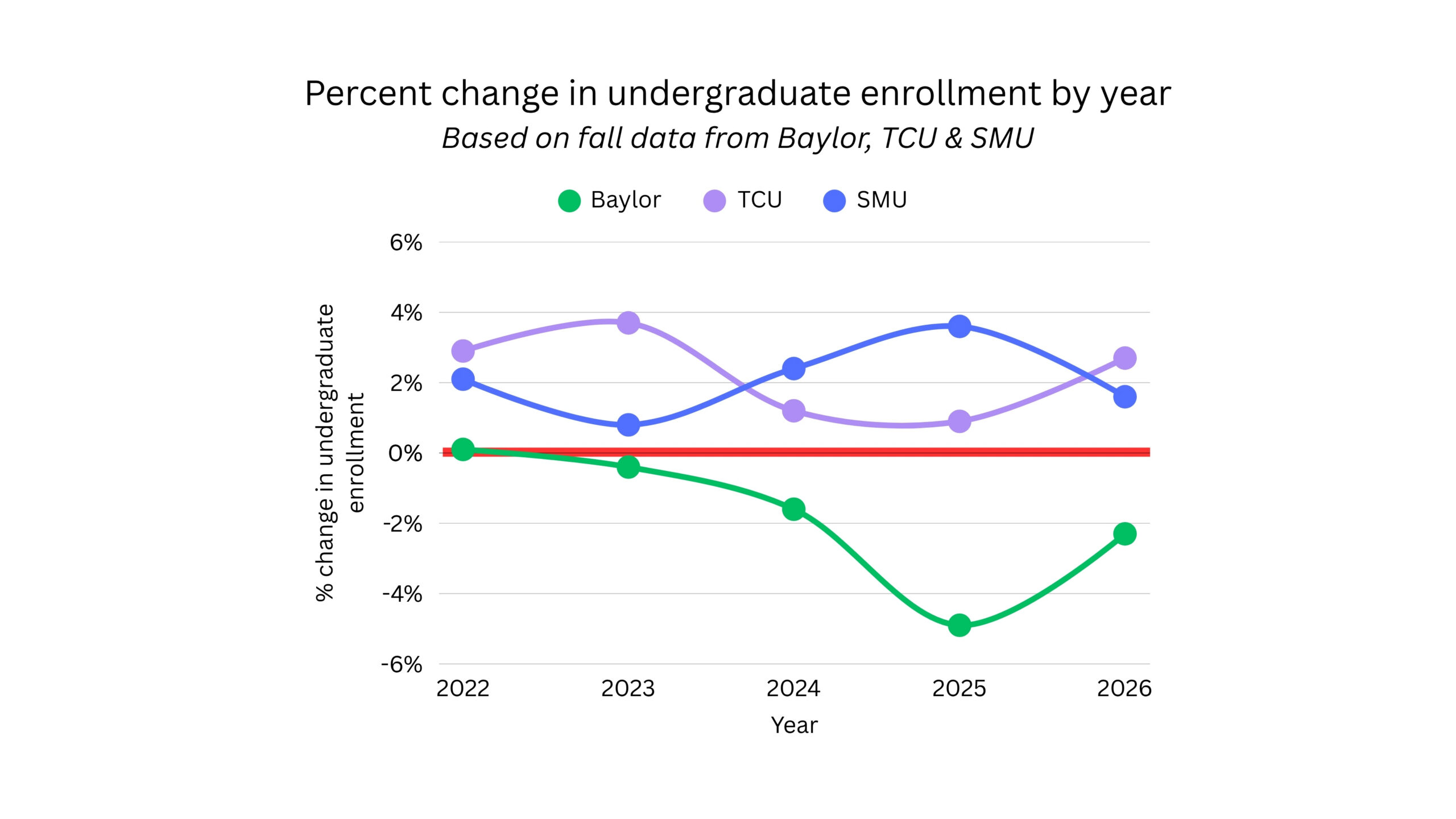
Baylor’s undergraduate enrollment is still falling, though the decline slowed this year. Enrollment dropped about 4.9% from 2024 to 2025, then about 2.3% from 2025 to 2026. TCU and SMU moved in the opposite direction: TCU grew about 2.7% this year, while SMU grew about 1.6%. The comparison shows that Baylor’s losses are easing, but it has yet to return to growth.
The different trajectories do not mean TCU and SMU are immune to the demographic shift facing higher education.
Barth said the “demographic cliff” — a projected decline in college-age students following a drop in births after the 2008 financial crisis — is a challenge no university can entirely avoid. He expects its effects to become clearer over the next few years.
Interim Chair of Anthropology Dr. Carson Mencken also said colleges broadly face a smaller pool of prospective students. He pointed to additional pressures, including fewer international students and some young people choosing trades or other paths instead of a four-year degree. Those pressures may affect universities differently, even while TCU and SMU are currently growing.
Barth cautioned against attributing Baylor’s decline solely to demographics. Concerns about artificial intelligence’s effect on jobs and changing attitudes toward college could influence students’ decisions, he said.
Mencken said Baylor’s pandemic-era classes were unusually large and created challenges, including a need for additional student housing. He described part of the decline since then as an adjustment, but said Baylor must work harder to reach students seeking its undergraduate experience.
“We have to do a better job of finding them and getting them on campus,” Mencken said.
Barth called the latest figure discouraging, though he said Baylor’s decline is not yet cause for alarm. For now, undergraduate enrollment has returned almost exactly to where it stood 12 years ago, even as TCU and SMU continue to grow.
“[The enrollment decline is] certainly not a good thing, but I don’t necessarily think it’s time to panic yet, either,” Barth said.