By Josh Siatkowski | Lead Writer
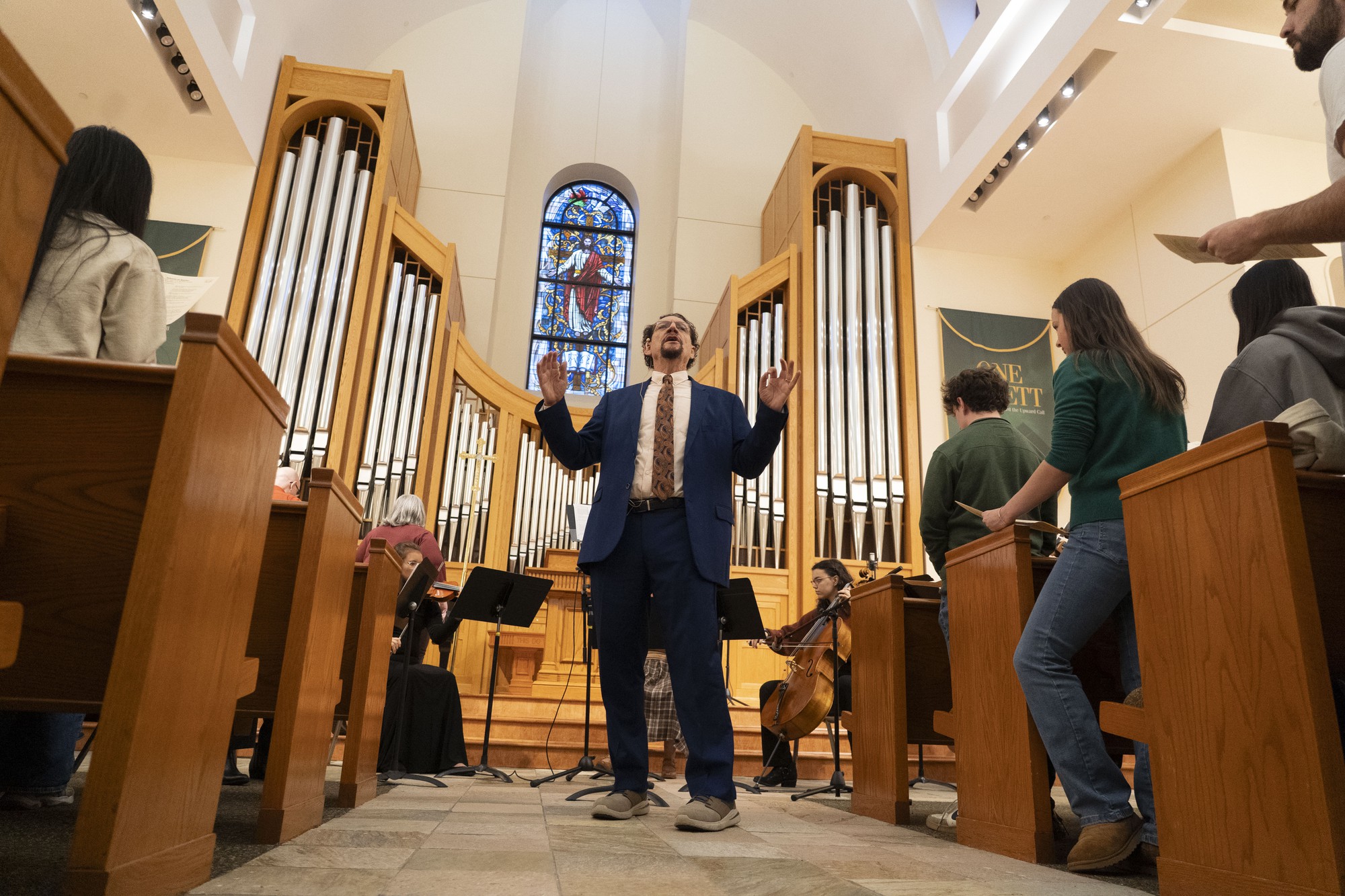
Carlos Colón has been featured in almost every news outlet in Waco, and for good reason. He’s a whole lot more than just the leader of Baylor’s chapel programming.
In his life, Colón has been many things: a refugee, a musician, a Catholic, a Baptist and a Catholic again, to name a few. He has seen more hurt than most, but he’s passionately faithful. When he recounts some of his experiences, he’s drawn back to something his pastor showed him as a boy while growing up in El Salvador.
“One of the deep lessons I learned from him is that the kingdom of God moves through relationships,” he said.
Colón, the Assistant Director for Worship and Chapel at Baylor, was born in Chalchuapa, El Salvador. But he did not stay there long. When he was 14, a civil war in his home country made him a refugee. He spent five years in Guatemala with some friends and family, while others in his family went to the U.S.
While it displaced him from his home country, the turmoil also sparked a religious shift among those in the country. El Salvador had traditionally been a Catholic country, but the war saw many convert to Protestantism with a sense of urgency.
“A lot of people were asking questions about life and death and turning to God,” Colón said.
Colón, raised Catholic, became part of that conversion at age 12 when he stepped into a Baptist church to ask the pastor about the piano and organ inside. The inquiry marked the start of relationships with the pastor and church, relationships in which he visited remote farming villages, grew closer to his congregation and evolved in his faith.
Two years later, Colón was no longer in the same country as the church that led him to the Baptist faith, as his family escaped to Guatemala just hours before a paramilitary group broke into their home. But for Colón, who has edited, translated, composed and performed many of his own hymns, the memory that so closely connected God and music remains.
“I don’t know exactly if I decided or if it was decided for me,” Colón said of his career as a musician and liturgist. “Even in that moment, the first time I set foot in a Protestant church, a place where my life was transformed, God was showing me my vocation.”
In Guatemala, another relationship — one with his music teacher — shaped his life again. She helped him become the pianist he is today and helped him reunite with his parents in America by helping him secure a scholarship to Belmont University in Nashville, Tennessee. Naturally, he studied music.
Colón appreciated the historic country singers who visited the Grand Ole Opry, but over time it became clear that, with his love of piano and his reverent faith, Christian music was his calling. Graduating Belmont in 1990, he arrived in Waco, where he earned a Master of Music in Piano Pedagogy.
Since then, Colón has made a hymnal music career of his own. He’s one of the editors of “Santo, Santo, Santo,” a multicultural hymnal whose purple cover students might recognize from chapel services. In that hymnal, he’s also one of the most credited composers, with numerous translations and compositions attached to his name.
His music has been performed around the world, but he’s continued to live and work in Waco since joining the Baylor chapel team in 2012. In the last 14 years, he’s helped diversify the chapel curriculum alongside Baylor’s former Chaplain, Burt Burleson.
“He asked me to help him start smaller chapels in the dorms that resemble prayer services and the Liturgy of the Hours tradition,” Colón said. “The decision was to multiply not just prayer chapels and worship services, but into things that look more like a class, like a place where people reflect about their vocation. That’s why you have a business chapel, faith and healing, faith and the arts.”
In his time with the chapel team, Colón has worked with a number of professionals and an even larger number of students. One of those students is Isaac Wrobel, who is now a Truett Seminary student after graduating in 2025.
Wrobel called Colón “reverent” and “someone who takes his faith seriously.” As a passionate Christian interested in ministry, Wrobel said he appreciated Colón’s constant mission to keep Jesus at the center.
“The centrality of knowing who truly Jesus is, even through song and through worship, is something that Carlos always emphasizes,” Wrobel said. “And honestly, it’s taught me a lot too, to really think through some of these songs in church. Do they help me to really know who God is?”
For Colón, this emphasis on centrality also shows in how he shares — or doesn’t share — about himself. The goal of his team, he said, is not self-expression but evangelism.
“I mentor students here at Baylor sometimes as a songwriter, and I try to change their minds,” he said. “I say, ‘Our role as Christian songwriters is to be messengers of the gospel.’ So, in the chapel, I will tell stories about my life, as long as they help people.”
Around the time he began working at Baylor, Colón lost his wife, Dr. Susan Colón of the Honors College. Even then, he never strayed from his faith.
“I probably could count with one hand a Sunday when I didn’t go to church,” he said.
Colón has since remarried, and he’s also returned to the Catholic faith. Part of it has to do with his wife’s Orthodox denomination and reverence for the old Church, but another part comes from his desire to balance two virtues.
“One of the turmoils of North American Christianity is that separation of love and truth,” Colón said. “People want to emphasize truth without love, and that can become brutality. Or people who want to emphasize love, but detach from truth, that becomes wishy-washiness.
“In the U.S. there really is a crisis of love and truth,” he continued. “But love and truth are not separated. And Jesus Christ — he actually keeps them in perfect balance.”