By Aarah Sardesai | Intern
Baylor’s Laparoscopy Lab, known across campus simply as Laparo, gives freshmen hands-on surgical training and a full year of guided research experience before they ever apply to medical school.
The yearlong course, housed in the Earle Hall pre-health program, is entirely student-run. Junior teaching assistants lead lectures and build the curriculum, while sophomore research mentors guide small groups of freshmen through designing and conducting IRB-approved studies.
“It’s an introductory lab where we simulate laparoscopic surgery with a box and all the tools that come with it,” Cypress freshman Madhumita Donavalli said. “We use those same boxes to conduct research. We come up with research questions, run experiments, analyze the results statistically and draw conclusions.”
The course mirrors the structure of a traditional research lab. During the fall semester, students learn foundational concepts in healthcare, surgical technique and research ethics while developing their research questions and writing their introductions, according to Naperville, Ill., freshman Vrinda Tadepalli.
“There’s a heart unit, an insurance unit and overall healthcare content,” Tadepalli said. “It’s entirely student-run. The TAs teach everything and create the coursework, and the research mentors guide students through their papers.”
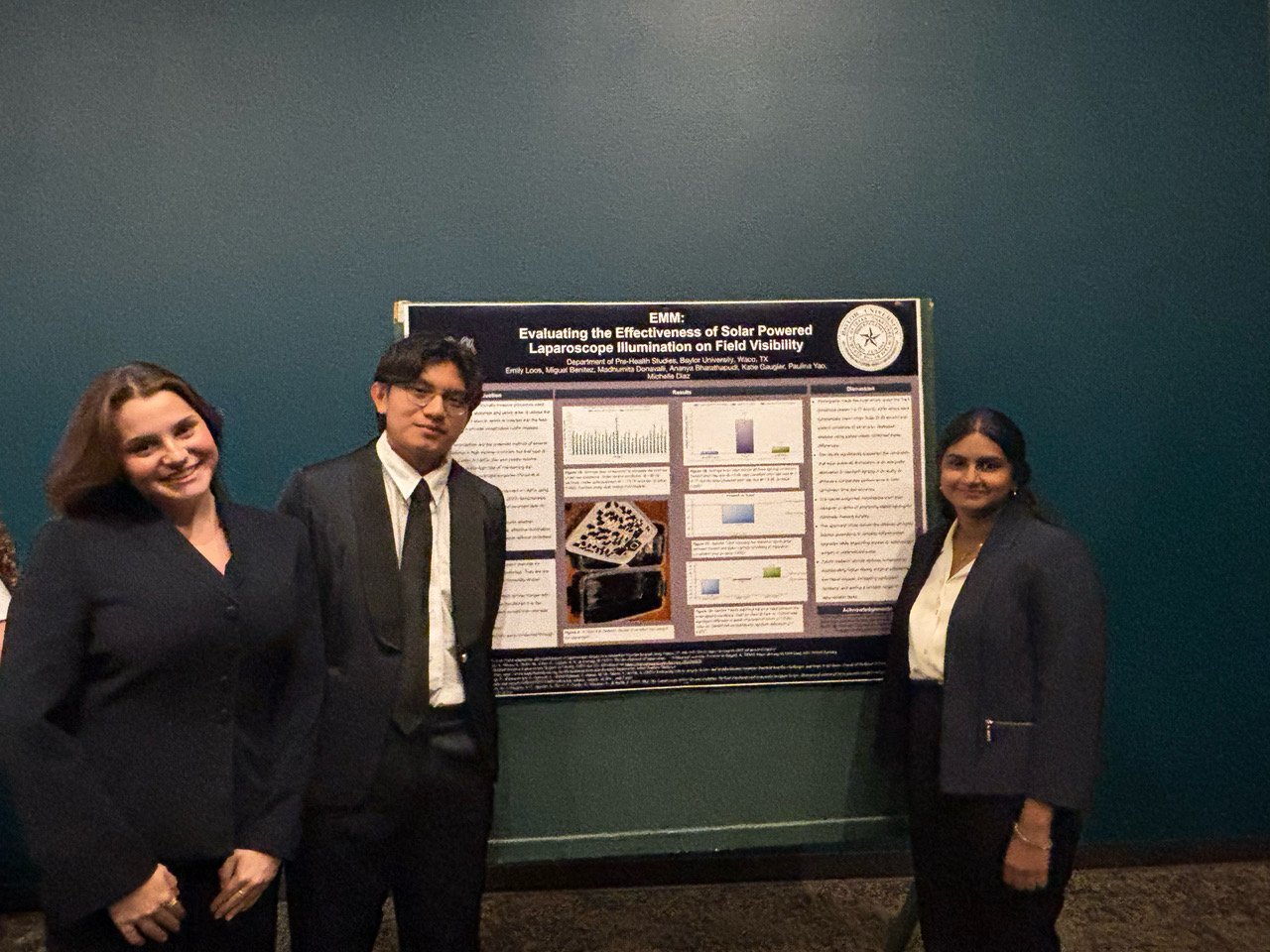
In the spring, students begin running experiments, not only for their own projects but also as participants in their peers’ studies. By the end of the year, each team compiles its data into a research poster and presents its findings, often marking students’ first experience with academic presentation.
Beyond technical skills, students say the program builds confidence and community.
“It’s a very close-knit group,” Donavalli said. “We support each other and uplift each other in the pre-health community, which can be so hard sometimes.”
Laparo was originally created by a small group of undergraduates who wanted to make research more accessible to early pre-health majors. Today, the program continues to be shaped by the students who run it.
San Jose, Calif., sophomore Ananya Bharathapudi and Chicago sophomore Anishvaran Manohar, both TAs in the lab, said much of their work happens behind the scenes, planning curriculum, organizing events and supporting research mentors.
“The typical role of a Laparo TA is to give the lecture and to build the course in general with a lot of behind-the-scenes work, but we also do a lot of work with community building,” Bharathapudi said.
Manohar said the student-led structure is what makes the program so impactful.
“By being in Laparo for two years, TAs gain a lot of knowledge about what Laparo really is and what initiatives you want to take,” Manohar said. “We’ll be going into the summer planning all of the events and the curriculum and trying to make the best possible class environment for our future students.”
Laparoscopy, the minimally invasive surgical technique at the center of the course, is practiced using FLS-certified training boxes and tools such as Maryland dissectors. Students complete skill assessments like the pegboard and circle-cutting practicals, which mirror the procedures medical students use to earn laparoscopic certification.
This year, TAs and research mentors plan to introduce live demonstrations of these procedures to help students better visualize the techniques.
“This will help them visually see the FLS-certified procedures of laparoscopic surgery right in front of their eyes,” Manohar said.
Students are encouraged to design research projects that reflect their interests. Donavalli explored how solar-powered lights could expand access to laparoscopic surgery in underserved communities. Manohar’s group tested whether attaching a laser to a laparoscopic tool could improve visibility during procedures.
The program’s structure, freshmen as students, sophomores as research mentors and juniors as TAs, creates a built-in mentorship pipeline that many students say defines their experience.
“My research mentor, who is also my TA, has been such a monumental part of my journey,” Bharathapudi said. “We build in that guidance so freshmen aren’t lost and know exactly who they can go to for help.”
For many, Laparo becomes more than a class.
“Once you’re in Laparo, you’re in Laparo,” Bharathapudi said. “We’re basically a safety net. I found my best friends in Laparo. I can’t even imagine undergrad without it.”
When asked to summarize the experience in one sentence, Manohar didn’t hesitate.
“Laparo gave me a home,” Manohar said. “It’s a place where I feel safe and confident stepping up and conducting research as a freshman, and mentoring students throughout their time at Baylor.”