By Addison Gernenz | Intern
Across Baylor’s campus, students are taking action to live more sustainably, whether through personal habits, volunteer opportunities or launching campus initiatives.
Grandville, Mich., senior Sophie Lynch-Iudicello said she has found small ways in her daily routine to become more environmentally friendly.
“I don’t think a lot of people realize that sustainability can be done in really small ways,” Lynch-Iudicello said. “One of my favorite habits I’ve picked up is bringing a jar to a coffee shop. Or a mug or a Yeti travel mug.”
Several coffee shops, such as Common Grounds and Be Kind Coffee, will offer discounts for bringing your own mug.
Lynch-Iudicello also said she practices environmental awareness by unplugging her major appliances when they are not in use and by being intentional about not running the sink water unnecessarily.
St. Louis junior Elise Zeigler said that prioritizing an environmentally conscious outlook is crucial.
“It takes more work upfront to go sit down and have a meal than it does to use a to-go box,” Zeigler said. “It takes more work to reuse containers instead of just throwing away a paper plate. But in the long term, it’s worth it to see the joy gained through exploring creation and seeing nature, which is something I would love to share for generations and hope to preserve.”
Zeigler elaborated that a good first step is learning what sustainability is, which could mean reading a book or listening to a podcast.
Zeigler also encourages her fellow students to learn about the efforts currently underway at Baylor.
The Baylor Hunger and Poverty Collaborative, for example, is working to help Baylor compost, educate students and donate food from the dining halls to homeless shelters in the Waco area.
The group has campus initiatives, such as the Student Food Security Council, that have been working to raise awareness of food insecurity on campus and to help students understand the resources Baylor offers.
Frisco sophomore Bianca Shah is the vice president of organizational outreach for the Student Food Security Council, which stems from Baylor Collaborative.
“I enjoy being able to work with other people who are passionate about working toward solving food insecurity on Baylor’s campus,” Shah said. “A lot of our projects this year have been on educating people on food insecurity, since students aren’t aware of it unless they are experiencing it.”
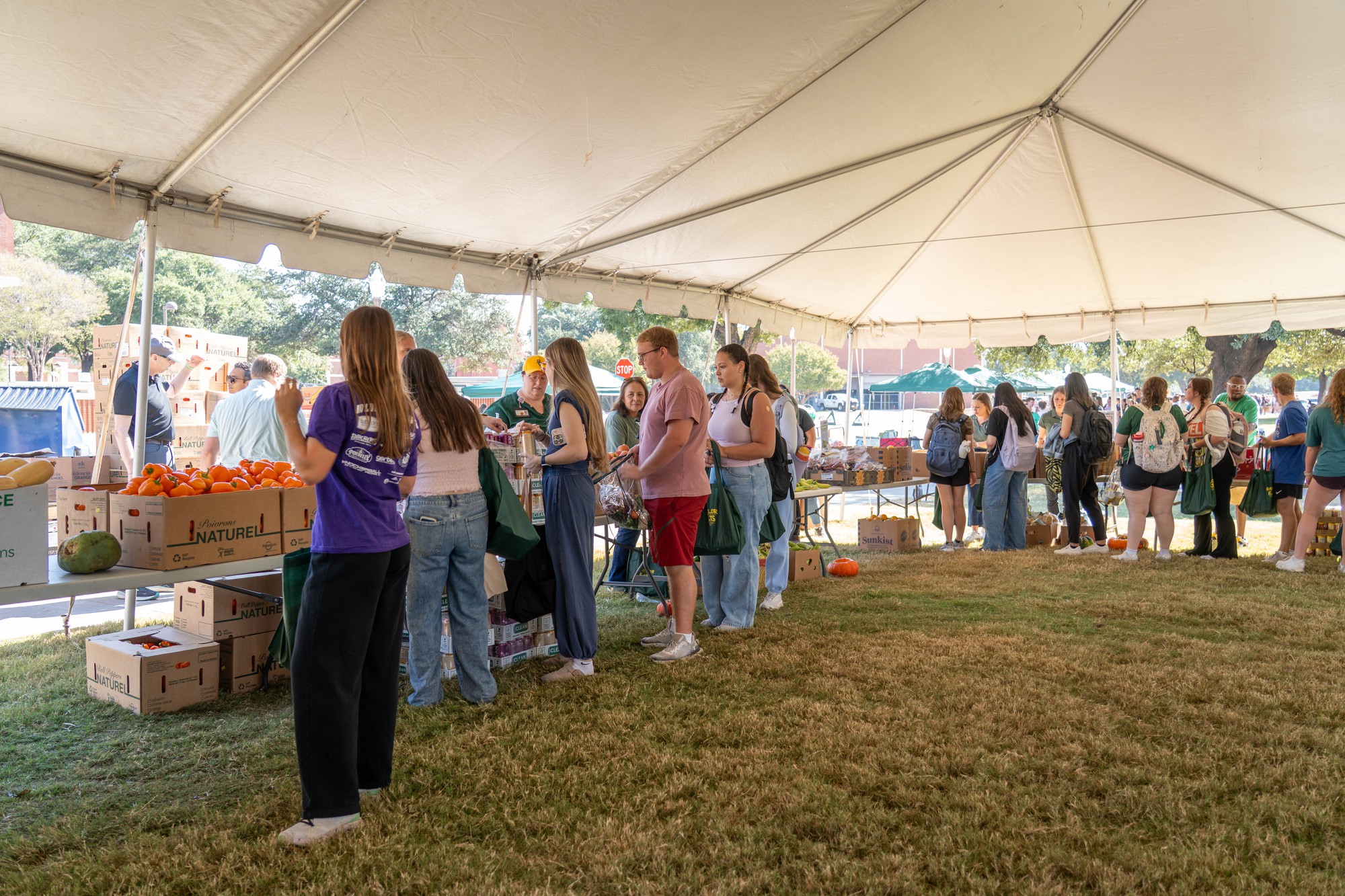
One of Shah’s favorite parts of working with the Food Security Council is helping with Baylor’s Free Farmers Market.
The farmers market takes place once a semester and provides seasonal produce, health and wellness resources from campus and local organizations.
The farmers market also provides information tables discussing food insecurity, sustainable agriculture and support services.
It’s a way for students to get fresh food, since that’s not something which is always accessible to students,” Shah said. “Especially for the international students and graduate student population.”
University Innovation Fellows launched an initiative called “Leave No Trace” to reduce dining hall food waste. The initiative has three sections: Sic ’Em Sampling, Sic ’Em Scales and Sic ’Em Stats.
The goal with this program and initiative is to make a real difference at Baylor.
Simpsonville, S.C., junior Ethan Friend, a member of the inaugural UIF cohort, said tackling food waste seemed like the perfect place to begin.
According to Friend, the “Leave No Trace” initiative provides students with ways to taste-test samples to reduce food waste in the dining halls.
In addition, the stats campaign shows students the real, visual impact of the waste that’s produced, and the scales project tracks kitchen data so the UIF fellows can measure their progress behind the scenes.
Waco also has an abundance of sustainable businesses with volunteer opportunities.
The Sustainable Community and Regenerative Agricultural Project (S.C.R.A.P.) partners with the City of Waco to advance the common goal of improving food waste, food insecurity and climate resilience. S.C.R.A.P. points their website visitors to partner organizations that students can volunteer at.
Below is a list of organizations, most of which are partnered with S.C.R.A.P., that focus on the environment that students can volunteer at.
Students can volunteer at one of Baylor’s two community gardens: either the 9th and James Fellowship Garden or the one at Teal Residential College. Students can volunteer as individuals or as a group.
One of Waco’s gardening opportunities, Global Revive, provides an environment to grow fruits and vegetables for the community. The nonprofit teaches volunteers to farm organically, protect the environment and learn about well-rounded diets through various classes.
Waco’s World Hunger Relief offers a multitude of volunteer opportunities, from volunteering once a week as a farm partner, working as a group on their 40-acre working farm or participating as a live-in volunteer for a minimum of a month.
Urban Reap has a garden center in Waco. They place a heavy emphasis on composting and provide resources and information for how individuals can compost at home.
Volunteers can call ahead or show up to distribute food boxes to clients. The food pantry distributes on the first and third Saturdays of each month. Volunteers are also needed on Mondays and Fridays to pack boxes of staple goods and fresh produce, respectively; more information is available on their website.