By The Editorial Board
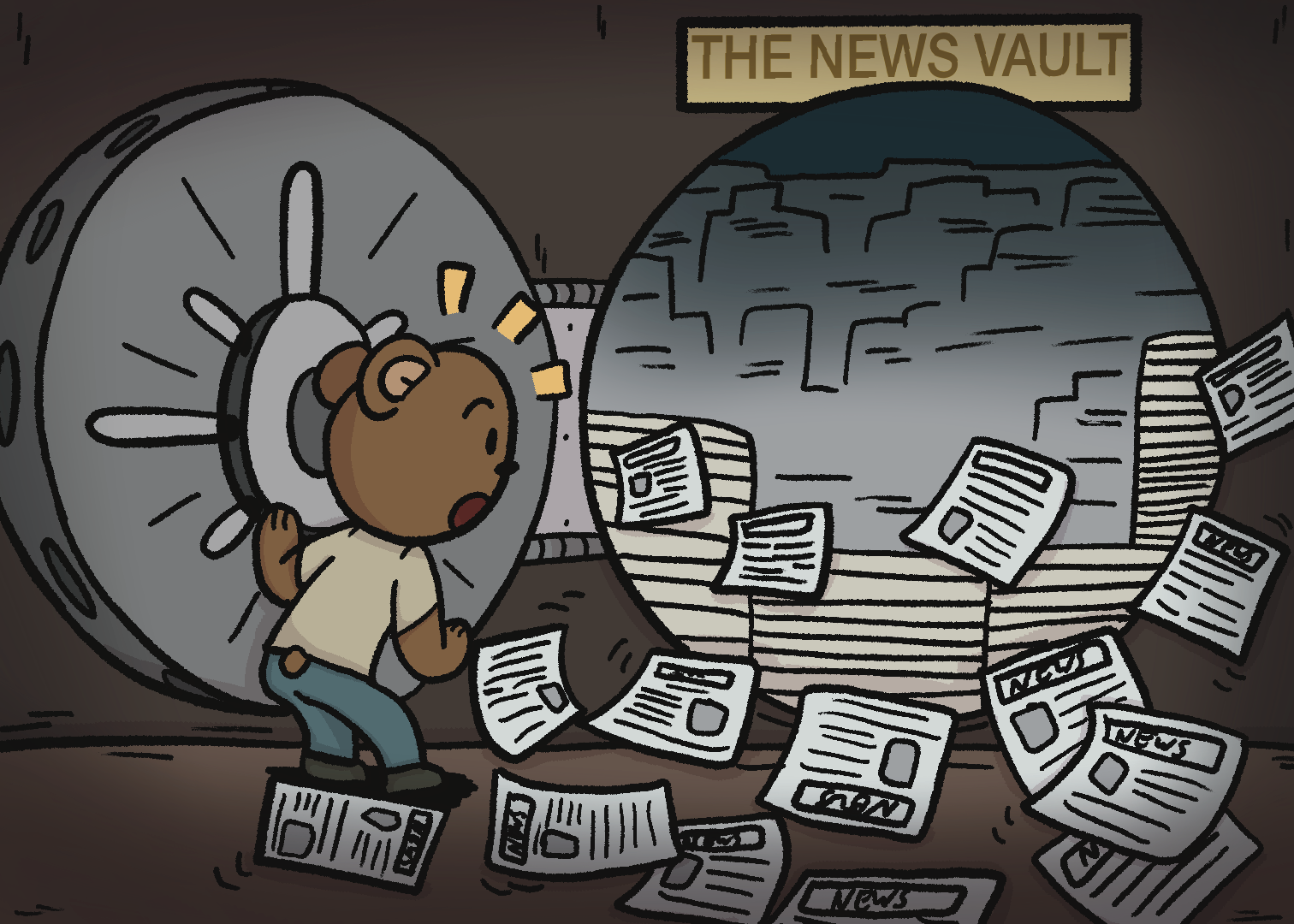
At a time when it seems like world news hits new extremes every day, it feels nearly impossible to distinguish AI-generated clickbait from reality. While this phenomenon has only intensified with our coverage of international affairs, it started quite a while ago at the national level.
Picture this: you’re at dinner with your friends. Exchanges of friendly banter and back-and-forth comments continue until the conversation shifts to current events.
It starts with a sly remark about the government, war, gas prices, inflation or a mix of all. Everyone chimes in, confirming the concerns until eventually it becomes the main topic of conversation.
Phrases like “the bottom line” or “when all is said and done” are thrown around, ultimately turning your evening chatter into a tutorial on how clickbait news thrives.
To clarify, we aren’t talking about right or left-wing media; we are talking about all of it.
Because of commoditization, news now thrives on fear.
In George Saunders’s 2007 essay “The Braindead Megaphone,” he outlines the reality of media coverage. While this seems long ago, his ideas are incredibly relevant to today.
“But more than fear, our new braindeadness has to do, I think, with commerce: the shift that has taken place within our major news organizations toward the corporate model, and away from the public-interest model,” Saunders said. “The necessity of profit is now assumed for our mass-media activities.”
News outlets now have to focus on providing profitable truth, not just truth — this is where we’ve all gone wrong. The news we see is not all the news there is.
What makes this shift particularly dangerous is not simply what is added, but what is quietly removed. Context is trimmed for speed, nuance is sacrificed for virality and complexity is flattered into something easily digestible and shareable.
In our dopamine-chasing, attention-deficit society, we thrive on short, punchy news that grabs our attention. What doesn’t garner views doesn’t get outrage, attention or advocacy.
In this way, misinformation does not always arrive as outright falsehood. More often, it comes as an incomplete truth that feels convincingly precise because it is shorter.
And with the current Iran war on our hands, it seems as though international coverage has become unreliable from both parties.
Saunders described that this reality was born from the media’s coverage of the O.J. Simpson trial.
The trial could have been summarized in an 800-word article every week; instead, there were thousands of hours of coverage floating around the U.S. Because of the sheer amount of information being published, something had to be added to fill the gaps and reach those hundreds of hours.
Somewhere along the way, media outlets adopted this style of reporting and now use it to cover major international affairs, such as wars.
“In that hour of fear and need, finding in our hands the set of crude, hyperbolic tools we’d been using to discuss O.J., et al., we began using them to decide whether to invade another country, and soon were in Baghdad, led by Megaphone Guy,” Saunders said.
Our media is designed for distraction; as a result, you can’t have productive conversations because they want intellectual diversions.
The result is a kind of intellectual echo chamber masquerading as informed discourse. We mistake familiarity for accuracy and repetition for truth, echoing headlines we have absorbed rather than arguments we have examined.
The more saturated we become with rapid-fire updates, the less equipped we are to discern what actually matters. Information is no longer a tool for clarity; rather, it becomes a mechanism of confusion.
You’re not getting the whole truth from either side; you’re getting whatever would bring in the most profit.
To shut down this echo chamber, it’s crucial to intentionally educate yourself and shut off the “noise.”
The media provides us with a million different perspectives on the same subject every day; it’s crucial to understand the entire story.
This requires a shift not just in what we consume, but how we consume it. Slowing down, seeking primary sources and resisting the urge to react instantly are small but necessary acts of resistance. To be informed is no longer passive; it is an active discipline that demands attention, patience, conviction and discernment.
While liberal outlets typically provide more humanitarian news and conservative ones are capitalistic, a functioning, thriving society needs both.
Turn off TikTok, read past the headline and do your own research. Neither CNN nor Fox provides the full story, so don’t get comfortable just reading those. This is the only way to break past the intelligence ceiling that’s been placed on us.