By Mia Martinez | Reporter
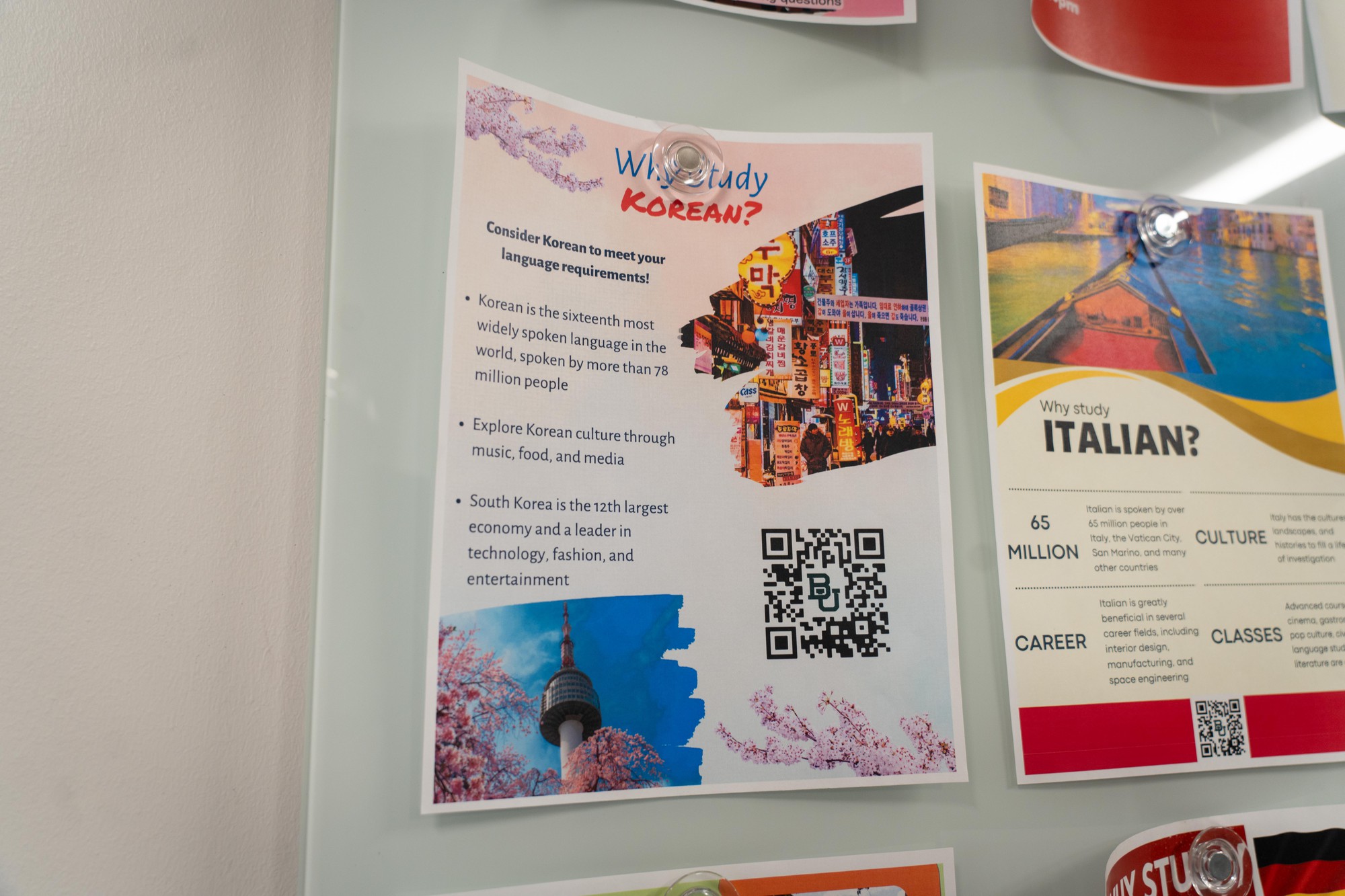
Throughout the many languages and cultures offered at Baylor, a growing interest in smaller languages is drawing students who are eager to expand their global cultural perspective and language. One example of this is the Korean language.
The Korean language has course offerings but isn’t currently offered as a major, minor or certificate. Students say it continues to create barriers for those who wish to continue their language studies. Additionally, these frustrations extend to other languages, like Swahili and Portuguese.
Chanyoung Park, a Korean instructor in the department of modern languages and cultures, emphasizes that students enrolled in Korean courses often have motivation and curiosity for learning the language.
“Baylor students are very welcoming and very dedicated,” Park said. “The fact that they’re choosing Korean shows a lot of motivation.”
Park has taught Korean at Baylor for two years and leads both the beginner and intermediate Korean courses. Park said that while teaching, what’s most rewarding is the sense of community that develops among students.
“I love the community that the Korean language can offer,” Park said. “Students bond over one common thing, which is the language.”
Over recent years, Korea has grown in influence on the global Korean media and culture. Park emphasized that many students choose to take Korean out of pure curiosity and genuine interest, rather than convenience.
“For non-Korean students, it’s easier to take Spanish because they’ve been taking it since middle school,” Park said. “But the fact that they’re choosing to take a Korean class shows a lot of internal interest.”
Although the Korean department experiences growth, they continue to struggle with the limitations of expansion. Park is currently the only full-time Korean instructor at Baylor, which makes it difficult for students to receive more advanced-level courses.
“We currently have only one full-time instructor,” Park said. “It’s impossible to teach multiple proficiency levels.”
Due to the lack of advanced levels and absence of any incentive, such as a minor, major or certificate, Park said students aren’t likely to continue studying it. Yet low enrollment limits expansion.
“We need more students to offer more classes,” Park said. “But students don’t continue because there’s no certificate. It’s a vicious cycle.”
As Korean continues to increase the interest of students, it isn’t the only language program facing limitations. Baylor currently doesn’t offer minors, majors or certificates for several languages that are less commonly taught, including Portuguese and Swahili. With these programs led by non-full-time faculty members and limited course offerings, it’s harder for many of the classes to expand to higher language-level courses or culture classes.
Limitations discourage students from continuing their studies, not because of a lack of interest, but because of the lack of institutional support for students and faculty who want to continue to learn and teach the languages further.
Houston senior Hanna Al-Hayek said there are far fewer opportunities to learn languages like Korean compared to more Western languages.
“I took both French and Korean, and while the lower levels are basically the same, the upper levels are where the difference is shown,” Al-Hayek said. “French offers courses that dive into cuisine, pop culture, cinema, theater and music, while Korean simply stops at 2320.”
Al-Hayek emphasizes that the disparity between languages is often due to students’ perception of available language courses.
“I don’t think Baylor necessarily values a certain language more, but unfortunately, due to the nature of the languages, more common languages like Spanish or French are bound to get chosen over Korean,” Al-Hayek said.
Despite these limitations, Al-Hayek said her Korean courses and learning from Park was a great learning experience for her.
“He is one of my absolutely favorite professors,” Al-Hayek said. “He made learning fun and engaging to the point where you didn’t even realize you were learning.”
Though Al-Hayek enjoyed her time with Korean courses, she said time constraints didn’t allow her to continue with the language.
“If I did not have such a time-consuming schedule, I would’ve always kept Korean on my schedule,” Al-Hayek said. “It was a class outside my major that was fun.”
Park said the department is currently working to create more opportunities for students interested in Korean and other less commonly-taught languages.
“We are currently working on creating a certificate in Korean studies,” Park said. “We don’t want to limit it to language, but expand into culture, society and other disciplines.”