By Dylan Fink | Sports Writer
Two months ago, former Baylor track athlete Darryl Payne Jr. was on the edge of Olympic history, nearly becoming the first Black skeleton athlete to compete for the U.S. in the Winter Games.
Now he’s staring down the barrel of retirement from a sport he’s given over six years of his life and hundreds of thousands of dollars.
Payne fell in love with competition at a young age. By his sophomore year in high school that love became an obsession. As a 15-year-old track star, Payne knew he wanted to be an Olympian the moment he first watched the 2008 Beijing Summer Games.
“I saw the opening ceremony just on TV,” Payne said. “I immediately knew that it was something I wanted to be a part of. Everyone all dressed up getting to represent their countries and so many different cultures all brought together over competition was amazing to me.”
Payne carried his high school track talents into a short collegiate career at Baylor, where he excelled at the 400-meter hurdles in his lone season for the Bears.
“I’ve always been good at finding how to use my athleticism to find something I could compete at,” Payne said. “I was good at the hurdles and I could run a pretty fast 400 meter, so I combined the two to get a place at Baylor.”
In 2016, Payne decided to make his first attempt to represent the United States at the Olympics, as he tried out for the 400-meter hurdles ahead of the Rio De Janeiro Summer Games. Despite his committed training, the hurdler fell short of his childhood dream at the Olympic qualifiers.
“Those guys there were on a whole other level,” Payne said. “I thought I was in pretty good shape but I got just blown out of the water there.”
Following his first chase at his Olympic dreams, Payne was not able to return to Baylor due to financial issues.
“There was a whole deal with my FAFSA stuff and I just wasn’t able to afford to stay there,” Payne said. “I made some really close friends at Baylor that I still hear from, but unfortunately I wasn’t able to be there very long.”
Unsure of what his future would be, Payne made his way down I-35 to Austin hoping to find a new career outside of track. Facing a fork in the road, Payne brought his competitive spirit off of the track and into the kitchen as he enrolled in culinary school.
“I’ve always loved to cook,” Payne said. “I did well in culinary school and worked in a couple different kitchens across Austin for a while.”
Payne was working two jobs, as a sous chef in a higher-end Austin restaurant and as a personal trainer at a local gym when the COVID-19 pandemic hit in 2020. That year saw a lot of change for the former Bear.
With the closing of restaurants throughout the pandemic, Payne walked away from the culinary world and began to pursue personal training full-time. His childhood Olympic dream felt long lost, until a phone call one late summer afternoon changed the trajectory of his next half-decade for Payne.
“The U.S. Olympic Committee called me and wanted me to come up to their facilities in Lake Placid, New York, and try out for the bobsled,” Payne said.
Payne had never competed in a Winter Olympic sport before, let alone bobsledding, but the opportunity to further chase his dream was too good to pass up.
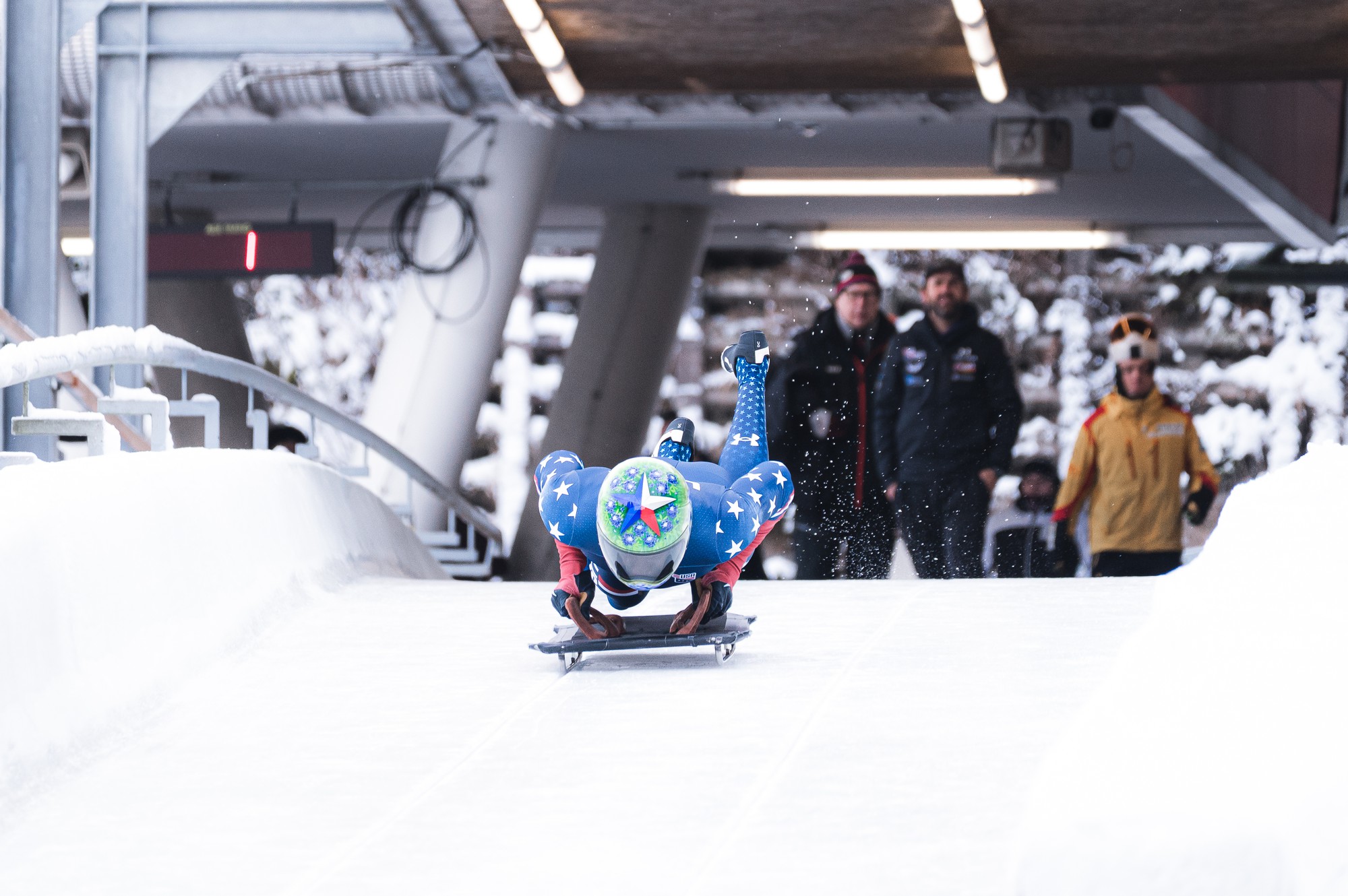
The former hurdler, standing at 5-foot-9, was deemed too small for the bobsled. Instead, Payne was introduced to his next passion when he was given a shot to compete on the International Bobsleigh and Skeleton Federation circuits for the skeleton.
“Skeleton is named after the sled the athlete is on,” the official Olympic description for the sport reads. “Riding on a thin metal frame, athletes fly down a track headfirst at over 80-G’s of force.”
Payne once again found a niche sport curated for his athleticism that he was able to excel at. He spent the next four years going around the world to train and compete in skeleton tournaments, with his eyes on the 2026 Winter Olympics in Milan.
Winter sports are regarded as some of the most expensive athletic events to remain competitive in, often requiring athletes to have a handful of sponsors who believe in their ability to qualify for and excel at the Olympic games.
“Skeleton probably costs about $50,000 a year just to remain the least bit competitive,” Payne said. “I was lucky enough to have some generous sponsors who supported me along the way, but I also had to give a lot to this myself.”
While spending the last few years on the road competing in many skeleton circuits, Payne often found himself missing home. Long travel days and competitive tournaments created extended stretches where he and his wife would be in Europe looking for ways to battle their homesickness.
Food is what kept them grounded on the road.
“As an American, you have to celebrate Thanksgiving,” Payne said. “I remember one year we were in Switzerland, which oddly enough had loads of turkeys at the local grocery store. We had all our friends from the circuit over to the Airbnb we were staying at and I fixed up a whole traditional Thanksgiving for everybody. It was a lot of fun.”
The past season for Payne became the most important competition of his life so far. The U.S. Olympic team only takes two skeleton sledders to the Games and Payne was sitting in the third spot, looking to make the jump up.
“We had a whole plan to overtake him,” Payne said. “I just had to sled my consistent race and hope that he would get in his head and make a mistake. If the guy ahead of me could have slipped up then I would be able to overtake him in the rankings.”
Alas, for Payne, the Olympic dream remained just out of reach as his leader, Austin Florian, secured a berth.
“He probably got in his head a little bit because everyone does, but I was the one who was way into mine,” Payne said.
Payne missed out on a trip to the Olympics once again, having to watch his peers compete on the highest stage from home.
“I couldn’t bring myself to watch the opening ceremonies this time,” Payne said. “I shot my friends a text and told them like, ‘Oh, good luck,’ and some other words of encouragement, but it was too emotional for me to sit down and watch any of the actual events.”
Payne, now 33, is not completely ruling out the possibility of one last attempt at his Olympic dream in 2030, but is most likely looking to retire from the skeleton for now.
“It costs too much money and is too wearing to try and maintain at this point,” Payne said.
The skeleton sledder is now looking to move past his half-decade of winter sport competition and look to the future to see what is next for him.
“I have been thinking about going back to school and finishing my degree,” Payne said. “I was studying biology when I was at Baylor so now I’m seriously contemplating exploring a career in physical therapy. But again, who knows what God has for me next.”