





By Maggie Meegan | Reporter
Throughout history, people around the world have had to face forces that control their religious practices, limit their rights and persecute those who practice openly. Thursday’s Keston Center lecture focused on these issues through the lens of Russian Orthodoxy.
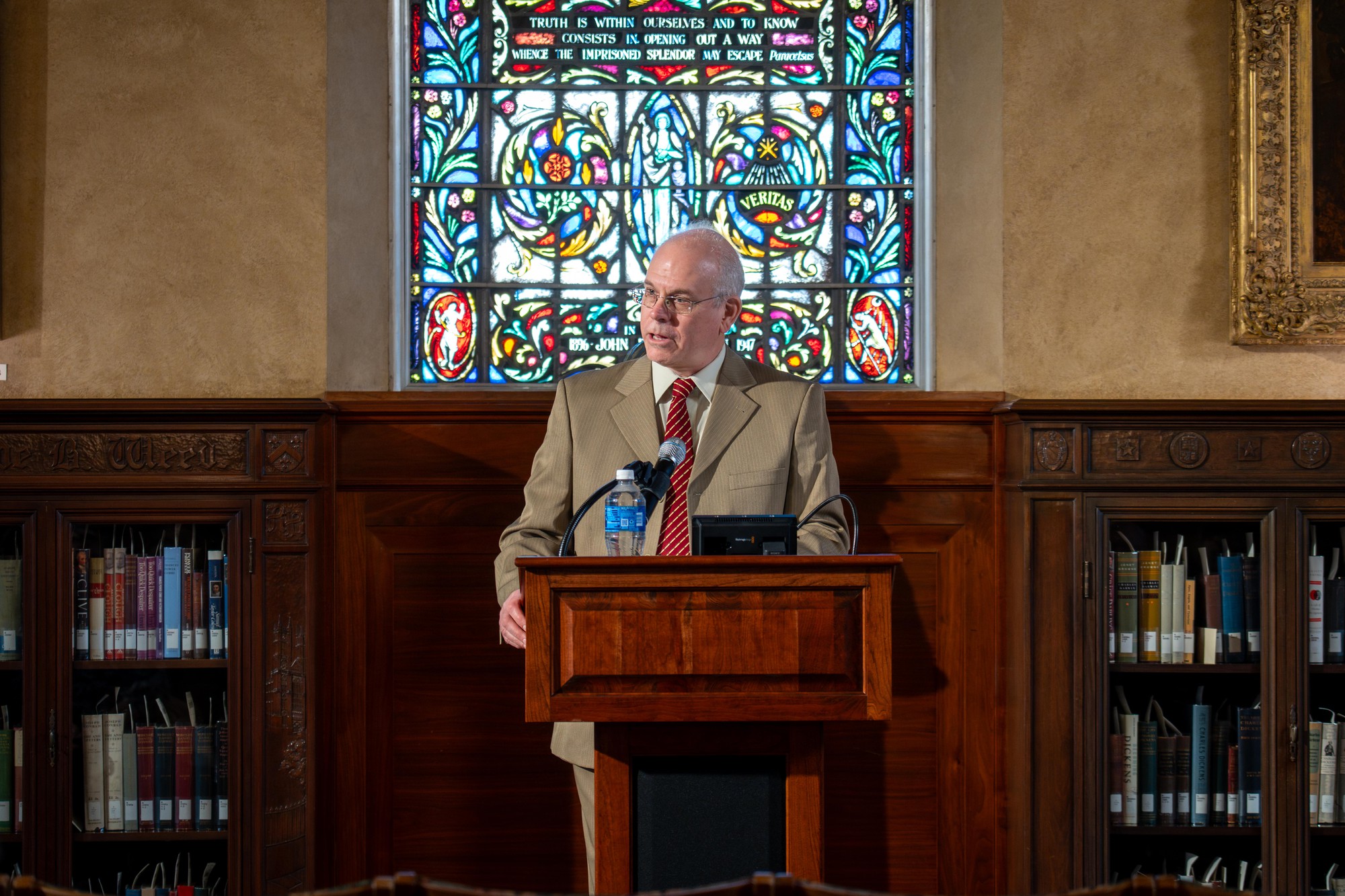
The Keston Center for Religion, Politics and Society, in conjunction with the history department and the Department of Modern Languages and Cultures hosted Dr. Scott M. Kenworthy, a professor in comparative history and religion at Miami University.
The Keston Center is home to the largest collection of artificially made anti-religious propaganda, so it is a fitting location to hear about defending religion in early Soviet Union Russia.
Through Kenworthy’s research and recently published book, the conversation covered the life of Patriarch Tikhon Bellavin, who became the head of the Russian Orthodox church following the Bolshevik Revolution.
Bellavin was faced with being the only archbishop of North America for nine years, Kenworthy said. He learned there what it truly looked like for state and church to be separated.
“Even when a political faction claims to be defending the interests of the church, all politics is ultimately about power,” Kenworthy said. “It is more likely to use the language of faith for its own aims in seeking power, rather than seeking to further the Gospel.”
For the rest of his life, Bellavin called on the people of Russia and the people of the Russian Orthodox Church to stand up to the government for trying to take political actions against allowing the people of Russia to practice their religion freely, Kenworthy said.
“He came under pressure to embrace this position, but he resisted,” Kenworthy said. “[He summoned] believers to express their support for the church, to send the message to the government that the people did not support their policies against the church.”
Though Bellavin lived approximately 100 years ago, his persistence in history and through the research of Kentworthy shows a strong example of how defending your faith is crucial to being able to separate it from church and state.
Grand Rapids, Mich., senior Josh Bueker thought it was interesting to learn about the early persecution of the Russian Orthodox church.
“We often hear a lot about the late-Soviet religious history and persecution, but it was quite interesting to hear a perspective that is early-Soviet during the revolution,” Bueker said.
Kenworthy has had multiple books and articles of research published looking at persecution in this region of the world. He is also the former president of the Association for the Study of Eastern Christian History and Culture. As more scholars research into the high point of religious persecution in the Soviet Union, Kenworthy makes sure that no historical figure is overlooked and makes their mission heard.


