





By Tolga Sahin | Intern
The 2026 midterms — widely seen as the first referendum on the Trump administration — are underway as Texas opened early voting for its March 3 primary, the first contest in what is projected to be the most expensive midterm cycle in American history.
Baylor students registered in McLennan County were eligible to start casting ballots Tuesday. This year contains a competitive U.S. Senate race, newly drawn congressional maps, state legislatures and local offices. Texas is an open primary state, which means voters do not register with a party, but they must choose a Republican or Democratic ballot at the polls. After that choice, voters are locked into that party’s runoff — if needed.
Early voting for the March 3 primary goes from Feb. 17 through Feb. 27. This week, polls are open from 8 a.m. to 5 p.m., but hours expand starting Saturday from 7 a.m. to 7 p.m.
Students who will not be in McLennan County during early voting and Election Day can apply to vote by mail, as can voters who are 65 or older, disabled or expecting to give birth within three weeks of the election. The deadline to request a mail ballot is 5 p.m. Friday. Voters must select a party on the application to receive the correct primary ballot.

McLennan County has five early voting locations. Registered voters must bring an approved photo ID and can cast a ballot at any of them:
- McLennan County Elections Administration Office at 214 N. 4th St. in Waco
- Waco Multi-Purpose Community Center at 1020 Elm Ave.
- Waco First Assembly of God Church at 6701 Bosque Blvd.
- Hewitt City Hall at 200 Patriot Court
- Robinson Community Center at 106 W. Lyndale Ave.
On Election Day, polls will be open from 7 a.m. to 7 p.m. at 39 vote centers across the county. In a race, if none of the candidates receive more than 50% of the vote, the top two will advance to the May 26 runoffs.
Waco freshman Hutson Harper said he is eager to cast his first midterm ballot.
“I look forward to being able to do my civil duty and taking part in elections, being able to vote in the, not just the major midterms, where the two parties go against each other, but in the primary election as well,” Harper said. “Because I think it is equally as important to be able to pick a good candidate in the chosen party compared to being able to vote in the general election as well.”
Whichever primary a voter chooses, they will see races for U.S. Senate, U.S. House, governor, lieutenant governor, attorney general, comptroller, land commissioner, agriculture commissioner, railroad commissioner, Texas Senate, Texas House, State Board of Education, judicial seats and local offices, including McLennan County sheriff.
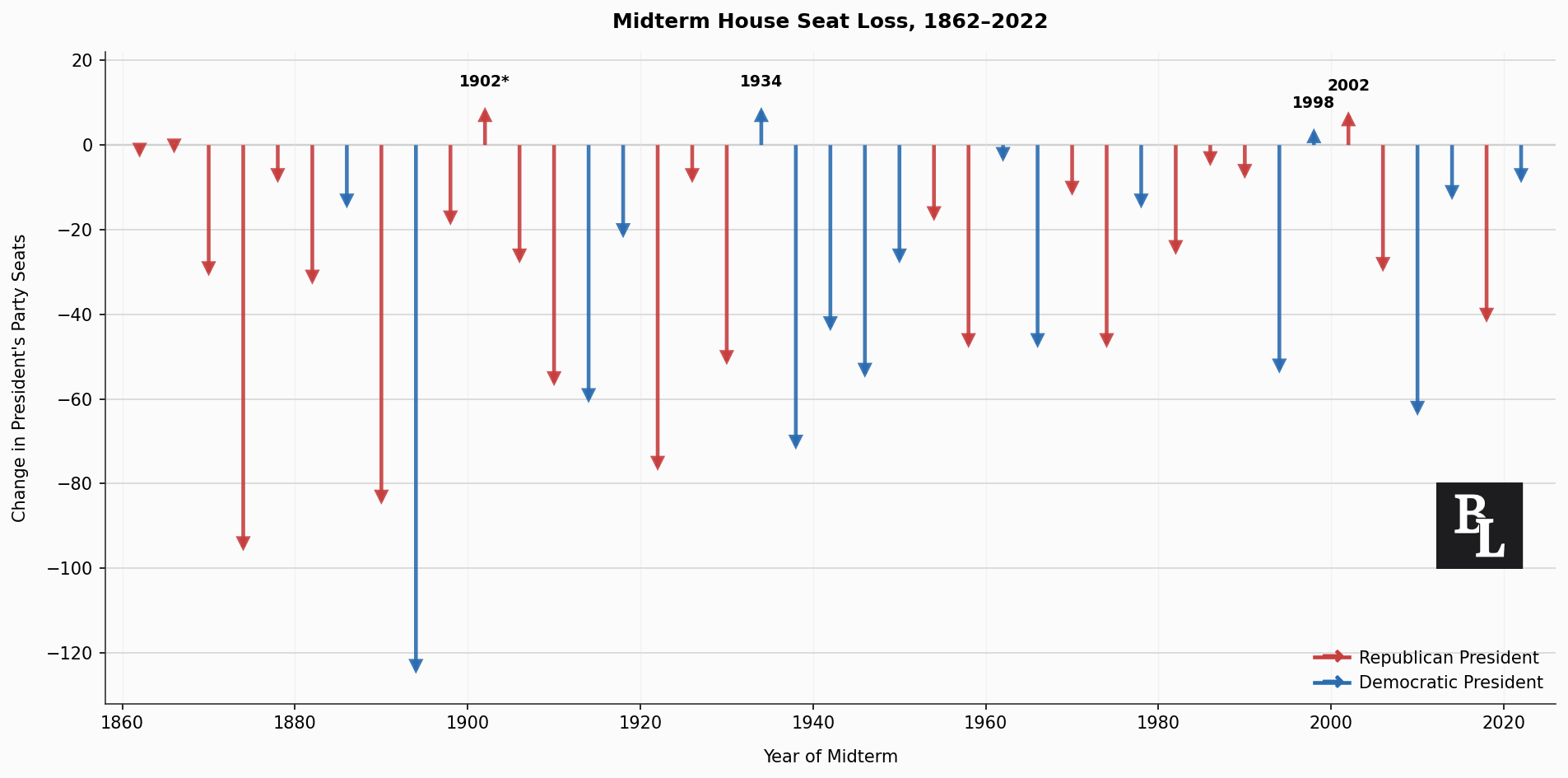
Looking back into history, the party holding the White House regularly plays defense in midterms. Out of 41 midterms shown on the graph, the president’s party lost seats in 37 of them — usually by double digits, and occasionally by landslide losses that had impacted the country for years.
Only four midterms show a net gain for the president’s party: 1902, 1934, 1998 and 2002. Ahead of the 2026 midterms, Republicans are looking into breaking a long-standing pattern.
Baylor College Republicans President Lindsay Flanigan, a College Station senior, said the party is bracing for the historical midterm pattern, but she described the mood among Republicans in Texas and nationally as more optimistic.
“You’re not wrong about the incoming party usually losing seats during midterm elections. That is not unusual — it’s a pattern, no matter which party is in power,” Flanigan said. “So I think it is, in keeping with the pattern of history, very likely that Republicans may lose seats, but the general feeling is hope because we want to unite the Republican Party more so than it has been in the past year or so. People are motivated to band together and make sure we retain seats at the midterms.”
One of the most important races in the country is the contest for John Cornyn’s U.S. Senate seat. He is facing the most serious primary challenge of his two-decade career. It is a three-way fight between Cornyn, Attorney General Ken Paxton and Rep. Wesley Hunt.
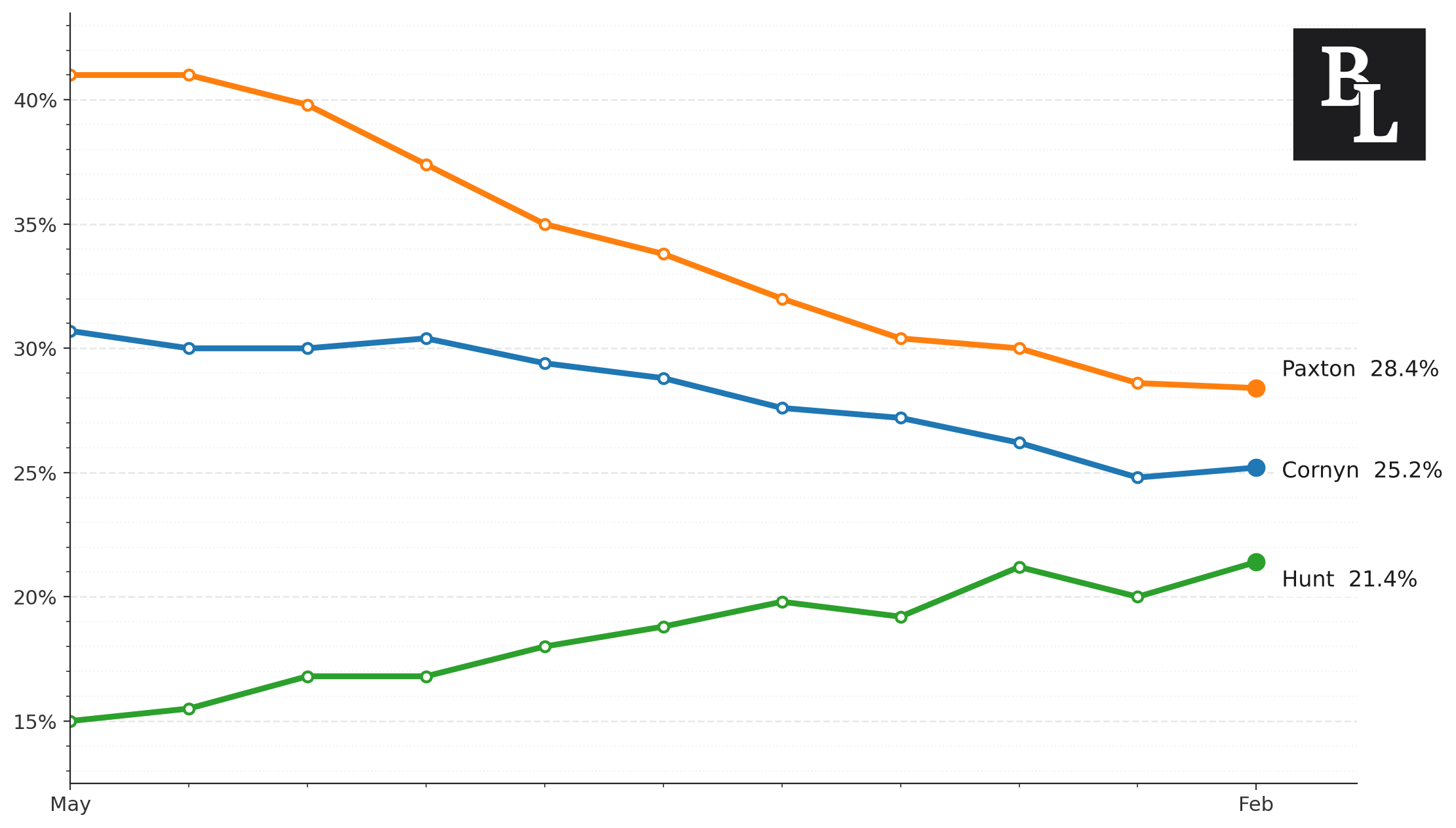
Recent public polling suggests the Republican primary for the U.S. Senate is likely to go to a runoff. None of the three candidates polled received a majority. As election day approaches, the margins have narrowed significantly. Attorney General Ken Paxton and Senator John Cornyn are likely to face each other again in the May 26 runoff.
Compared with the Republican primary, there has been significantly less public polling in the Democratic Senate primary; therefore, fundraising is the only clear sign to look ahead. End-of-year filings show state Rep. James Talarico raised $6.9 million in the last quarter of 2025. On the other side, U.S. Rep. Jasmine Crockett raised $2.1 million for her Senate campaign, while transferring $4.5 million from her House campaign account. Talarico’s campaign has also raised another $7.4 million in the first six weeks of 2026, while Crockett has not publicly posted an updated fundraising total beyond the year-end report.
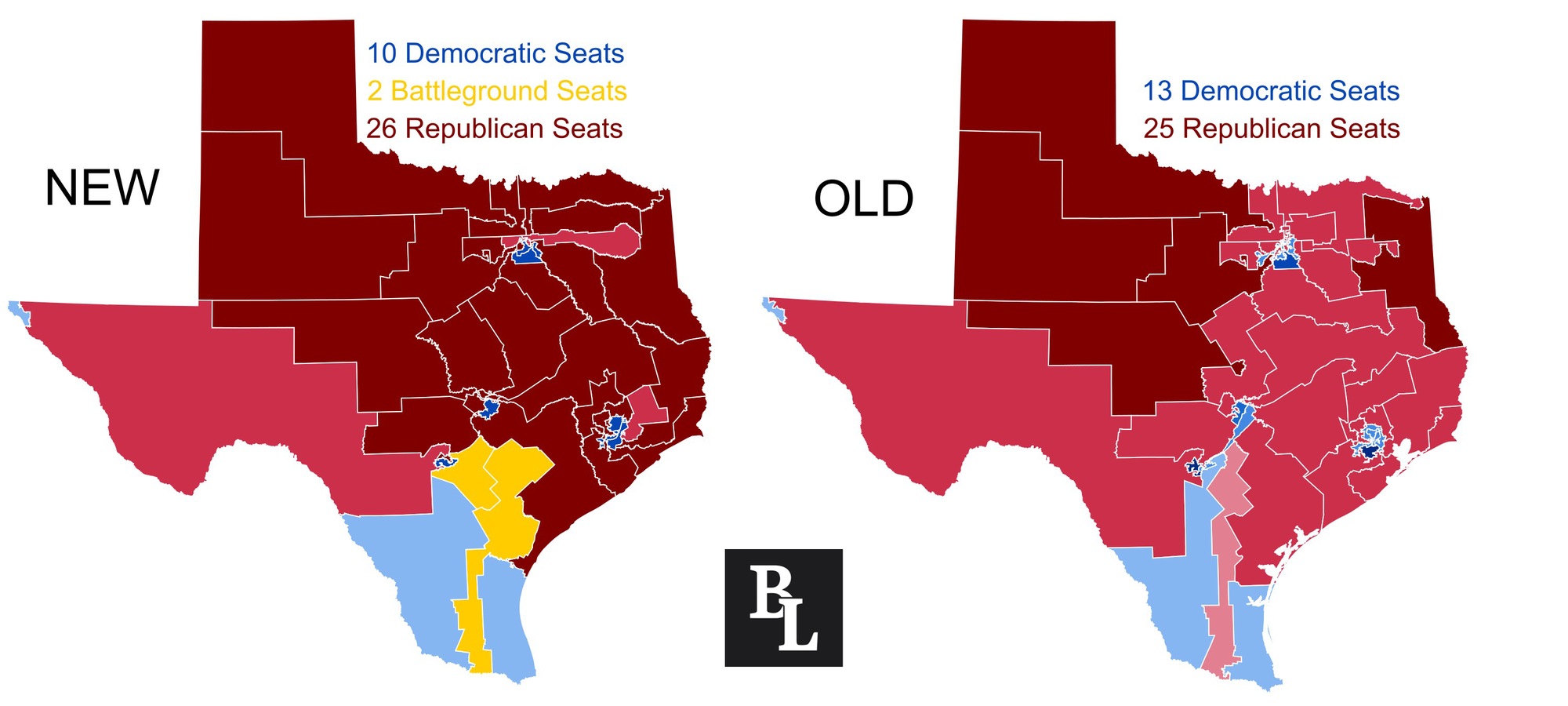
Perhaps the biggest structural change on this year’s ballot is the new congressional map. In August, the Texas Legislature redrew the state’s 38 congressional districts at President Trump’s urging, aiming to flip five Democratic-held seats to Republicans. The U.S. Supreme Court allowed the maps to be used in 2026 while legal challenges alleging racial gerrymandering continue.
According to recent National Generic Ballot polling and Hispanic voter partisan lean calculations, planned five pickups could fall short of just one.
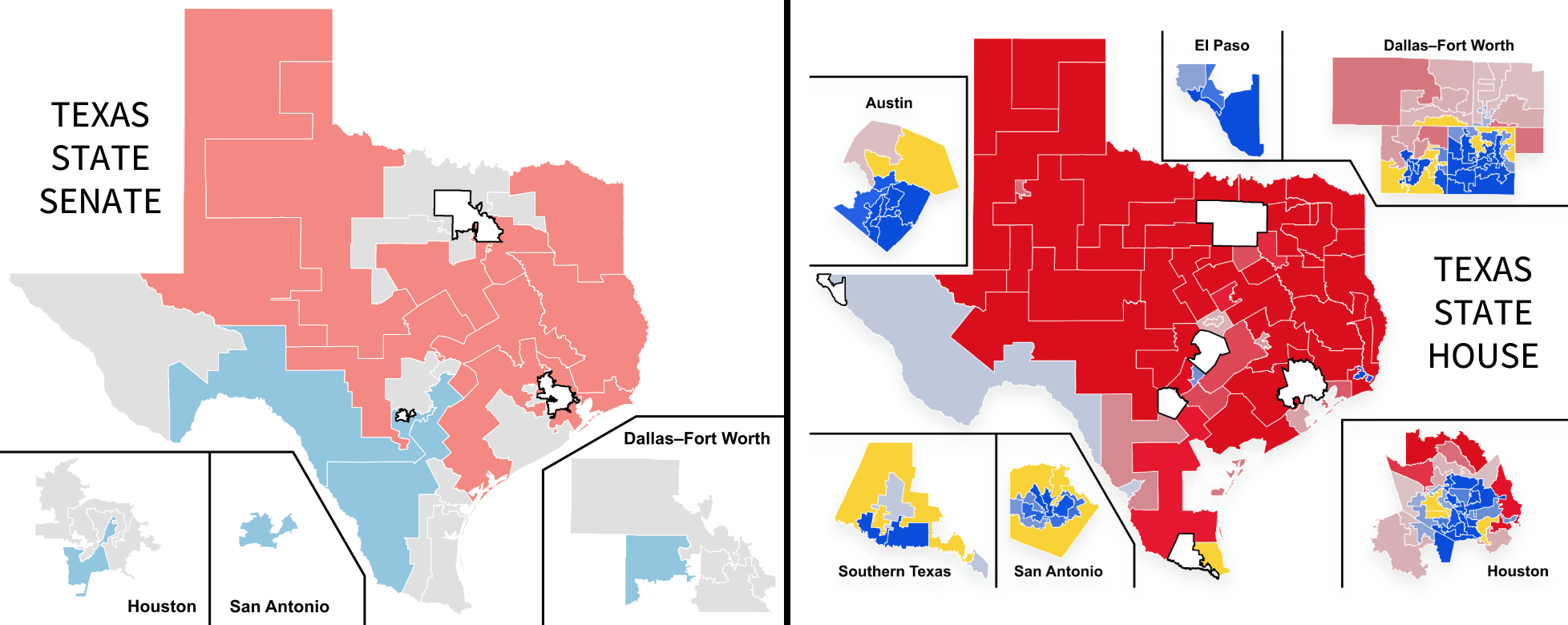
At the Texas State Capitol, Republicans begin the cycle holding a trifecta — 88-62 lead in the Texas House and an 18-11 advantage in the 31-seat Texas Senate, with two vacancies, and 16 seats will be up for election this year. These senate districts have voted consistently for one party in recent elections.
But Senate District 9 is now the outlier: Democrat Taylor Rehmet won a special-election runoff in late January to fill the seat in a district President Donald Trump carried by 17 points in 2024. This victory has gained national recognition on how the midterm election could turn out. Despite winning the special election, Rehmet is running again this November.
In the House, Democrats would need a net gain of 14 seats to win the chamber. There are more than 20 battleground districts. In contrast to the Senate, the House will feature numerous competitive races.


