By The Editorial Board
At the intersection of midnight exam cramming and desperation to keep our grades up, ChatGPT has become a frequent tab for most of us.
According to ChatGPT’s website, there are 700 million weekly active users. With over 770 million downloads last year, ChatGPT was the most downloaded app, beating Instagram by over 100 million downloads. There were also 18 billion messages sent every week by July 2025, according to research by the National Bureau of Economic Research. For reference, there are only about 8.2 billion people in the world.
The overuse of ChatGPT has become an epidemic. Every day becomes more of a guessing game about what is authentically created and what is the result of artificial intelligence.
Art is no longer art. Music is no longer music. News is no longer news. With efficiency comes a loss of reality. And in a world clouded by AI-generated art, news articles and social media posts, authenticity is one of our most valuable commodities.
Rather than using ChatGPT as a virtual assistant, we have begun using it to replace thought, resulting in an epidemic of echo chambers and digitally curated groupthink.
Even worse, the cost is not only our intelligence but also our environment.
In layman’s terms, ChatGPT’s generative models, like OpenAI’s GPT-4, require an incredibly high amount of electricity to run, resulting in staggering carbon dioxide emissions, according to MIT News.
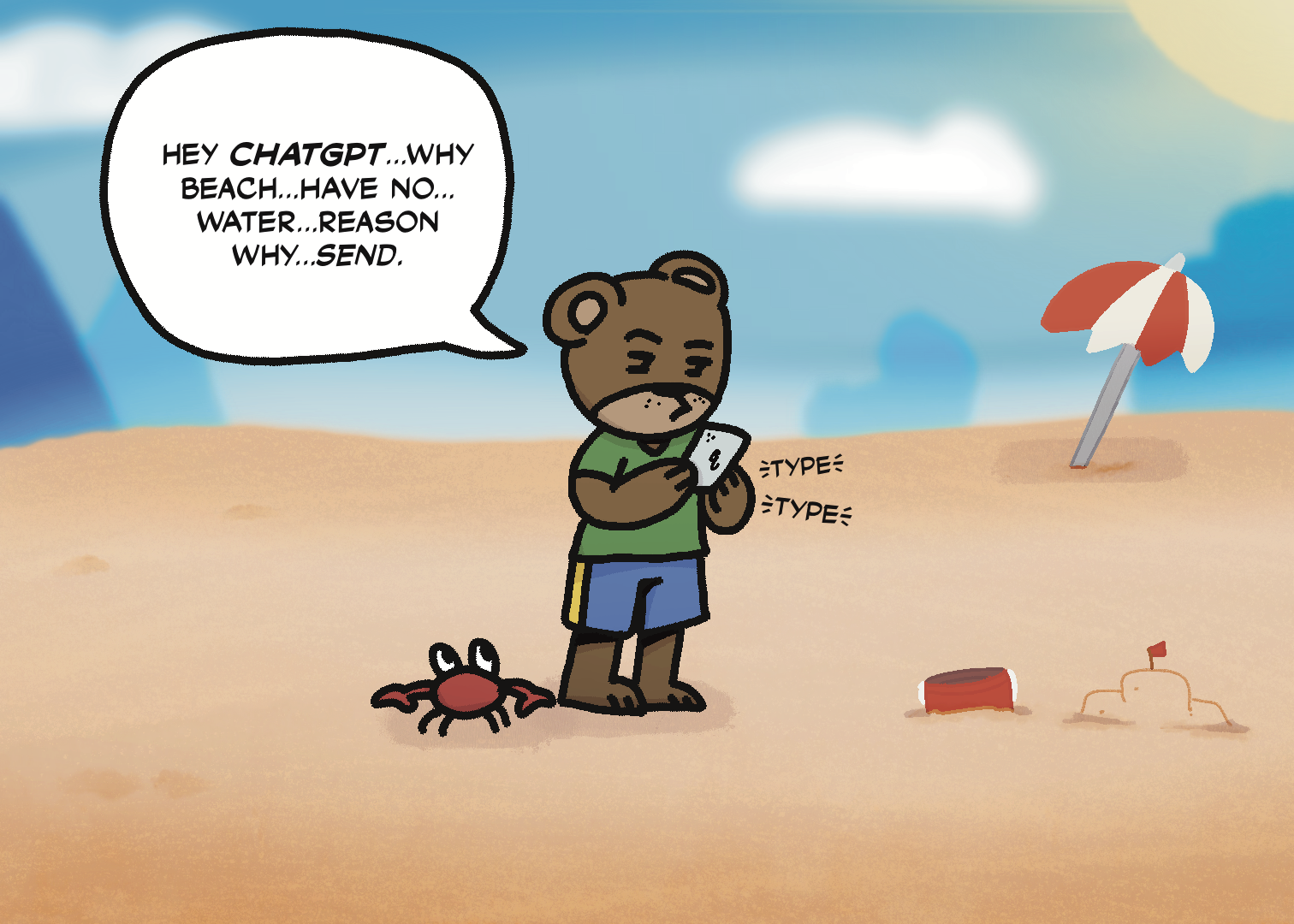
Due to the electricity demands, an extremely large amount of water is needed to cool the hardware used for these generative models. Writing just one 100-word email utilizing ChatGPT’s generative model uses one bottle of water.
The destruction caused by ChatGPT use is a silent killer. Not only are we losing the quintessential nature of humanity, but we are simultaneously destroying our planet at the same time, all in the name of convenience.
What we are talking about runs much deeper than just ChatGPT-ing your homework — which we do not endorse. We are talking about using AI for emails, seeing how a new hair color would look or what our friends would look like as cartoons. Yes, it’s fun in the moment, but the long-term effects are unjustifiable.
While the future might seem far away, we’re already seeing the consequences that funny AI videos are having on our neighbors. Bloomberg reports that two-thirds of data centers built or in development in 2022 were located in “water insecure” areas, meaning there is barely enough clean water to support those living there — and the water-guzzling AI machines are stripping them dry.
Just like the consequences of social media use, nobody warns you about the effects of ChatGPT. It’s not advertised on the news, there’s no warning on the website and it’s quite difficult to access facts about the platform.
So it’s up to each person not only to restore human intelligence and creativity but also to protect our environment.
Create art. Read books. Talk to people. Pay attention in class. And most importantly, prioritize the environment.
Losing creativity and independent thought is reversible; environmental damage is not. There is no AI homework shortcut, animated selfie or email that is worth the amount of damage that ChatGPT is causing.