By Giselle Lee | Staff Writer
Social science shows that descriptive representation, where an individual is represented by someone with a similar race, gender or ethnicity, increases the likelihood of feeling acknowledged and valued in one’s experiences.
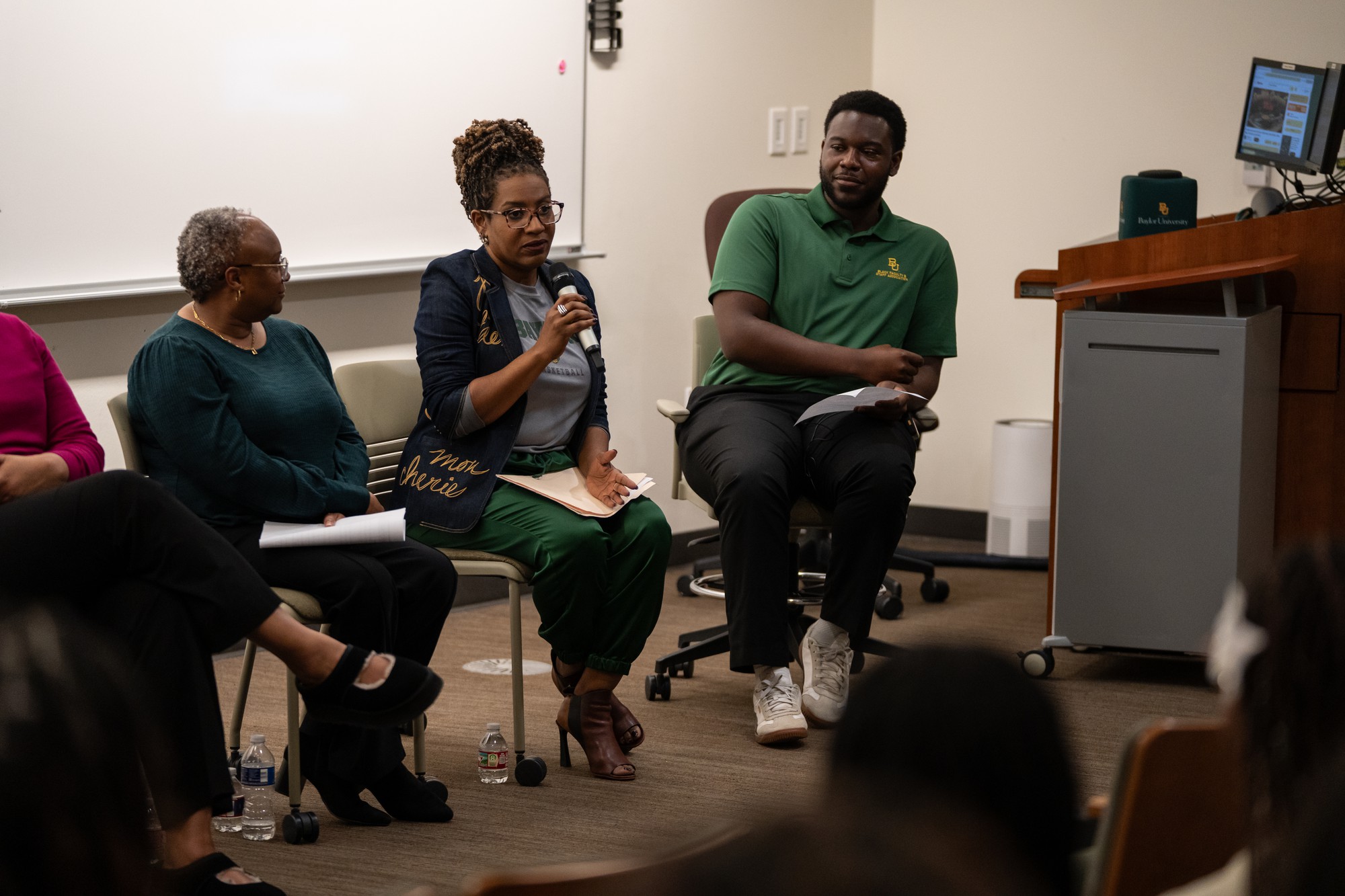
The Black Student Success Initiative and Black Faculty and Staff Association co-hosted Forward Together on Tuesday night in Marrs McLean Science Building to discuss descriptive representation. The goal was to encourage Black students and students of color to navigate struggles at Baylor and to prepare for life after graduation by hosting a career-readiness and leadership panel discussion.
Featured panelists included Dr. Coretta Pittman, vice provost for community engagement and belonging; Dr. Tyrha M. Lindsey-Warren, clinical associate professor of marketing; Professor Connie Powell Nichols, professor of law; Crystal Woods, lead systems engineer at L3Harris; and Dr. Oluwarotimi O. Adesina, orthopedic sports medicine specialist at the Ascension Medical Group.
The panel touched on time management, asking for help and actively searching for opportunities. In particular, all the panelists highlighted the cruciality of mutual reliance between students and professors of color.
Lindsey-Warren, who teaches in the Hankamer School of Business, emphasized that professors want to see students succeed and that students should not be afraid to seek guidance from them.
“You wouldn’t imagine the wealth of information they have for you, especially if you’re going through setbacks or challenges,” Lindsey-Warren said. “Don’t do it alone. I’ve seen so many students come to college and get frustrated because they feel like they have to figure it all out. That’s not the Baylor community. We’re all here for each other.”
Pittman emphasized that students should connect with faculty of color, even if they are not in the students’ field of study because this provides them with useful resources to cultivate their future success.
“Mentorship is important, but if you don’t come see us, we can’t help you,” Pittman said. “Sometimes we forget we need each other.”
The panelists also noted that student organizations on campus bustle with activity throughout the school year, which is beneficial for students seeking more opportunities. Woods said students should think of a niche within their interests before stepping out of their comfort zones and talking to people, as this helps them understand who they are and what they are capable of.
“Stay true to yourself,” Woods said. “I have strength knowing that I earned my seat at the table. Start here. Start with the people in this room.”
Nichols said student organizations may be useful in the future when students need help, so they can rely on familiar groups for reassurance, describing the process as “finding your tribe.”
Houston senior Makaylah Williams said it was inspirational to hear people of similar backgrounds and a wealth of experience so “willing to pay it forward” to the next generation.
“One of the big things I took away from this is these people exist, and they want to help me in my field, so that’s a big encouragement,” Williams said. “Also to take that mentorship that people are offering and passing it on to other students, not hoarding that for myself, but wanting to bring up the next generation behind me as well.”
Little Rock, Ark., senior Mia Ellington-Williams, current president of the Black Student Union, found it inspiring to hear from people who look like her and was encouraged to be an active participant in her own success.
“The overall spirit of mentorship … so many people have poured into us from the very beginning of time,” Ellington-Williams said. “Even in spaces right now, in college, we all have people who are really taking time to pour into us. I learned that it’s important to continue on, be appreciative and give back to other people who are struggling.”
Moving forward, both Williams and Ellington-Williams repeated the panelists’ insights on allowing oneself to belong with the personality one has. There is no need to alter just to conform in certain spaces.
“There are people in spaces that you might think you need to conform to that are going to love you for exactly who you are,” Williams said.