





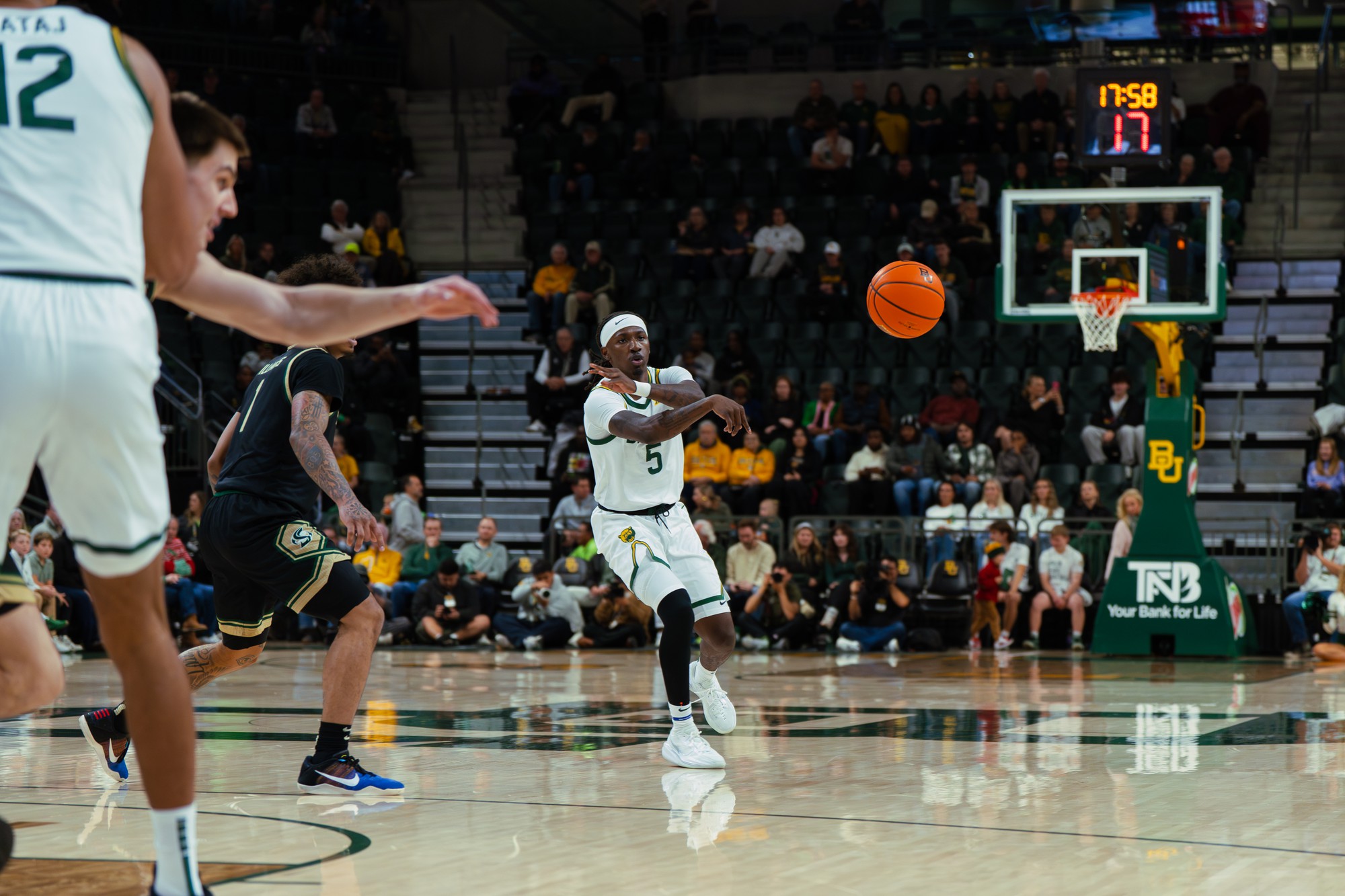
By Dylan Fink | Sports Writer
Defense, historically a strong suit for head coach Scott Drew’s Baylor teams, has been a struggle point the past few seasons.
Following three straight years with a top-20 defensive rating in KenPom metrics from 2020-2022, the green and gold haven’t sniffed an equal rating since. Despite currently sitting at 94th nationally in KenPom’s adjusted defensive efficiency metric, Drew’s squad has the potential to finish the season back in the top-20 range.
Coming off a 2024-25 season that was plagued with a lack of size, poor rebounding and injuries that shortened an already limited rotation, the Bears needed a big change on the defensive end.
Assistant coach Bill Armstrong departed after one year to take over the head-coaching gig at McNeese State. In his stead, Baylor called upon one of the most prolific defensive minds in college basketball, Ron Sanchez, to take over the associate head coach role.
Before coming to Baylor, Sanchez spent a year as the interim head coach at Virginia following the retirement of Hall of Fame head coach Tony Bennett. While the Cavaliers went 15-17 and missed the NCAA tournament under Sanchez, they still finished with a top-30 defense.
Sanchez led a top-20 defense in 11 of his 16 seasons as a head coach. Now, the defensive guru is hoping to bring back that same physical dominance in Waco.
Baylor is sitting at 94th in adjusted defensive efficiency and 323rd in points allowed per game. The Bears have a mountain to climb to crack the top 20 in the first metric. While the numbers don’t look great — the lowest point total Baylor has held an opponent to this season is 74 — Drew and Sanchez’s defense is better than the analytics are giving credit for.
Sanchez is notorious for the “pack line” defense he brings from Virginia, popularized by former Wisconsin head coach Dick Bennett and his son, Tony. The philosophy is built around all five defenders have to stay behind an imaginary arc just inside the three-point line (except for whoever is actively guarding the ball).
The scheme is aimed at protecting the paint at all costs. A fusion of man-to-man and zone adjustment, the “pack-the-line” style — when done correctly — prevents a high rate of cuts and pick-and-rolls while relying on individual players’ closeouts to stop 3-pointers.
Based on the idea of help defense, the approach is meant to cause turnovers and low-percentage shots.
When done correctly, as with the 2019 national champion Virginia team, the pack line defense is almost unstoppable, save for a flurry of made 3-pointers.
The Bears have yet to enact the defense in its unstoppable form. Primarily due to second-chance breakdowns — Baylor ranks top-20 in the nation in allowing offensive rebounds — Sanchez’s defense is yet to get the national respect it deserves.
The injury to junior center Juslin Bodo Bodo, the reigning two-time Big South Conference Defensive Player of the Year, has greatly hurt the Bears’ defensive prowess as they attempt to enact Sanchez’s unique philosophy.
Four winnable home games lie ahead of the Bears as they try to get completely rested and healthy before conference play. The stretch will give the team time to polish its new defensive scheme.
The Bears have succeeded so far at limiting shots from deep, holding opponents to a 34.2% mark from deep through eight games. If improved defensive rebounding can lead to fewer second-chance opportunities, the sky is the limit for the pack line defense in Waco.
The Bears will return to action at 11 a.m. Wednesday against Norfolk State at Foster Pavilion. The game will be streamed on ESPN+.


